As we finally arrive to the
conclusion of the Hunger Games (should have been a trilogy) four-part series we
appreciate it’s first two segments. “The Hunger Games,” and “The Hunger Games:
Catching Fire” both gave us a very real glimpse into the world that author
Suzanne Collins created. Jennifer Lawrence’s Katniss Everdeen captured the
attention of America’s youth in quick succession. Though these first two films
did not have the vision or strong acting to receive such notoriety, they did
give us something more. Though it takes place in fictional “Panem,” these films
gave us something real. Then, in the way that most endings are ending these
days, they spilt the finale, “The Mocking Jay,” into two parts. Part 1 was very
much a lifeless film that could have been completely avoided, for the exception
of the final scene.
Every teen queen requires a throne
Mocking Jay: Part 2 begins right
where Part 1 left off. Kantiss is recovering from her reunion with the now
brain washed, Peeta Mellark (Josh Hutchinson). The film progresses with
Everdeen’s realization that filming propaganda isn’t enough to help to the
cause that wishes to free itself from the clutches of its evil ruler, President
Snow (Sutherland). There are scenes throughout, involving mostly the more
reputable actors, which give the film depth and presence. Although not seen
often, the late, Phillip Seymour Hoffman captivates audiences as turn cloak
game maker, Plutarch Heavensbee. Woody Harleson
and Elizabeth Banks enhance the film, giving it more renown and perhaps
nearly taking it above the expectations of your typical teenage angst film.
The film picks up as it moves
forward, don’t await a repeat of Part 1. Teamed up with a group of loyal rebel
leaders, complete camera crew, and her two lovers, Katniss enters the capital
on a mission to end the war, to see president Snow dead, to finally end the
suffering of her people. You’ll find no arena in this film, but do suspect more
ploys from Snow and his elitist.
If you’ve seen the first three
films of this series please see it through completely. I do not believe anyone
who has watched the first three films could be disappointed with this final
chapter. I will note that the ending is not one of too much popularity. Besides
having split the final adaptation into two parts this series has taken a step
in elevating what we expect from our films that aim towards “tweens.”
The holidays are a time in which people come together
with family and friends to celebrate as a new year approaches and reflect upon
all that has come and gone in the year passed. Sometimes, seasonal nostalgia
can call attention to the people and things we have lost and things we would have liked to
have changed in the last year, lending us just the gumption we need to alter
our lives for the better. In the 2006 romantic comedy The Holiday, the holiday spirit proves to be just the inspiration
that two women need to learn to live life to the fullest all year long.
Laughter truly is the best medicine
The film starts with British newspaper reporter Iris
(Kate Winslet) ending her year on a decidedly low note when the ex-boyfriend
(Rufus Sewell) she is still struggle to get over announces his engagement to
Iris’ co-worker. Half-way across the world in Los Angeles, movie trailer
producer Amanda proves similarly unlucky in love when she learns that her
live-in boyfriend (Edward Burns) has been having an affair with his much
younger secretary. While each woman pursues her own course of grieving, with
Iris despondently blaming herself and Amanda fuming at her boyfriend’s
betrayal, both find themselves searching for a way to get away from their
fraught love lives and both find their answer in the same place; the internet.
Amanda spots Iris’ online ad for a home-exchange vacation and the pair agree to
swap lives for two weeks over the holidays, marking the start of a whimsical
journey in which each will find new friendships, a renewed sense of self, and
of course, a little romance.
While romantic comedies have long been a holiday
staple, The Holiday succeeds as a
year-round crowd pleaser by transcending both the holiday and romantic comedy
genres. Although on its surface the film appears to be a typical tale of love
lost and found just in time for the holidays, the script is actually an
empowering tale of two people searching for things that they ultimately find
within themselves. Iris is so lacking in confidence that she continues to
pursue a man who had previously been unfaithful to her and clearly only maintains
contact with her in order to utilize the free editing she does on his novel. In
an opposite characterization, Amanda has become so accustomed to being the
strong one in her relationships that she has lost touch with her own
vulnerability and her ability to cry. Despite their vast differences, both
women engage in behavior patterns that prevent them from growing while either
single or in a relationship. As a result, it is their common struggle to accept
themselves and live life on their own terms, rather than their search for love,
that is the film’s central conflict. Although both do eventually find romance,
they do so only incidentally, as the film remains firmly focused upon its
heroines’ personal development. The film also avoids the rom-com cliché of love
interests solving all of the story’s problems. While both Amanda’s charming beaux, Graham (Jude Law), and Iris’ endearing flame, Miles (Jack Black) are
enjoyable characters, the script makes them three dimensional men rather than
stereotypical ‘knights in shining armor’ by revealing their shortcomings and
insecurities as well as their strengths. This in turn makes the relationships
between both couples more interesting and realistic than the paint by numbers
plotting of many romantic comedies. While the holiday ambiance adds to the film’s
whimsy and romantic atmosphere, its central messages of ‘believe in yourself’
and ‘be open to life’ are ones that resonate throughout the year, making The Holiday a cinematic vacation that
viewers can enjoy any time.
Who says complicated has to be a bad thing?
One of the more unique aspects of the film is the way in
which the script pays homage to the romantic comedies of the 1930’s and 1940’s.
While the life-swap premise already lends itself to screwball antics, the film
takes its nod to the classics a step further by making numerous references to
classic films and the men and women who brought them to life. The most obvious
of these cinematic connections comes in the form of Amanda’s elderly
screenwriter neighbor, Arthur, whom Iris quickly befriends. Played by classic screen
veteran Eli Wallach, Arthur offers nostalgic insight into Hollywood’s
Golden Age and serves as a mentor to Iris by encouraging her to follow the
example of the no-nonsense female protagonists of his favorite films. The film’s
music also adds a classic touch through the focus upon Miles’ job as a film
composer and the old-fashioned sensibility of the film’s soundtrack. As a
result, the film serves as a valentine to not only the holiday season, and
love, but also to film itself.
The cast keeps the laughs and sparks flying throughout
the film’s running time. Cameron Diaz makes Amanda an endearing combination of comic
cuteness and inner strength, making her a protagonist that audiences would want
to take a holiday with. Similarly, Kate Winslet imbues Iris, who could have
been a one-note role, with an intelligence, wit, and kindness that make her a
heroine that cannot help rooting for. Jude Law adds a level of vulnerability to his
usual charm that makes Graham a truly irresistible love interest and Jack Black
brings an unassuming quality to his role which, combined with his expected
hilarity, makes Miles the boy we all wish lived next door to us. Finally, Eli
Wallach adds just the right touch of wisdom, whimsy, and gentle humor to his
role as Arthur.
Feel-good, breezy, and charming The Holiday is the rare modern romantic comedy that succeeds as
both a romance and a comedy. Through its combination of slapstick set-ups and
dry wit the script brings a freshness to the genre while successfully paying
homage to the genre’s past greats. The members of the cast each utilize their unique
strengths to bring their roles to surprisingly realistic life, while still
maintaining the film’s romantic idealism. You don’t need to travel to get away
from it all with The Holiday in your
film lineup.
Thank you so much for your continued support! In keeping with Confessions of a Film Junkie's mission of spreading the love of film and storytelling, I've included links to some of my recently published plays and screenplays. All of the scripts are historical fiction written in the tradition of the classic films I review on the blog.
Thank you so much for your continued support for our blog. We've come a long way over four years three-hundred posts, and we couldn't have done it without all of you! In keeping with our mission of spreading and sharing the love of cinema we've added a new blogger. Without further adieu, I'd like you to join me in welcoming writer, film buff, and fellow Lasell College alumni, Miguel Taveras a/k/a Theodore Theater.
In my previous review, I discussed French films in
tribute to the victims of the recent terrorist attacks in Paris. Unfortunately, recent
events have brought terrorism to the forefront of our lives once again. In this
past week alone, fifty-seven people have been killed and one-hundred fourteen
have been injured in terror attacks in Chad, England, Yemen, and the United
States as well as an ISIS execution of a Russian citizen. In recent years, radical Islamist terrorist groups have caused death
and devastation in cities across the globe. These attacks have been carried out
against civilians of numerous races, ethnicities, religions, and political
affiliations for one reason; the victims did not adhere to the oppressive
beliefs of radical Islam. In light of recent events, it is undeniable that we
as citizens of the free world are at war. It is a war that we have faced and
overcome in the past, and will continue to face as long as there are people in
the world who seek to threaten the freedom that defines our way of life. From
1932 to 1945 we faced a similarly dangerous threat from another group
determined to invoke their beliefs and rule over others at any cost; the Nazis.
Terrorist groups of today resemble the Nazis in their brutality,
oppressiveness, and determination to eliminate any viewpoint that conflicts
with their own warped ideology. After the Paris attacks, social media users
around the world shared a clip from the 1942 classic Casablanca in order to show support for and solidarity with the
victims of those attacks. The film, which chronicles a “fight for love and
glory” and “case of do or die” that remains strikingly relevant today, contains
far more inspiration than that one scene and conveys truths
that hold as much meaning now as they did at the time of its debut in the midst
of World War II. This week I will be discussing lessons from the film that our
divided world once again desperately needs at this crucial moment in our
history.
The usual suspects
Isolationism
is no longer a practical policy: Adapted from a 1940 stage
play written by Murray Burnett and Joan Alison, which was in turn inspired by
the playwrights’ experiences in occupied Europe, Casablanca was written as both a critique of American
isolationism and rallying cry for the Allied cause. The film focuses upon a
world-weary saloon owner whose philosophy has been reduced to his repeated
mantra of “I stick my neck out for no one”.
Convinced that defeat is inevitable, Rick (Humphrey Bogart) shuts
himself away from the conflicts of the greater world, only to have world events
enter his cafe and re-enter his life with the return of former flame, Ilsa
(Ingrid Bergman). Just before Ilsa’s arrival in the café, Rick reaffirms his
isolationist stance when he stands by as black market racketeer Ugarte (Peter
Lorre) is arrested by the Nazis, despite Ugarte’s pleas for his help. While
Ugarte was presented as a mercenary character, he was also revealed to be
playing an active role in fighting the Nazis by selling illegal visas to
refugees seeking to escape from occupied Europe and assassinating two Nazi
officers. Even after Ugarte’s arrest and eventual execution, Rick remains reluctant to take part in the Allied cause when he refuses to assist Ilsa and her husband, fugitive resistance leader Victor Lazlo (Paul Henreid), escape Casablanca. Rick’s refusal to help Ugarte and Victor sets off a chain of events that effects
the lives of people on both sides of the war, much in the same way that the
complacency of the global community has proven to be a catalyst in the rise of
terrorist groups, as jihadism has been permitted to wreak havoc and gain power
across the Middle East and Africa with precious little international action
taken.
Today,
we face a crossroads which is eerily similar to Rick’s in wake of the latest
attacks, as we are presented with the choice of either taking necessary further action
against terror organizations or continuing to push the issue of terrorism aside
as ‘someone else’s problem’. Throughout the film, Rick dismisses the threat of
fascism as a problem for Europeans like Victor and Ilsa, which holds no real
meaning in his simple life. As the plot twists and turns, however, he is faced
with the reality that for any man who hopes to maintain his integrity and
humanity fascism is indeed a dire problem. It is all too easy and human to be too consumed
by our personal concerns to pay mind to the troubles of people we have never
met, but by continuing to do so we fail to realize that global issues like
terrorism are in fact our problem. Today,
people continue to advocate for causes such as racial, gender, religious, and
sexual orientation equality. While each of these causes is indeed a worthy one, many fail to see that all of these individual causes fall under the same category of the fight against
terrorism, as terror groups continue their mission of religious intolerance,
gender oppression, racism, and homophobia. As a result, just as fascism was not
just Europe’s problem, radical Islam is not a problem restricted to the Middle
Eastern and African nations where its influence has taken the strongest hold, or of individual cities that have faced attacks, but is in fact a threat to every nation and city in which equality, dignity,
and freedom hold any value.
Friendship
is a beautiful thing: Set against the backdrop of a city
populated by occupying forces and refugees from across Europe as well as local
Moroccans, Casablanca contains an
international cast of characters from various walks of life.
One of the most poignant aspects of the film is the way in which its diverse
cast of characters put aside their differences and unite to work together for a
cause greater than themselves. It is unsurprising that several of the
expatriates in the café continue to fight against the oppression that they previously
escaped from, but the film also includes mercenary characters such as Ugarte
who commit small acts of resistance, even as they continue to profit from the
call for black market items that the Nazis have created. Even the cynical
Ferrari reveals where his true sympathies lie when he tells Victor that Rick
has the letters of transit, even though his decision to do so actually harms
his own profits. One of the film’s most heartfelt moments occurs not between
star-crossed lovers Rick and Ilsa, but instead between Rick and his friend, corrupt
Vichy official Louis Renault (Claude Rains). Throughout the film, Louis insists that his
sympathies ‘blow with the wind’ as he consistently acts in his own
self-interest by aiding the presiding Nazi government and extorting sexual
favors from desperate refugees in exchange for visas. After witnessing Rick’s courage in risking his
own life in order to help Victor and Ilsa escape, however, he finally realizes that
it might be a good time to become a patriot after all and follows his friend’s
example by covering up Rick’s murder of Gestapo officer Major Strasser (Conrad Veidt) at the risk of his own career
and freedom.
Just as the diverse cast of characters at Rick’s Café overcome
their differences to support and work with one another for the greater good,
many people today have shown their own support in the fight against terrorism.
Following the Paris attacks people voiced their support for France and the
victims by sharing videos, words of encouragement, prayers, and images on the
news and through social media. In the midst of this support, however, I was
shocked and disgusted to see that many others offered only apathy, cynicism,
and snide remarks. The majority of those who shared such negative reactions
defended their views by saying that other terror attacks did not receive the
same amount of public attention and raising questions concerning race. While
all crimes of this nature deserve to be denounced, to make such distinctions in
the midst of a tragedy is splitting hairs at best and causing further division
in an already divided world at its worst. These reactions reminded me of a
scene in Casablanca in which Strasser smugly asks Rick “are you one of those
people who can’t imagine us in your beloved Paris?” to which Rick, who bitterly
associates Paris with his painful break-up with Ilsa, replies “It’s not
particularly my beloved Paris”. In this scene, Rick is focusing upon his personal biases rather than the reality in front of him, much in the same way that people
dismissing the Paris attacks placed their own agendas before the gravity of those tragic events. Like the Nazis, terrorists today are utilizing a ‘divide
and conquer’ tactic by causing chaos and unrest in our society which pits us
against one another when we should be uniting in a common cause. By continuing to focus upon our
differences and attacking each other’s views we are taking the same resources
that we should be using to stand up to this enemy and instead utilizing them to
alienate one another. In this way, we are allowing terrorists to claim further
territory, not on our lands but within our minds and hearts. Our battle against
terrorism, while indeed a violent one, is at its heart a battle of ideas, and
by failing to stand together in words and ideas we are in fact giving in to the
ideology of fear and distrust that terrorists are hoping to instill within us.
Rather than allowing ourselves to fall into the ideological trap that has been
set for us, we should instead take a lesson from the clientele at Rick’s and
come together, not in a café, but in a movement to face and overcome the fear
and division that our foes are working to inspire within us.
Taking the sting out of occupation
If
we stop breathing we die; if we stop fighting our enemies the world dies: When
Rick first learns of Victor’s arrival in Casablanca, he is instantly impressed
and there is little reason to wonder why. While Rick’s hardships have left him
embittered, Victor’s hellish ordeal in a concentration camp has left him more
determined than ever to fight for his beliefs. Prior to the events of the film,
Victor is described as using his job as a reporter to print stories exposing
and denouncing the atrocities committed by the Nazis. After narrowly escaping
the Gestapo in Prague he went on to Paris and, rather than safely living in anonymity,
continued his work where he had left off. Upon arriving in Casablanca, he is
closely monitored by the corrupt Vichy government and under constant threat of arrest.
Even under these dire circumstances, however, he continues to carry on with his
work by attending resistance meetings and heroically leading a public
demonstration in front of Strasser and other Gestapo officials. Victor's actions, while seemingly small, prove so inspiring that Rick eventually follows his example first through subtle acts of resistance such as helping a newlywed refugee purchase a visa so she will not be forced to sell herself to Louis and eventually through his decision to give up his relationship with Ilsa and aid Victor's escape.
In our own lives it seems impossible to take action
against such a massive threat, and Victor Lazlo is a character who seems more
myth than man. There are, however, always ways both great and small to
contribute to the causes that we believe in. Since the Paris attacks of January 2015, the hacker/activist group Anonymous has launched a cyber
assault against ISIS and other terrorist organizations by reporting organization members’ identities and funding sources to police, shutting down
supporters’ social media accounts, hacking into websites that express views
which are sympathetic to the groups, and on December 12 will be launching its own
propaganda campaign. Although the group utilizes sophisticated tech skills and
methods in its efforts, it has opened its doors to any citizens interested in
doing their part to fight terrorism by releasing a ‘how to’ guide with
instructions on how to cyberattack ISIS regardless of would-be hackers’
computer skills. The group has also requested that the public take part in its“Trolling Day” propaganda campaign this Friday by posting jokes, cartoons, and memes
exposing ISIS for the barbarians, hypocrites, and cowards that they are. This
campaign is strikingly similar to the much shared scene in Casablanca in which
Victor inspires the café’s patrons by leading them in an impromptu rendition of
French national anthem “La Marseillaise” which drowns out a group of Gestapo
officers’ rendition of the German patriotic tune “Die Wacht Am Rhein”. While it
may not be saving lives or attacking these groups at their source, Trolling Day is
a similarly admirable effort, which I hope will serve to boost morale as well as
destroy the carefully constructed image that ISIS has created online. For those who
prefer not to utilize social media there are other ways to contribute, such as reporting
suspicious activity you see to the authorities, voting on issues related to
foreign policy, writing letters to your local representative or news outlet, showing
support for our troops as they participate in military action against terrorism, offering support to victims of terrorist
attacks, boycotting social media sites that refuse to censor terrorist
propaganda, discussing events related to terrorism, and even the simple act of
remaining informed of current events. As is shown by the enduring power of
Victor Lazlo’s demonstration, any effort regardless of how small it may seem
can and does matter. Despite what Rick might say, the problems, and more
importantly the actions of little
people do matter, even in this crazy mixed up world. While the threat of the
Nazis may be long since passed, radical Islamic terrorists have taken up the
torch of hate and oppression set down by their predecessors, thereby becoming the
threat of our time. The fight against terrorism is our burden and struggle, and
if we fail to come together in this cause we will regret it. Maybe not today.
Maybe not tomorrow. But soon, and possibly for the rest of our lives.
In the film Midnight
in Paris, aspiring novelist Gil Pender asks, “How is anyone ever gonna come
up with a book, or a painting, or a symphony, or a sculpture that can compete
with a great city?” as in his words, “every street, every boulevard is its own
special art form”. Throughout history there have been countless cities that
have become famous for the blend of unique qualities that make up their culture.
Even amongst the world’s cosmopolitan havens, however, one city has always
stood out as a center of art, romance, and culture; Paris. Throughout its vast
history, Paris has produced countless artists, entrepreneurs, and scientists,
and inspired many more who have had the opportunity to visit the City of Light.
The city has withstood revolution, war, and enemy occupation with its spirit of
innovation and resilience intact. On Friday, November 13, 2015 Paris was
attacked in a series of terrorist assaults at locations throughout the city.
The attacks ultimately resulted in the deaths of one-hundred thirty people and
injury to over three-hundred others. The recent attacks come in the wake of
attacks across the globe executed by the terrorist group ISIS and other Islamic
terrorist groups, including the infamous attack on satirical magazine Charlie Hedbo in January, 2015. Once again Parisians have faced the
tragedy in true Paris fashion by taking action against terror threats abroad,
while refusing to be ruled by fear and carrying on with their daily activities at home.
In honor of this truly great city and its citizens, this week will feature three
films that each capture some small piece of the magic of Paris.
Taking 'picturesque' to a whole new level
Midnight
in Paris: This 2011 Hollywood crowd-pleaser portrays Paris from
a tourist’s perspective, capturing each of its many landmarks with the idyllic
freshness that a traveler experiences upon their maiden voyage to the city. The
film follows idealistic American screenwriter, Gil Pender (Owen Wilson) as he
falls in love with all things Parisian. While a trip into the sights of the
city would have been enjoyable enough, the film takes viewers on a true
adventure when Gil is magically transported back in time to his idea of the
‘golden age’; Paris during the 1920’s. Over the course of the film, he meets and
mingles with the great artists of the decade and soon finds the inspiration of
the era rubbing off on him. Complications ensue, however, as he finds himself infatuated
with fashion designer and artist’s model Adrianna (Marion Cotillard) while he is
already struggling to salvage his relationship with his materialistic fiancée,
Inez (Rachel McAdams), in his own era. This frothy romantic comedy possesses
the wit, charm, and romantic spark that ensure it is equally successful as both a comedy
and love story. What stands out about the film, however, is the fact that it
contains two love stories; the love triangle between Gil, Adrianna, and Inez
and the love affair between Gil and Paris. At the film’s
start, Gil is infatuated with the city in the way that so many newcomers are,
and sees it through an idealized perspective. As the film progresses,
however, that infatuation grows into a full passion as he experiences Paris
through three different eras and makes a true connection with the city and its
diverse citizenry. When the breezy journey reaches its finale, Gil comes to
realize that not only can the past not be repeated, but that it inevitably
contained just as many complications and frustrations as the present. While Gil’s
infatuation with the 1920’s may cool to fond nostalgia, it’s no wonder why his
love affair with Paris remains sizzling hot.
Silly balloon, tricks are for kids
The
Red Balloon: Released in 1956, The Red Balloon remains one of cinema’s most innovative films and
one of, if not the most, acclaimed film short. The nearly dialogue-free story follows
a young boy, Pascal (Pascal Lamorisse), and his magical friendship with his new toy, a red balloon
that seems to possess a consciousness and will of its own. The film chronicles
the pair’s enduring friendship as stuffy adults and neighborhood bullies threaten to tear them apart. Throughout the film’s
thirty-five minute running time, the balloon takes on a series of roles in
Pascal’s life ranging from dog-like companion, to partner in mischief, to
devoted protector. In this way, the balloon serves the dual purpose of acting
as a crucial character in the story and portraying the film’s overarching
symbol of the power of imagination. Throughout the film, adults misunderstand
Pascal’s relationship with the balloon and try to separate them, while other children
are jealous and try to take the balloon for themselves, much in the same way that
people who don’t understand imagination suppress or dismiss it and those who
lack it often try to take credit for other’s creative pursuits. This recurring
pattern establishes the film’s theme of imagination versus conformity, which
comes full circle in the breathtaking finale as Pascal’s imagination allows him to literally rise above the confines of the world around him. Set against the
backdrop of post-war Paris, the story also serves as a metaphor for France's creative spirit, which not only survived but continued to
thrive even after the devastation of occupation during WWII. Beyond its sweetly
inspiring story, The Red Balloon also
perfectly portrays Paris through the innocence and curiosity of a child, with
each street becoming its own adventure and each sunrise carrying the hope of a
new day full of endless possibilities. For a journey back into the wonder of childhood,
follow the trail of The Red Balloon.
Just two notes and I'm seeing things rosie
La
Vie En Rose: During the 1940’s and 1950’s,
the songs of Parisian torch singer Edith Piaf were an instantly recognizable and
poignant addition to the soundtrack of a generation. The film La Vie En Rose explores Piaf’s (Marion Cotillard) tumultuous life from her poverty-stricken childhood to her eventual international
stardom. Passed from her neglectful street performer mother, to her irresponsible circus performer father, to her no-nonsense brothel madam grandmother, Piaf’s
childhood was anything but conventional. Forced by her parents to earn her own living
when she was still just a child, she quickly found her calling and escape from
the slums in music. As she rose in the industry, however, life continued to be
a struggle as she faced the deaths of both her only child and the love of her
life (Jean Pierre Martins), as well as a debilitating car accident and subsequent morphine addiction. Rather
than following the traditional trajectory of a birth to death biography format,
the film is instead comprised of a series of flashbacks that appear through
association to Piaf's present as she attempts to launch a comeback shortly before
her death at age forty-seven. In this way, the film is more personal than most
biopics as it is told entirely from the perspective of its protagonist, which
provides additional insight into who she was and what it was about her that
made her stand out among so many other talented artists. Marion Cotillard’s
performance is nothing short of mesmerizing as she goes beyond mere mimicry and completely
inhabits her role as the complicated singer, as she captures Piaf’s fascinating
combination of backstreet toughness, girlish vulnerability, world-weariness,
and carpe diem sensibility. From street waif, to Montmartre bohemian, to international
celebrity Edith Piaf was a woman whose resilience and originality reflected the same inspiring qualities of the city in which she spent the majority of her days. Even today, over fifty years after her death, Piaf's music continues to enchant and inspire as a symbol of Paris in its all of its artistry. Below, I have included a link to a clip of Celine Dion's performance at the American Music Awards of Piaf's Hymne a'lAmour in an emotional and fitting tribute to the victims of the Paris attacks.
It is often said that the best way for an artist to
create meaningful work is for them to portray that which they know best. As a
result, it is little wonder why one of the most enduring portrayals in art is
the struggle and sacrifice of the artistic lifestyle. From consumptive
bohemians, to mad painters, to reclusive writers, many of the most raw
characterizations in modern storytelling are those of artists striving to
achieve success and fulfillment regardless of the cost it may require. While
each art form entails its own set of challenges, one of the most demanding of
art forms is dance, particularly ballet. Unlike ancient eastern dance
traditions designed to work with and accentuate the body’s natural movements, ballet
captures audience’s attention by revealing the beauty of the human form beyond
the limits of everyday movement. Similarly, while modern dances thrive upon
spontaneity and improvisation, ballet is a rigorous art form, which requires
the utmost precision in each of its choreographed movements. By its very nature
ballet is an art form which is consuming, elite, and inaccessible; in short it
is the ideal vehicle through which to explore the passion, doubts, obstacles,
and triumphs of life as an artist. As a result, there have been numerous books
and films which have used ballet to portray diverse characters facing obstacles
ranging from aging (The Turning Point),
to unemployment (Waterloo Bridge), to
political oppression (White Nights),
to personal loss (Save the Last Dance).
Despite the many critically and commercially successful ballet films, the film
that many critics and viewers continue to immediately think of when they heard
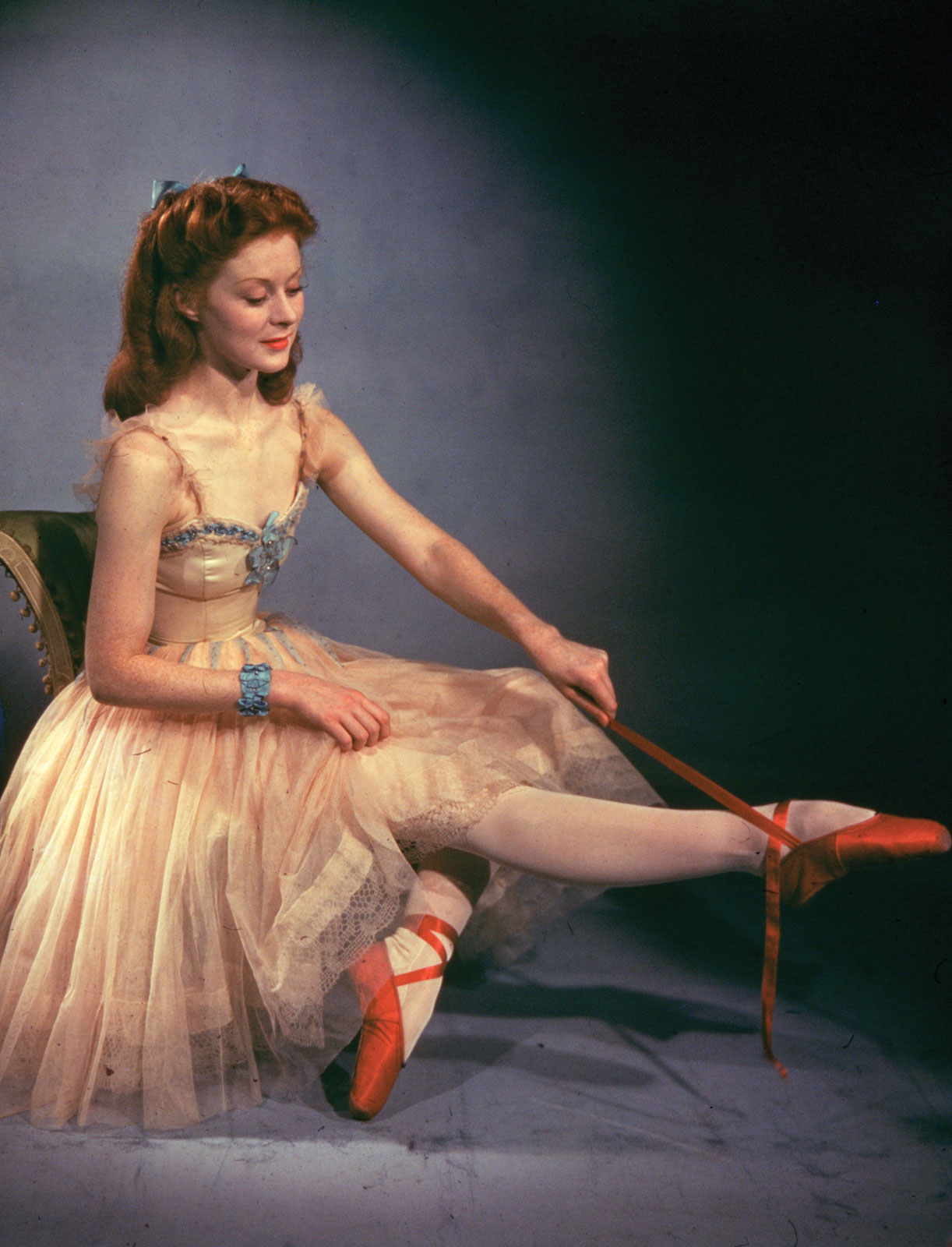
the word ‘ballet’ is the 1948 British drama The
Red Shoes.
Ballet; the stuff nervous breakdowns are made of
The story of The
Red Shoes is a deceptively simple one; inexperienced but passionate dancer,
Vickie (professional ballerina Moira Shearer), joins an elite ballet company
where she achieves the success she’s always dreamed of, only to become
conflicted between her professional goals and personal needs. While the
conflict between love and art was already a well-worn theme even in 1948, what
the film lacked in original storytelling it made up for in accuracy, visual
innovation, and emotional honesty. Few dance films can compare to The Red Shoes in terms of attention to
detail and realism. Rather than focusing upon the glamour of the performances,
the film spends most of its time backstage, as it shows the painstaking work
that goes into a ballet from its first draft to its final rehearsal. In this
way the film provides an insider’s perspective to viewers who are unfamiliar
with the world of professional dance and pays apt tribute to the men and women
who tirelessly work to bring that magical world to life. The film even goes so
far as to populate its cast with professional dancers rather than utilizing
established actors and body doubles. The film also accurately portrays its
heroine’s struggle for success rather than relying upon the cliché of a
meteoric rise to stardom, as Vickie frustratedly works her way through the
ranks of the ballet company over time.
The film approaches its characters with similar
realism in its exploration of daily life in a ballet company populated with a diverse
array of three dimensional characters. Despite the film’s age, The Red Shoes is remarkably
refreshing in the way that it treats its
story as one of a particular dancer working in a specific company rather than
as a commentary upon ballet, dance, or art at large by avoiding typical clichés
such as abusive directors, ego-maniacal stars, and petty rivalries. In this way
the film ensures that the audience is able to invest in the characters as
though they were real people, which in turn lends the relationships and
conflicts between the characters emotional weight.
A girl and her best frenemy; toe shoes
Today, another ballet film has taken center stage
using a very different approach. In the 2010 psychological thriller Black Swan, Natalie Portman plays
similarly impressionable and eager dancer, Nina, whose quest for stardom takes
a disturbing turn. In order to provide viewers with insight into Nina’s
fractured mind the characters, plot, and visuals take on a sinister quality
befitting a horror movie’s haunted house rather than a typical theater. Because
the story is told from an unstable character’s perspective, the world of ballet
quickly escalates from a competitive, but fulfilling, working environment to an
elaborate prison in which dancers torture their minds and bodies in order
impress fickle audiences and lecherous directors. Although the fantastic
elements heighten the surreal atmosphere and suspense, they also bring the film
dangerously close to caricature as Nina is constantly surrounded by the very
stock characters that The Red Shoes
widely avoided as she is alternately sexually harassed by her volatile
director, threatened by a bitter ballerina forced into early retirement, and
tormented by the impossible expectations of her ex-dancer stage mother. This
tendency toward camp is most obvious in Nina’s one-note abusive relationship
with exploitive director Thomas LeRoy (Vincent Cassel), which sorely lacks the
subtlety and complexity that made Vickie’s relationship with impresario Boris
Lermontov (Anton Walbrook) both fraught and fascinating. Through its unabashed
sense of melodrama, Black Swan
creates its own surreal world of light and shadow in which everyone and
everything poses a potential threat, which works wonderfully for a
psychological thriller, but fails to shed any light or add any dimension to the
public’s understanding of ballet.
When did things get all Lewis Carroll around here?!
Nina’s struggle with her unraveling psyche, for all of
its flash and theatrics similarly fails to resonate when compared with the much
more relatable and timeless conflict that proves to be Vickie’s undoing. On the
dvd box and in critics’ summaries, Vickie is described as being torn between
‘love and dance’. Although this statement is accurate given the fact that she
is forced to choose between her position in the company and her marriage to its
temperamental composer, Julian (Marius Goring), there is also another more
resonant struggle that she faces; the conflict between career and family. Today
we often hear about the conflict between career and family and the difficulty
of balancing the two is hotly discussed and debated. At the time of this film’s
release, this debate was more than a mere talking point; it was the frontier
faced by an entire generation of women who had held down the home-front by
managing homes and taking jobs as the men in their lives fought overseas in
WWII, only to be forced back into their former roles when peace returned. In
her attempt to balance her marriage and her career, Vickie simultaneously faces
another, even greater, challenge to find her place in a changing society. It is
through this battle within its heroine that The
Red Shoes rises above its ‘dance movie’ premise and becomes a true tragedy
when Vickie finally makes the ultimate sacrifice in order to escape a world in
which she cannot be her true and complete self.
Despite their drastically different approaches to
their stories, the films share a number of striking similarities beyond their
focus upon ballet. Both films tackle the emotional toll of dedication to art,
with Black Swan taking this idea to a
chilling end. The Red Shoes and Black Swan also share breathtaking
visuals that border on the surreal as the fairy tale landscapes of the
performances not only come to life, but expand to permeate the characters’
entire worlds. It is these visuals that not only transport viewers into the
world of both heroines, but also provides audiences with crucial insight into
how each woman perceives that world. The most notable similarity, however, by
far is the ambiguous endings to both films that leave viewers spellbound as they
continue to ponder if it the fates of Vicky and Nina were accidents, deliberate
or just two more casualties of the dark side of dance. Both films succeed at telling very different tales set within the ballet world, but once the initial lights came on following Black Swan the shock of the film's darkness faded while I was still haunted by Vickie Page and the tragic end she was driven to by The Red Shoes.
What a little hard work and psychosis can accomplish...