Thursday, November 21, 2013

Classics: A Review of Throw Momma From The Train By Lauren Ennis


Every great romance, mystery, and murder includes a train
The expression goes that “imitation is the sincerest form of flattery”. While imitation in the arts can range from lazy clichés to outright plagiarism, one form of imitation is truly flattering and innovative when executed properly; the spoof. In spoofs, a popular creative work that audiences are familiar with is parodied and altered to comic effect. The most deft spoofs manage to balance between poking fun at and paying tribute to their original sources. Many spoofs take the more assured route and utilize classic genres and sources that have since become overused or outdated and will easily lend themselves to a comic reworking. When a spoof opts for the more difficult approach by referencing well respected and/or dark source material, however, the risks can prove hilariously rewarding. One such spoof, Throw Momma From the Train, succeeds in the unlikely task of making a classic Alfred Hitchcock thriller into a slapstick comedy while offering commentary on the absurdities of writers and the creative process.

The story begins as struggling writer, Larry Donner (Billy Crystal), makes ends meet by teaching creative writing at a local community college. It is quickly revealed that despite his talent as a writer, Larry is forced to maintain his day job teaching a class of assorted misfits after a messy divorce that resulted in his ex-wife, Margaret (Kate Mulgrew), gaining possession of most of his assets. To make matters worse, Margaret plagiarized his latest novel and used it to become an exceedingly wealthy best-selling author. The combined loss of his marriage, financial assets, and creative work has led Larry to become obsessed with Margaret and the life of critical and commercial success that she stole from him. This obsession eventually becomes so consuming that he is unable to focus on any other aspect of his life including his neglected love interest, Beth (Kim Greist), and his failing writing career.

Meanwhile, one of Larry’s students, Owen Lift (Danny Devito), faces a similar problem in that he is also unable to lead a full life because of his obsession with wanting to kill his cantankerous mother (Anne Ramsey). Unlike Larry, who is dwelling upon events from his past, Owen is forced to endure his mother’s abuse on a daily basis. Mrs. Lift’s constant barrage of insults, demeaning requests, and physical assaults takes such a toll on Owen that he is unable to separate himself from his stressful situation in order to see how irrational his obsession is.  In an attempt to combat his matricidal tendencies, Owen begins writing gruesome murder mysteries in Larry’s class, hoping that vicariously killing in fiction will alleviate his fixation. Unfortunately, Owen’s stories lack believability and complex plots. Desperate to find some success in his life, Owen becomes fixated on becoming a competent writer and harasses Larry into teaching him how to improve his mysteries. At one point, Larry tries to use a hypothetical premise of killing Margaret to explain the intricacies of planning  a murder in fiction and in the process bonds with Owen, who reveals his similar desire to kill his mother. Exhausted by Owen’s relentless questions, Larry finally gives up and tells Owen to watch Alfred Hitchcock movies to understand the structure of a mystery. Owen eagerly follows Larry’s advice and views the Hitchcock classic Strangers on a Train. The film takes a hilariously zany turn when Owen takes his notes on Hitchcock a bit too literally and proceeds to follow the example of Strangers on a Train by pushing Margaret overboard on a cruise ship and using the murder to blackmail Larry into trying to kill Mrs. Lift.

Like mother, like homicidal son
One of the most entertaining aspects of the film is the way in which it balances parody and tribute. While the outrageousness of Hitchcock’s initial premise would seem to lend itself to a comic send-up, the reality of turning the director’s signature thrills into slapstick laughs could not have been an easy task. The character of Owen, for example, had to be likable enough to make audiences look past the fact that he is bent on committing matricide. In Strangers on a Train, Robert Walker’s expert combination of cunning and charisma made psychotic Bruno an intriguing and unsettling, but far from relatable character. In order to ensure that Owen would be sympathetic, the film’s makers used the originally deviant image of a grown man living like an adolescent and turned it on its head to make Owen the likable loser that he is on screen. Similarly, while Throw Momma closely followed the original film's sub plot of protagonist Guy Haines in Larry’s struggle with Margaret, the crucial change of Bruno’s stern father to Owen’s abrasive mother opened the story up to an array of comic possibilities. The film also highlights the complexity of the plot in the original film by showing how easily that same plot would be muddled when in the hands of modern characters. The juxtaposition of retro plot and contemporary setting enables the film to poke fun at the way in which Hitchcock’s film tended to take themselves too seriously, while bringing one his most beloved classics to a new generation. Thus, its innovative approach to Strangers’ original premise allows Throw Momma to be a success in its own right while paying homage to its source.

Although the screenplay is filled with hilarious action and clever dialogue, the film would not have been the unique success that it is without its cast.  Billy Crystal’s deadpan delivery adds a biting element to Larry’s everyman persona, making him an excellent stand-in for the audience point of view. Similarly, Danny Devito’s unassuming portrayal makes Owen a paradoxical character in that he’s a killer that audiences can’t help but root for. Anne Ramsey’s uproarious performance as the caustic Mrs. Lift keeps the laughs coming while adding believability to Owen’s obsession with killing her. During shooting, Ramsey was undergoing treatment for throat cancer, but reportedly refused to miss a day of shooting as she didn’t want to hold up production for the cast and crew. Her dedication paid off in a performance that was so memorable that she was nominated for an Academy Award for Best Supporting Actress; a rare feat for a performance in a comedy. The supporting players all lend apt support, particularly Branford Marsalis who makes a lasting impression in his brief part as Larry’s wisecracking friend, Lester.

Through its combination of black comedy, slapstick, and parody Throw Momma From the Train is a truly innovative film experience. The expert casting and writing enable the film to balance dark themes with light comedy in a way that keeps audiences entertained and on their toes. The film’s simultaneous sending up of and respect for Strangers on a Train demonstrates the very best in comedy spoofs. In this instance, imitation just might be the sincerest form of flattery; even if you won’t look at Hitchcock the same way again.

Let me tell you 'bout my best friend...

Thursday, November 14, 2013

Classics: Battle of the Babysitters; Mary Poppins Vs. Maria von Trapp

Not one of the film's most environmentally responsible moments

For many, childhood is a time of wonder, learning, and exploration as we discover something new about ourselves and the world around us each day. Since the advent of film, movies have been a way for children to explore their imaginations and learn about the greater world outside of their own lives.  Two essential childhood films, Mary Poppins and The Sound of Music, were instant successes upon their release in the 1960’s and are today considered film classics. Both films are musicals which feature infectious songs, historical locations, curmudgeonly fathers, and most importantly, enchanting nannies played by the legendary Julie Andrews. Both films have stood the time, leaving only one question to remain; which of these nannies was the closest to being “practically perfect in every way”?

1.     IT’S A HARD KNOCK LIFE: Child care is a crucial profession that is unfortunately underrated by today’s society. Both Mary Poppins and Fraulein Maria have their hands full with their difficult charges and stubborn employers. While in both films the heroines take on children notorious for terrorizing past nannies until they quit, experienced Mary Poppins has the significantly easier task of watching only two children at the Banks home. Fresh from the abbey Maria is assigned to care for seven children ranging from ages five to sixteen without any assistance as, unlike the Banks family, the von Trapp children are largely raising themselves following their mother’s death and their father’s subsequent depression. Maria’s job is also exacerbated by the fact that Captain von Trapp is harsh and patronizing upon her arrival, and insists upon treating her in the same condescending fashion that he treats his children. When she finally does adjust to her new position and begins to have a positive influence on the household, Maria’s job is again complicated by the conflict between her commitment to the cloth and her emerging feelings for the newly softened captain. After achieving happiness and fulfillment upon marrying the captain, Maria is faced with the greatest crisis of her life when Austria is annexed into Nazi Germany following the Anschluss. The couple is ultimately faced with the decision of serving the Third Reich or risking their lives in an escape from their beloved homeland.

Although Jane, Michael, and Mr. Banks are unruly individuals, Mary Poppins never appears stressed or intimidated while working for them. She is also permitted days off in which the children are watched by their parents (the bank trip) and remains in contact with her friends and associates outside of the household (Bert, Uncle Albert etc.), both of which provide her with the outside support and rest needed to maintain her own well being. Mary’s position also remains ‘just a job’ for her as she avoids the complications of becoming emotionally attached to the family and promptly moves on to another family in need ‘as soon as the wind changes’. Finally, Mary’s whimsical adventures never present her with any real danger and cannot compare with the life or death choices that Maria is forced to make following Austria’s annexation. For her personal and political crises Maria is the clear winner for the title of Most Arduous Assignment.

The benefits of treating the help like people
2.     DANGEROUS MINDS: One of the most challenging and vital aspects of a nanny’s job is teaching their young charges life lessons. Mary Poppins teaches Jane and Michael a seeming myriad of things during their various adventures across London. She immediately begins her work as the children’s teacher by instructing them to clean up their cluttered nursery. While the children initially complain, she turns the job into a game and shows them the satisfaction of a job well done as well as the fulfillment of being independent. She later shows them the importance of maintaining one’s health by convincing them to take their medicine and using a bit of reverse psychology to teach them the value of a good night’s sleep. She also teaches the children far more significant lessons as the film progresses, including the freedom that comes from using one’s imagination and the benefits of giving to charity. One of the most striking things that Mary teaches Jane and Michael is respect for others. Although she does not explicitly explain this to the children, she shows them the value of equality through her example by maintaining her friendship with ne’er do well Bert, even though their friendship blatantly defies the rigid British class system. By interacting with Bert and Mary’s other colorful associates, the children realize that there is more to life than the limited upper class world that they have been exposed to, and that there is a great deal that they could learn from the outside world. Mary Poppins extends her wisdom to her employers as well by reminding Mr. and Mrs. Banks that they need to enjoy their lives and their children while they still have the chance to do so.

Maria also teaches the von Trapp family through her regular lessons and personal example. Like Mary, Maria teaches the children the importance of discovering life outside of the rules and restrictions that have been forced upon them as well as how to enjoy their childhoods. Unlike Mary, however, Maria passes on practical as well as moral lessons to the family by teaching them how to sing and play musical instruments. These lessons provide the children with a creative outlet in which to channel their energy and frustrations as well as a means of expressing their individual voices. She even extends her musical influence to the captain by reminding him of his former love of music, which leads to him slowly overcoming his personal demons. She also provides oldest daughter, Liesl, with some much needed advice when Liesl is confused by the changes in her boyfriend, Rolfe, after he joins the Hitler Youth. The most difficult lesson that Maria teaches is the need to maintain strength and calm in the face of adversity. When the family is forced to flee Austria, she remains calm throughout their ordeal, refusing to give in to her own fears and panic. Despite the gravity of some of Maria’s lessons, Mary teaches a greater variety of things to Jane and Michael and does so under the guise of friendly games and memorable adventures. Mary Poppins takes the title for Most Likable Lessons.

 
A simply supercalifragilisticexpialidocious view

3.     LONGEVITY: Both women clearly have a significant impact upon the families that they work for. At the film’s finish, Mary has taught the entire Banks family the importance of spending time together and appreciating the simpler things in life. Following her success, however, she realizes that she is no longer needed and leaves to seek out another family that could use her help. Although she will be ending her direct influence upon the Banks’ by moving on, Mary is also ensuring that she will not outstay her welcome. As a result, the Banks’ will remember her in an idealized and nostalgic manner that will continue to provide them with an example to aspire to. By stepping aside to allow Mr. and Mrs. Banks to reclaim their roles in their children’s lives, she also enables herself to help and spread her influence to countless other families.

      While Mary’s position changes with the wind, Maria is with the von Trapps to stay. Her new role as the captain’s wife and the children’s step-mother ensures that she will continue to influence the family throughout their lives. Her love of music also provides her with an activity through which she can maintain and strengthen the family’s bond as the years go on. Her ability to win over both the children and captain as well as outsmart his cunning fiancée demonstrates that she will have a lasting impact on the household and all of its inhabitants. Through their wit, warmth, and whimsy, both nannies endeared themselves to employers and audiences alike, making Julie Andrews a silver screen icon in the process. This one is a draw. Please feel free to share your favorite in the comments!

Flash mobs before they were cool

Wednesday, November 13, 2013

A review of "House of Bodies"

Confessions of a Film Junkie: A review of “House of Bodies”

By: Brian Cotnoir

When an actor stars in a film that they also produced you have to assume that they really believe in the project.  It’s not like the film is just another paycheck to them, so they don’t care how the film turns out; they’re putting their own money on the line, and they’re hoping to get a good return on their investment.  Besides a reasonable budget and a good script, you don’t need much, but if you manage to land a couple of Oscar® Nominated Actors for your film it couldn’t hurt your film right?  You take all of the elements and you’ll come out with a top notch low-budget Horror film, right?  Wrong!  No matter how many good actors and how much money you invest in a film, if it’s anything remotely like “House of Bodies” it is going to be a piece of sh!t movie.  So let’s take a look at this week’s film “House of Bodies”.                                   
What is wrong with some people?
    “House of Bodies” was released in 2013, and features the acting talents of Terrance Howard, Peter Fonda, and Queen Latifah (who was also one of the films financiers).  The plot to the film is actually kind of unique:  The house where a notorious fictional Serial Killer committed his crimes, was purchased by some weird Goth chick and she put cameras in every room, and started a live voyeur website, where men can pay to have beautiful women strip live on camera and re-enact the horrendous murders and any other sick twisted fantasy’s they may have.  However, the new girl Kelli, and her top client, a Deaf Teenage boy named Kyle, suspect that the violence on the website may not be fake, and they may actually be in actual danger.             
    I haven’t done any research on Google or anything like that, but I would not be surprised if there was a Porn-site like this on the internet.  The idea to the film sounds like a Sigmund Freud Wet-Dream.  However, it is very weak in its execution.  Part of the film deals with the actual murders while another part deals with a Detective asking a notorious Serial Killer, Henry Lee Bishop (a reference to real life American Serial Killer Henry Lee Lucas) for help because he thinks the killer he is looking for is copying Bishop’s crimes.  It jump’s back in forth from the two main stories and it all seems too clustered and confusing.  The story just doesn’t flow very well because it’s almost like two completely different films playing at the same time.                                              
    Now it’s time for my favorite part of the film reviews:  Attacking the actors performances:  The two main characters, Kelli & Kyle (played by Alexz Johnson and Harry Zittel) spend the majority of their time on camera acting cute together and bonding over a webcam.  They are both really boring.  Like so boring, that I honestly believe that they forgot they were the protagonists of this film and just stopped caring altogether about giving a competent performance.  But they’re both nobody actors, I suppose, and the real attention in this film belongs to its stars, like Terrance Howard.                          
Still glad you left the "Iron Man" Franchise?
Terrance Howard plays Detective Starks in the film.  He spends a good deal of his screen time questioning the killer Henry Lee Bishop, but in all actuality he’s not in the film that much.  Hey Terrance Howard, this is what you gave up the “Iron Man” Franchise for?  You just weren’t going to take a pay cut, so you let Don Cheadle walk in and steal all the fame, popularity, and glory, huh?  How’s that working out for you now?  This film is sh!t and you know it.  Next time, don’t let your ego get in the way of your work selection.  In 5 years you’re films managed go from A-List to the very bottom of the D-List.       
Why Peter Fonda?  Why?

    Then there’s Peter Fonda.  He plays the incarcerated Serial Killer Henry Lee Bishop.  His character gives off the Hannibal Lecter vibe but believe me he comes from giving an equal performance to Anthony Hopkins, but you can just tell from watching him that he is trying so hard to be like Anthony Hopkins in “Silence of the Lambs”.  His main purpose in the film is to talk to Detective Starks and hopefully give him clues to how he can catch the copy-cat killer.   Seriously Peter Fonda, what happened to you?  You’re a Hollywood Legend. Why did you take a role in this awful film?  It’s almost as bad as when you took that part in “Thomas & the Magic Railroad”.  What were you thinking?  Did you honestly believe in this film or were you just desperate for a paycheck.  You deserve better, Mr. Fonda.  Not only that but we all know that you are capable of doing better than some crappy straight to DVD Horror film.              
Fail to the Queen!
Now let’s talk about Queen Latifah.  Not only did she produce this piece of garbage film, but she also has a part in the film as well.  A part that takes up a whopping 3 minutes of screen time.  I can’t even bash her acting because she’s in this film so little, so I’ll make fun of her decision to co-finance this cine-massacre.  So Queen Latifah, what’d you use to finance this film: The DVD Sales from “Barbershop 2” (OOOOOOOHHHH!!!! I just went there, Burn!).  No, but in all seriousness, Queen Latifah you wasted your money financing this crappy film.              
    “House of Bodies” is easily one of the crappiest films I have watched this year, and I think will be a top contender for my Year End Award for “Worst Film of the Year”.  I’m just thankful that this film’s run time is only 78 minutes, because if I had to sit through a full 90+ minutes like most other films I review for this blog, I might have started bashing my head against the wall, so I wouldn’t have to finish it.  Don’t waste your time on this film, people, IT. SUCKS!

Thursday, November 7, 2013

Classics: 1982; Hollywood's Year of the Drag By Lauren Ennis


What would Mrs. Robinson say to this?!
The 1970’s and 1980’s saw a resurgence in the popular Depression era genre, the screwball comedy . During this time, Hollywood began releasing films that featured lovably eccentric characters in unusual (and often unrealistic) situations reminiscent of the wild antics so often employed in 1930’s comedies. Like their predecessors, these films often used the fun of their characters’ shenanigans to highlight important lessons about life, love, and the importance of remaining true to one’s self. Two of the most successful of these neo-screwball comedies, Tootsie and Victor/Victoria used a well worn plot device to make new insights into modern life. In many ways the films complement each other  as opposite sides of the same gender-bending coin, that provide commentary on the absurdities of society. Here are four ways in which these classic comedies reflect one another while utilizing their own unique and hilarious twists.

1.     LIFE’S A DRAG: In both films the protagonist is forced to think of a creative way to earn a living after being rejected for work despite their obvious talent. In Tootsie, actor Michael Dorsey (Dustin Hoffman) must overcome his reputation for being difficult to work with and in Victor Victoria, soprano Victoria Grant (Julie Andrews) must cope with the harsh reality of unemployment during the Great Depression. Both characters find the solution to their dilemmas by assuming a new persona and switching genders. Michael quickly finds success as a soap opera star under the persona of dowdy character actress Dorothy Michaels, and Victoria becomes a nightclub sensation as the impossibly androgynous drag queen Count Victor Grazinski. With the help of their best friends and agents, both performers are able to maintain dual lifestyles while keeping their true identities hidden from the public.


2.     PERSONAL VS PROFESSIONAL: Despite their success, both Michael and Victoria later come to regret their decisions when their professional deceptions complicate their personal lives. For Michael, revealing his true self would destroy his source of income and prevent him from helping his struggling friends put on their play. While keeping up the ruse for the good of the play, he also finds himself in a web of complex romantic entanglements as he starts to fall for his co-star, Julie (Jessica Lange), while simultaneously being romanced by her widowed father (Charles Durning). Similarly, Victoria’s success is essential not just for her own financial standing but also that of her best friend and manager, former nightclub performer Carole “Toddy” Todd (Robert Preston). Victoria also unwittingly finds herself in the midst of a love triangle as she catches the eye of ultra macho gangster, King Marchand (James Garner), leading him to question both his relationship with his moll, Norma (Lesley Ann Warren), and his sexuality. Both Michael and Victoria are unable to reveal their true feelings for their new love interests without blowing their cover and risking their professional success. As a result, they are ultimately forced to reevaluate their priorities and the cost of their newfound fame.
How do you solve a problem like Victoria...or Victor...


3.     ROMANTIC RIVALS: Both films also utilize their protagonists’ romantic rivals to their optimum comedy and plot effect. In Tootsie, Michael nearly loses the chance to audition as Dorothy because the soap opera’s chauvinistic director, Ron (Dabney Coleman), refuses to take the mild mannered ‘actress’ seriously. This incident provides Michael with insight into the discrimination that women regularly face in the acting profession. Throughout his time as Dorothy, Michael is consistently treated in a derogatory manner by Ron, causing them to clash on the set in a way that nearly costs Michael his contract. The situation only becomes more tense when Michael realizes that he has feelings for Julie, who is already dating Ron. Through his friendship with Julie, Michael begins to see how Ron’s mistreatment of her mirrors his own mistreatment of the women who have been in his life, leading him to reflect upon his behavior. Similarly, Victoria’s rival, Norma, proves to be both an obstacle in her career path and a catalyst to her personal growth. When Norma notices how intently King is watching ‘Victor’ perform, she becomes jealous until she realizes that Victor’s number is part of a drag act and assumes that ‘he’ really is a man. She then goes on to tease King for being foolish enough to mistake Victor for a woman, leading King to feel insecure and begin questioning his sexuality. This only alienates him from Norma, and in a direct threat to Victoria's career, leads him to become determined to discover the truth about Victor. Later, after King and Victoria have begun a relationship, Norma does all that is in her power to ruin her ex’s chance at happiness by 'outing' him to his mob cohorts. As a result of Norma’s vindictiveness, Victoria is ultimately forced to reconsider her goals by choosing between her relationship and her career.


4.     LESSONS TO LEARN: Living as the opposite sex provides Michael with insights into how the other half lives. Michael’s friendship with Julie and conflicts with Ron teach him about sexual politics and the importance of treating people with respect. Early in the film, Michael pretends to be sexually interested in his friend, Sandy (Terri Garr), in order to hide his double life. After their one night stand, Michael begins avoiding Sandy and argues that he doesn’t “owe her anything” as he never promised to be committed or faithful. When Michael (as Dorothy) confronts Ron about his mistreatment of Julie, Ron’s attempt to defend himself is almost identical to the argument that Michael used to defend his treatment of Sandy. Similarly, when he attempts to use a conversation between Dorothy and Julie to his advantage in pursuing her, she adamantly rejects him and he learns that there is a difference between being honest with a woman, and being invasive. Through his experiences living as Dorothy, Michael finally realizes that his regard for women is sorely lacking. He begins to remedy his old habits when he approaches Julie as a friend rather than as a suitor after his secret is revealed and tells her “I was a better man with you as a woman than I ever was with a woman as a man”. In Victor/Victoria, it is not Victoria who has a lesson to learn, but her boyfriend, King. At the start of the film, King sees life in clearly defined black and white terms. When he becomes infatuated with ‘Victor’ however, he begins to understand that life is far more muddled than he ever imagined. Later in the film, he is shocked upon learning that his “rough, tough, mean son of a bitch” bodyguard, Squash (Alex Karras), is gay. After spending more time with Squash and the gay men in Victoria’s social circle, however, he learns that he was relying upon stereotypes in his views of homosexuality and sees how ridiculous stereotypes are. By the film’s finish, King has learned that people are not defined by their sexual orientation and are far too complicated to be categorized and explained away by stereotypes.  Thus, with the release of both Tootsie and Victor/Victoria, 1982 truly was the year of the drag in Hollywood. Both films live up to their 1930’s screwball counterparts by pairing light-hearted hijinks with serious lessons about respect, tolerance, and equality. These films are a reminder of the high quality, intelligent, entertainment that comedy can be when in the right hands.
 
Our hero's in their natural habitats


Wednesday, November 6, 2013

A review of "Blood Runs Cold"

Confessions of a Film Junkie: A review of “Blood Runs Cold”

By: Brian Cotnoir


     This film is a sloppy, confusing mess.  That’s the best way I can think to describe it.  It’s not even a bad movie to be honest with you, but it definitely holds itself back from being a much better movie than it deserves, and what the audience deserves.                                                 
“Blood Runs Cold” was a Swedish film released in 2011 by Stockholm Syndrome Film Company.  It was made on a budget of just $5,000 dollars, and tells the story of a girl named Winona who decides she needs a get away from her life.  Her manager books her a quaint house in the woods near her old hometown.  Upon her arrival, she decides to take a break and heads to the World’s Worst Dive Bar in town, where she runs into her ex-boyfriend, Richard.  Over the course of a few hours (and drinks) Winona and Richard rekindle their romance, and Winona invites Richard—along with his friend Carl and Carl’s girlfriend Liz—to stay the night at her house and party.  Unfortunately, for the four friends, the house isn’t as empty as they thought and they are now at the mercy of an axe-wielding cannibal murderer.          
Who are you and why should I care???
    Where this film really fails is its inability to establish things like characters, and plot, and motives.  Winona is our films protagonist.  She’s in the majority of the film, and yet we know very little about her.  We know that she was in a relationship with Richard, and that she returned to her hometown to “clear her mind”...and that’s about it.  It is mentioned by Winona that her “manager” was the one who rented her the house, but they never establish what he’s a manager for.  Is she a model?  Is she an actress?  A musician?  An author?  What does she do that’s so important that she requires a manger?  There’s a guitar in the house that we see her pick up once, but she never plays it...so I’m assuming that she’s a musician of some kind?  They also never actually establish what she left her hometown either.                                    
Hello, totally bad-a$$ killer
Then there’s the killer.  He’s this cool looking axe-wielding maniac, who eats his victims after he butchers them.  Unlike, killers in other Horror films, that lurk in the shadows and who try to stay out of the sight of their victims, this killer is loud and out-in-the-open.  He doesn’t try to hide from or surprise his victims, he comes right out there and let’s them know he’s there, and that he doesn’t care, and that he’s coming after them.  That’s a pretty creative twist to a character.  However, like our protagonist, we don’t know anything about him.  We never see his face, we never get his background story, we never get an explanation for anything.  Is a little character exposition too much to ask for?  Not only that, but nothing can freaking stop this guy!  He gets hit in the back with his own axe and he doesn’t even grunt in pain.  He gets shot in the head five times and he just keeps on going.  The only thing that stops him is when Winona drops a large rock on his head and crushes his skull!  I’m willing stretch my belief’s pretty far in most films, but seriously that is far too of an exaggeration for any character.  I’m calling some serious bull sh!t on that decision.                                          
Bloody Hell (Literally!)
    
Now I can understand that when you make a film on a very small budget, you’re not going to have the best special effects or the best actors, but I have to nitpick this next part.  This film was made in Sweden, with Swedish actors, but they are speaking English in the film.  It’s not even very good English, I had to watch the film with subtitles on, because at some points in the film, I couldn’t understand much through their Swedish accents, but again that’s just a part of the film, that I had a grievance with.  The dialogue (or lack thereof) isn’t that great either.  Most of the film relies on scenes depicting one character—usually Winona—just going about their daily business, without speaking.  When character do speak on camera it’s a very Europeanized version of English.  The way the cast talks sounds more like, how European’s think American’s talk. Almost every fourth or fifth word out of the character Carl’s mouth is “f*ck”, he sounds like he’s trying to talk like a teens in American Horror films.  The dialogue just isn’t that great.  I would have much preferred if all the actors spoke Swedish, and I had to watch this film with subtitles on.                        
I think due to its small budget, the film suffered a bit as piece.  It is not a terrible film by any stretch of the imagination, there are dozens of horror film that have been released in the past 5 years that are much worse than “Blood Runs Cold”, but this film just feels like its lacking.  It has potential, and I think if they would have spent more time establishing its characters than this could have been a more enjoyable film.  Should you check this film out?  I’d say go for it.  It’s only about 80 minutes long, and like I said, it’s not the Worst Film that I’ve seen.  It has it’s faults, but I still found it to be a decent film. 

As long as you keep your expectations low, I say Give it a shot

Thursday, October 31, 2013

Classics: A Review of House of Wax By Lauren Ennis

Nothing suspicious about this...

When one hears the phrase “movie star” one most often imagines the glamorous images of leading actors. Some of film’s most talented and versatile stars, however, are character actors who defy the stereotypes that often restrict leading players. One such character actor is the consistently entertaining master of horror, Vincent Price. Through his combination of dry wit, commanding presence, and an unforgettable voice, Price rose above the restrictions of character roles to become an icon in his own right and the face of horror for a generation. In honor of horror’s high holy day, Halloween, I’ll be presenting a review of one of Price’s earliest and most well known forays into the genre, House of Wax.

The film begins innocently enough as struggling sculptor Henry Jarrod (Vincent Price) presents a potential buyer, Sidney Wallace (Paul Cavanaugh), with his impressive museum of historical wax works. Jarrod lovingly shows Wallace each of his masterpieces, which he regards as his prized possessions. Wallace expresses interest in the pieces and offers to settle on a deal upon his return from a trip abroad in three months. The film takes a sinister turn when Jarrod gleefully informs his business partner, Matthew Burke (Roy Roberts), of the impending deal. Rather than chance Wallace changing his mind during the three month trip, Burke insists that the most assured way for both of them to prosper is to embark upon an insurance fraud scheme. After Jarrod refuses to take part in the scheme, Burke takes matters into his own hands by setting the museum on fire; with Jarrod still inside. Miraculously, Jarrod survives the fire but is crippled and disfigured by his injuries. Rather than resigning himself to his seemingly hopeless fate, Jarrod uses his sculpting skills to start over with a new, macabre, wax museum aimed at procuring ticket sales rather than attaining artistic value. Life seems to be taking a turn for the better for Jarrod until his party girl date, Cathy (Carolyn Jones), and several other people are found murdered, and later disappear from the local morgue. When Cathy’s roommate, Sue (Phyllis Kirk), sees that Jarrod’s sculpture of Joan of Arc bears an eerie likeness to Cathy, she becomes convinced that there is more to the wax museum than manufactured horrors and sets out to find Cathy’s killer.

Horror is a genre that is often unfairly maligned as trivial and mindless. While some horror movies unfortunately fall into this category, many earlier efforts at the genre avoided this trap by utilizing implied scares in favor of pandering to audiences with cheap shocks. Although it does delve into some frightening sequences, most of the violence in House of Wax is carried out off screen. Although this relatively bloodless approach is likely due in large part to the Hay’s Office Production Code, it provides the film with a more subtle and genuinely unsettling plot. While the acts of murder and corpse desecration certainly make for horrifying visuals, the implication of such acts can often be far more disturbing. When viewing violence on screen, viewers are often prevented from being fully engaged in the scares that they are seeing by knowledge of the fact that what they are viewing is fiction. This lack of engagement would only have been exacerbated in House of Wax by the limitations of 1950’s special effects, which would have prevented any on screen violence from looking realistic enough to cause any actual thrills. As a result, the film incurs far more fear by allowing viewers to create their own images of violence, uninhibited by studio effects, than it ever could have through the use of graphic or explicitly violent scenes.
A possible reason the movie is no longer in 3D

The film also rises above horror’s stigma by taking a unique approach to its villain. While most horror films feature villains that are either mindless monsters or one dimensionally evil, Henry Jarrod is a complicated and sympathetic figure. By showing Jarrod’s near rise and tragic fall, the film enables viewers to identify with him and see him as a person rather than as a stock villain. During the film’s exposition, the audience becomes familiar with Jarrod as the mild mannered artist that he is before his disfigurement, and is meant to view him as tragically wronged man. Even after his escape from the museum fire, the film continues to show Jarrod as a cultured man about town and invites audiences to root for his renewed success. Similarly, when Jarrod executes Burke in an act of vengeance, it is difficult for audiences to condemn his actions given the damage that Burke inflicted upon Jarrod’s life. As a result, when Jarrod does start inevitably taking in fresh corpses to supply his museum, the audience is clearly meant to view him as an anti-hero rather than as an outright villain. By utilizing a sympathetic character foundation, the film provides audiences with an even more disturbing prospect; if circumstance could change a seemingly average person like Henry Jarrod into a twisted maniac, couldn’t the wrong circumstances do the same to each of us? It is this notion of the evil lurking in all of humanity that creates the most lasting and effective scares in House of Wax.

Overall the cast provides the script with ample support through solid performances. Phyllis Kirk is a refreshingly strong and resourceful heroine, especially for a 1950’s horror film. Similarly, Carolyn Jones does well as a gold digging ditz, making her character both daffy enough to be an ideal target for Jarrod’s schemes and likeable enough for the audience to want her killer brought to justice. Paul Picerni provides an adequate performance in his underwritten role as Sue’s artist boyfriend and eventual rescuer. Despite the fine quality of the supporting cast’s performances, Price completely steals the film with his by turns mild mannered and chilling portrayal of the vengeful sculptor. Price alternates between his character’s extremes with ease, lending credibility to both the cultured, Dr. Jekyll-esque, artist, and the tormented, deranged, killer.

Through its combination of layered characterizations and subtle thrills, House of Wax is a bit of Halloween horror that the whole family can enjoy. The story avoids the typical genre tropes of monsters and gory mayhem and instead takes on the more complex task of making us examine the dark side lurking within us all. The film cemented Vincent Price’s place as the face of horror in the 1950’s and 1960’s, providing audiences with a true genre icon. Get into the Halloween spirit by taking a trip into Price’s wax museum for a night of thrills, chills, and vintage horror frights…if you dare…

Wax women are the best listeners

Wednesday, October 30, 2013

A History of Horror pt. I: The Silent Horror Films.

Confessions of a Film Junkie: A History of Horror Films

By: Brian Cotnoir

     Hello My Loyal & Awesome Readers, this is Das Film Junkie here introducing a new Mini-Segment to the Blog.  Now I mostly only review Straight to DVD Horror films made between 2001-and-the-present, but I wanted to try something different.  Instead of me tearing apart some Blood & Gore crap-fest, I decided that I wanted to talk about the Good Horror films that have left a lasting impression on filmmaking and open some of you up to some Horror films, that you may not have heard of or even seen.  This is a Mini-Segment that I am introducing to the blog called “A History of Horror Films”.  I am going to still post my regular reviews (and other things like Top 5’s, Retrospect’s, and 2-4-1 Specials), and I will try to limit these postings to only 1 per month so as to not overwhelm you the reader, but to also give you all the opportunity to provide feedback to this new segment of the blog.  Please, let me know what you think, and be sure to check out Part I of the “History of Horror” here on “Confessions of a Film Junkie”.
PART I.  Silent Horror Films

     Since the earliest days of motion pictures, there have been Horror films.  Since motion pictures were new form of visual medium and artistic expression, many of the early silent films relied and trial and experimentation.  Many early films had short running times as well.  Some films ranged from only a few minutes long to as much as an hour long.  This is quite a stark contrast between films today that typically range from 90 minutes to 120 minutes.  The shorter the film, the less time the filmmakers had to tell their story.                                
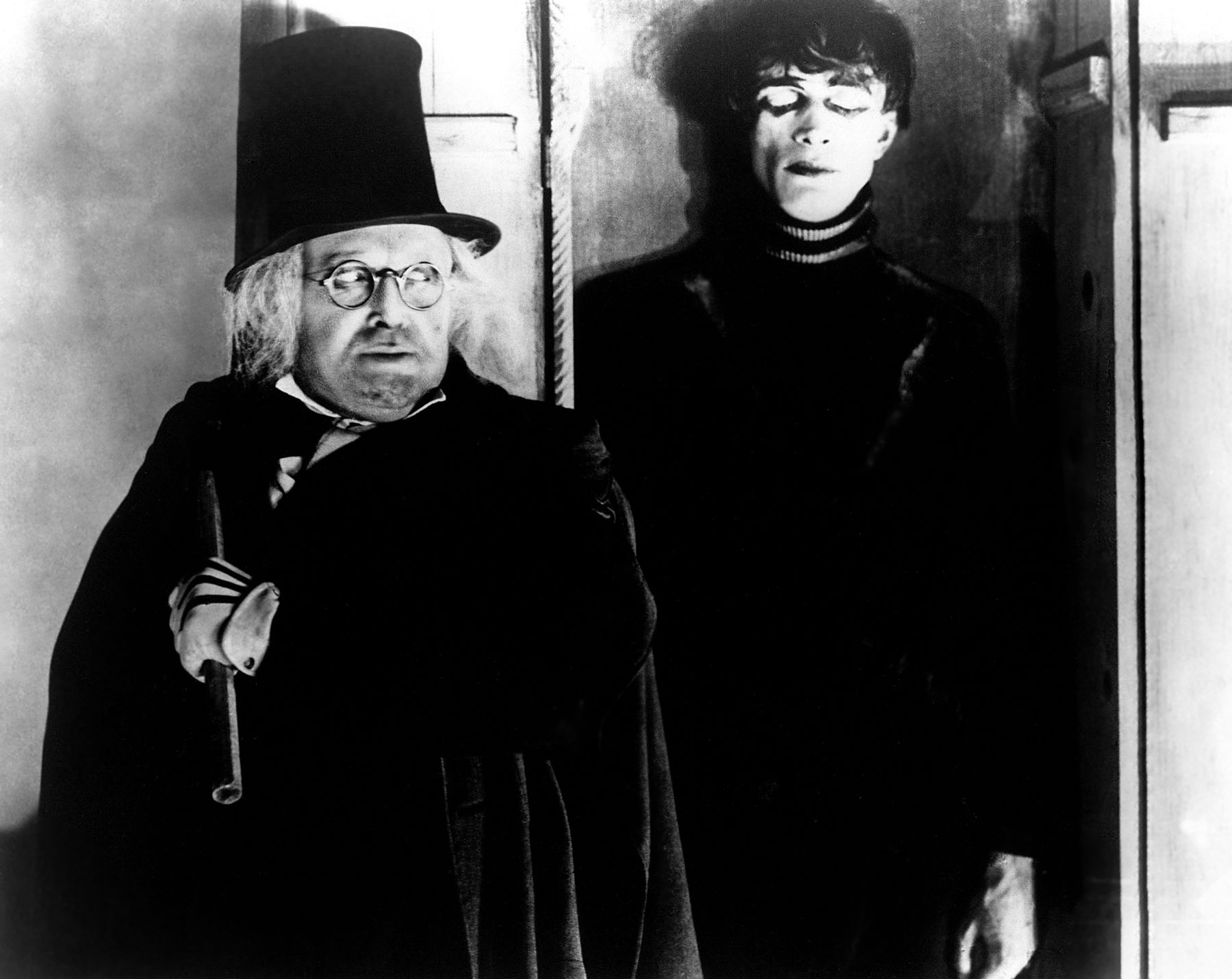
   Following the end of World War I in 1918 there was an emergence of “Expresionist” Art films that came out.  These films bounced across multiple genres and eventually managed to influence the earliest Horror films.  One such film was the 1920 German classic, “Das Cabinet des Dr. Caligari” (translated into English: “The Cabinet of Dr. Caligari”).                    
“Das Cabinet des Dr. Caligari” was written by Hans Janowitz and Carl Mayer.  Both Janowitz and Mayer were both heavily influenced by their experiences from World War I as well as some pre and post war activities.  For example, while attending a carnival in 1913 in his native Germany, Janowitz came across a young girl (whom he had never met before) named Gertrud.  The next day Janowitz was shocked to find that Gertrud had been found murdered in the woods.  While attending her funeral, Janowitz re-marked that he had an unsettling feeling that the killer was—perhaps—among the mourners attending Gertrud’s Funeral.  These experiences from Janowitz’s own life are a very good explanation as to why the murders in the film occur after the two main characters leave a carnival.                    
I ADORE these sets; they are phenomenal
   Another distinctive characteristic that set’s “Das Cabinet des Dr. Caligari” apart from other early Silent Horror films was its creative and unique sets.  The set design for the film was heavily influenced by Austrian Expressionist artist Alfred Kubin, whom both Janowitz and Mayer wanted to personally design the set’s for the film.  However, the film’s producer, Erich Pommer would not give Janowitz or Mayer the funds to pay for Kubin and instead, Pommer paid his own studio crew to design the set for the film.  Most of the sets—actually—had to be painted in the dark because Pommer didn’t want to spend the extra money on his electricity bill.  Many of the sets were painted in black and white and contain spirals, curves, and many other German Expressionist designs.                   
Doctor Caligari & Cesare
What “Das Cabinet des Dr. Caligari” is known most famously for is for being the first film to have a “twist-ending”.  Many film scholars and historians claim that “Das Cabinet des Dr. Caligari” was the first film to an incorporate a twist ending into its plot.  This new idea shocked and impressed audiences who thought they were just walking in to see a film with a basic plot.  To this day, many people still consider it one of the best “Twist-endings” in film of All-Time.  What is this twist-ending, you may be asking.  I dare not spoil it for you.  This film is far too important for me to ruin the ending, and it simply must be viewed by all to appreciate its influence it has left on filmmaking.                                                   
    A shot-for-shot remake was done of the film in 2005.  The plot remained unchanged and the film studio actually re-created the entire set from the original 1920 film, which speaks volume of their dedication.  This fan has two benefits for modern movie watchers; it includes Sound and it was done in English.  It is ideal for those of people who find it difficult to make it through “silent films”.                                               
One year later, in 1921 another film following the German Expressionist art trend was made.   The name of the film was “Nosferatu”.  “Nosferatu” was another important early Silent Horror film, but unlike “Das Cabinet des Dr. Caligari”, which was an original story, “Nosferatu” is an unofficial (Or “unauthorized”) adaptation of Bram Stoker’s popular Horror novel, Dracula.  Since the film studio could not obtain the film rights for Stoker’s novel, some changes had to be made to avoid legal troubles.  The word “vampire” was replaced with “Nosferatu” and Count Dracula became “Count Orlok”.  Despite the name changes to all the characters, the films makers were still sued by the family of Bram Stoker, who ordered that all copies of “Nosferatu” be destroyed.  Fortunately, a few copies of “Noseferatu” were saved.                                          
    “Nosferatu” was a direct rip-off of Dracula, and even though Universal Film Studios got the rights to make an official adaptation of “Dracula” in 1931, many people still praise “Nosferatu” and believe it has left a legacy on all Horror films made since its release in 1922.                                   
Not all that Subtle, eh, Count Orlok?
 
    The make-up worn by actor Max Schreck’s for Count Orlok is still quite frightening, and has become one of the most iconic images in Horror films.  Despite its influence, and popularity, I still don’t get the appeal of “Nosferatu”.  I’m not saying it’s a bad film, I just feel like Bela Lugosi’s “Dracuala” (1931) is much better.  The problem with Max Schreck’s Count Orlok is that he looks like a monster, so there’s no subtlety or suspense whatsoever.  Lugosi actually looks like a person in “Dracula”, and so it’s much more suspenseful.           

       
The Most Iconoic Shadow in Horror Film History
     I hope you all enjoyed this article, and stay tuned for next week when we will be discussing the Universal Movie Monsters of the 1930’s, 40’s, and 50’s as well as other “Pre-Code” Horror Films