Monday, February 8, 2021

Classics: A Review of The Wedding Singer By Lauren Ennis

Even as the winter winds blow hearts everywhere are set aglow, signaling that Valentine's Day is upon us once again. In keeping with the holiday, this week I'll be turning the spotlight on one of modern cinema's most endearing and entertaining romantic comedies; 1998's The Wedding Singer. This joyride through 1980's New Jersey offers first class comedy while relating a love story that is sweeter than a box of drugstore candy. Warm your heart on a cold winter's night this Valentine's Day and curl up with The Wedding Singer.


The story begins with small town wedding singer Robbie Hart preparing for his impending nuptials. His dreams of marital bliss are quickly dashed, however, when his fiancée leaves him jilted at the altar. Despite his best efforts he spirals into a depression that threatens to end his career until his co-worker, Julia, enlists him to help her plan her wedding. As the planning gets underway it becomes obvious to everyone except them that the pair are perfect for each other. When he learns that Julia's fiancée is unfaithful, Robbie becomes determined to tell her how he really feels. It's then up to Robbie and his friends to stop the wedding and save the day.

The Wedding Singer is that rarest of films; a romantic comedy that evokes laughter and sentiment in equal measure. While the film delivers plenty of Adam Sandler's signature slapstick it infuses even its most absurd moments with an unexpected tenderness and sincerity. Similarly, the film aptly balances the racy humor typical of the genre with the essential wholesomeness of its leading couple. Although the characters showcase outrageous behavior, the emotions and situations that they are coping with are all too familiar. As a result, viewers will be hard pressed not to root for Robbie and Julia finding their happy ending regardless of what shenanigans they face along the way. As an additional bonus the film also makes the most of its 1985 setting by paying loving homage to all things '80's to uproarious effect. For a romantic comedy that is certain to have you laughing and get your toes tapping hit the dance floor with Robbie and Julia in The Wedding Singer.


The film transports viewers back to the awesome '80's thanks to the work of its cast. Angela Featherstone is the ultimate 80's bad girl as Robbie's equal parts sultry and selfish fiancée, Linda. Matthew Glave would fit right in on Gordon Gekko's Wall Street as Julia's philandering stock broker fiancée, Glenn. Allen Covert is riotous in his macho turn as Robbie's best friend, limo driver Sammy. Alexis Arquette nearly steals the show as Robbie's Boy George obsessed backup singer, George. Christine Taylor infuses her role as Julia's sexy cousin, Holly, with a humor and charm that is nothing short of infectious. Drew Barrymore sheds her wild child persona and exudes girl next door wholesomeness in her beguiling turn as Julia. Adam Sandler lends what is arguably is best performance as loveable but lovelorn Robbie. Together the two form one of modern cinema's most endearing couples, showcasing a sparkling chemistry that lights up the screen.

The Wedding Singer contains all the romance of a wedding ceremony and the fun of the reception party. The by turns hilarious and heartfelt script and expert comedic performances is guaranteed to melt even the hardest of hearts. For a romantic comedy to grow old with join Robbie and Julia in The Wedding Singer.

And that is what they call 'church tongue'


Friday, January 22, 2021

Classics: A Review of The Lives of Others By Lauren Ennis

Over the course of several months we have been separated from one another physically, emotionally, and ideologically, all with the promise that by doing so we are ensuring that we will ultimately be reunited. Even as we continue to be isolated from one another, however, government has become all too present in our lives. Few can appreciate the current paradox created by the restrictions of social distancing, the censorship of big tech companies, and the normalization of Marxism as fully as those who experienced life behind the Iron Curtain. The 2006 political drama The Lives of Others offers a devastating reflection upon the oppression of the German Democratic Republic and a dire warning for the future.

I always feel like somebody's watching me...

The story begins in 1984 East Berlin as Stasi officer Gerd Weisler teaches recruits how to interrogate a suspect. After finishing his lesson he is approached by a colleague with an assignment to collect information on playwright Georg Dreyman. The assignment intrigues Weisel, who is excited by the challenge of spying on a famous and seemingly incorruptible subject. As his work carries on, however, Weisel's once iron-clad faith in the GDR is shattered when he learns that the assignment is really a means with which prominent party member Minister Hempf (Thomas Thieme) hopes to eliminate Dreyman in order to pursue Dreyman's actress lover, Christa-Maria Seiland (Martina Gedeck). With each new revelation of the true nature of the Stasi's surveillance, Weisel becomes convinced that the only way to maintain the ideals he has devoted his life to is to sabotage the efforts of the very establishment that he once believed personified them.

In the months since the outbreak of the Covid-19 pandemic citizens around the globe have been subjected to government imposed isolation, censorship, and restrictions that would be all too familiar to the film's characters. As the threat of the virus begins to fade with the distribution of vaccines a new threat has emerged in the US which has led to even greater calls for government intervention; public dissent. In the wake of the disputed 2020 US election and Capitol Hill riot big tech and mainstream media have begun a campaign to designate those who question either the election or the actions of the incoming administration as domestic terror threats. Even in the midst of pleas for national unity the call has arisen for 'citizen detectives' to monitor and report upon their fellow citizens just as the citizens of the GDR were forced to report on their friends and neighbors. In an even more troubling development government officials have expressed their plans to utilize law enforcement and national security agencies in their efforts to quell dissent in a modern day replication of the Stasi. Such measures may foster fear, paranoia, and conformity, but are destined to inspire only further division. The film showcases the ways in which the Stasi's surveillance was all too often abused for personal gain and weaponized against even the most loyal of citizens. Should this administration follow the repressive example of the GDR similar abuses are certain to follow, just as they did under the NSA's global surveillance program. At one point in the film Weisel notes, "socialism has to start somewhere"; it is our duty as as Americans to ensure that it does not start here and now.

You can't write this stuff

The superb work of the film's cast transports viewers into the the bleak heart of the Soviet bloc. Ulrich Muhe is truly dynamic in his turn as Gerd Weisel, as he allows the audience to witness his character's transformation from dedicated tool of the state to jaded subversive. Sebastian Koch portrays conflicted playwright Georg Dreyman with a humor, intelligence, and idealism that makes his plight all the more resonant. Martina Gedeck expertly rounds out the central cast in her haunting performance as tormented actress Christa-Maria Seiland. Ulrich Tukur and Thomas Thieme lend excellent support as Weisel's Stasi colleague, Grubitz, and ruthless Minister Hempf, and infuse their performances with an ideal balance of entitlement, sleaze, and menace.

This historical drama has become more relevant with each passing year as our present increasingly mirrors one of the most harrowing eras of the recent past. The intelligent script and nuanced performances brilliantly relate a wrenching tale of duty, love, betrayal, and sacrifice that is as powerful today as it would have been in the midst of the Cold War. For a glimpse into a 1984 that is even more chilling than anything George Orwell could write, look no further than The Lives of Others.

Every breath you take, every move you make, we'll be watching you


Friday, January 15, 2021

Classics: A Review of V for Vendetta By Lauren Ennis

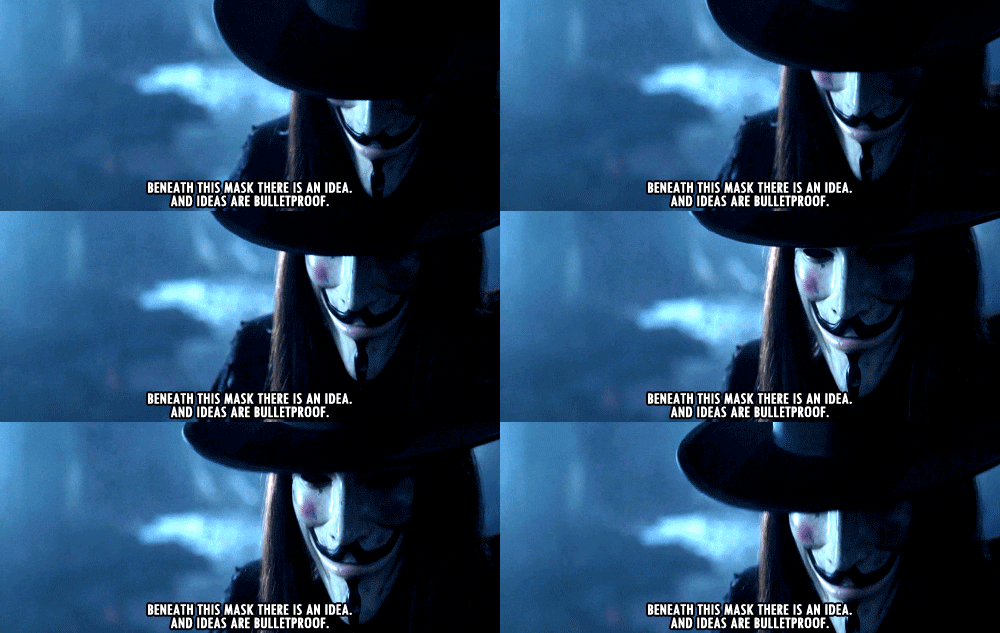
The year is 2020, the United States stands at the brink of a second civil war and a mysterious virus is ravaging Europe. Under the guise of controlling the pandemic and quelling domestic terrorism western nations designate themselves police states, ushering in a totalitarian era. This straight from the headlines scenario is the premise for the 2005 political action thriller V for Vendetta. Through its exploration of modern tyranny the film aptly predicts the all too real crises of 2020 and warns against the dark path that the events of this past year have set us upon.

The story begins with a masked vigilante known only as V rescuing state television employee Evey from the secret police. After she witnesses his attack upon the Criminal Court of England and Wales he takes her to his hideaway where he demands that she remain for one year. While pretending to aid in another of his attacks she escapes to the home of her colleague, Gordon, and is stunned to learn that he shares V's anti-government views and secretly engages in subversive activities. After learning of Evey's experiences with V, Gordon becomes determined to take a stand and satirizes the government on his television program. The broadcast inspires viewers, but ultimately leads to a police raid on Gordon's home during which Evey is arrested. After suffering numerous tortures she is ultimately released and emerges stronger, wiser, and determined to aid V in his crusade at any cost.

Over the course of the past year the world has found itself at a dangerous juncture. Much like the film's infamous 'St. Mary's Virus' the Covid-19 virus has become a global pandemic in the months since it was first reported in Wuhan, China in late 2019. The ways in which the virus is used as a pretext for the blatant violation of citizens' civil liberties in the film eerily mirrors the devastating impact of draconian lockdowns that have been imposed by governments across the globe. While numerous studies indicate that lockdown orders and mask mandates have failed to slow the spread of the virus, governments around the world have reimplemented and increased the severity of these same orders and mandates in recent weeks. Rather than fulfilling their supposed goal of saving lives, these measures have instead shattered lives by devastating citizens' economic, educational, mental, and physical well-being. Even as celebrities continue to echo that 'we're all in this together' citizens are encouraged to mirror the characters in the film by shaming and even acting as informants against one another all in the name of 'public safety'.  

One of the most chilling aspects of the film is the way in which information warfare is used to oppress the population. Throughout the film, state media promotes the narrative that the St. Mary's Virus was released by a terrorist organization, while in reality the virus was actually released from a state lab as part of an experiment in biological warfare. In this way, state media ensures that citizens will continue to trust the very government that poisoned them, all while remaining suspicious of each other. In a striking similarity the mainstream media and big tech platforms including Facebook, Amazon, and Twitter have come under fire for censoring or manipulating facts to form deceptive and often harmful narratives. State efforts to enforce lockdown measures created an ideal opportunity for these entities to justify their continued censorship efforts under the guise of 'preventing the spread of misinformation' related to the pandemic. Much like in the film these measures actually served to spread false information, particularly propaganda surrounding the responses of the WHO and Chinese Communist Party's responses to the virus.

Throughout the film those who dare to voice dissenting opinions are designated as terrorists. This act of manipulation serves the dual purpose of justifying the government's creation of a police state and ensuring that citizens remain in a perpetual state of government dependence and fear. Over the course of several months American and European cities descended into violent protests, the majority of which the mainstream media and big tech platforms by turns ignored, condoned, or actively encouraged in the name of 'social justice'. In the wake of the violent protest in Washington D.C. last week, however, these same entities have made an abrupt shift in their coverage policies by not merely condemning the violence, (as any legitimate outlet should do) but also extending their condemnation to any who hold conservative views, regardless of whether they were even present at the capitol. In keeping with this media narrative big tech platforms have begun a mass censorship campaign in which private citizens' social media accounts are surveilled and censored and free speech platforms are removed from the internet. In a chilling development the media has now begun to follow the film's example by designating those who dare question the accepted narrative regarding the 2020 election or the pandemic as potential terror threats. Much like in the wake of 9/11 this media narrative has given rise to a public demand for mass surveillance in a second incarnation of the Patriot Act. In a matter of mere months V for Vendetta's fictional dystopia has gone from cinema fantasy to a rapidly approaching reality.

The film is brought to explosive life thanks to the work of its cast. Stephen Rea infuses his performance as honest cop  Inspector Finch with an ideal balance between world weariness and decency. John Hurt portrays High Chancellor Adam Sutler with a cruelty and calculation that rivals history's most notorious dictators. Stephen Frey portrays Gordon with warmth and charm and aptly depicts Gordon's inner conflict as he produces propaganda for a regime that he secretly despises. Natalie Portman turns in one of the most multi-faceted, nuanced, and believable performances of her career as Evey. Even as he remains hidden behind his mask Hugo Weaving dominates the film in his magnetic turn as the mysterious V. 

Released in 2005 as a futuristic thriller V for Vendetta predicted the crises of 2020 with unnerving accuracy and offers a dire warning for the future as we enter 2021. Through its intelligent script and engrossing performances the film relates a tale of tyranny and liberation that raises vital questions surrounding politics, media, and the cost of freedom. As we stand at the brink of an era of censorship, suppression, and surveillance V for Vendetta proves to be vital viewing. Join the revolution with Evey and V in V for Vendetta...if the censors still let you.


Friday, January 1, 2021

Classics: A Review of Lust, Caution By Lauren Ennis

President John F. Kennedy famously said, "Ask not what your country can do for you, but what you can do for your country". In the 2007 espionage thriller Lust, Caution one woman asks what she can do for her country, but soon finds herself wondering how much she is willing to do for her country and at what cost. The film elevates itself beyond typical Hollywood spyjinks by shedding light upon the inner workings of the shadowy world of espionage and the relentless toll of war, even upon those who wage it in secret. Tempting, thrilling, and ultimately thought provoking Lust, Caution more than fulfills its mission.

Lie back and think of China...


The story begins in 1938 as inexperienced student Chia Chi Wong travels from occupied Shanghai to Hong Kong. She soon falls in with a group of politically active students and joins in their efforts to produce plays to promote the war effort in mainland China. As the war continues, the students become determined to participate in the war effort and decide to utilize their acting skills as spies. Alluring Chia Chi is recruited to seduce notorious collaborator Mr. Yee as part of an assassination plot. While she succeeds in drawing Yee's attention, the plot ultimately fails after Yee and his wife abruptly move to Shanghai and the students are forced into hiding after a fatal struggle with a Japanese agent. Four years later Chia Chi crosses paths with a former classmate who is now working as an intelligence agent for the Kuomintang and is recruited in another plot against Yee. She then reacquaints herself with Yee and the two embark upon a passionate and tumultuous affair. As the assignment continues she finds herself torn between her patriotic duty and her conflicted personal feelings. When final plans for the assassination are put in place she is forced to make an impossible choice between the country she loves and the enemy she has fallen in love with.

Through its nuanced portrayal of its conflicted heroine Lust, Caution raises vital questions surrounding the complex relationships between patriotic duty and personal freedom as well as the relationship between its central couple. Chia Chi begins the film as a passionate idealist, willing to do anything to secure her people's freedom. As the story progresses, however, she finds herself sacrificing her personal liberty and identity in an attempt to secure that of her country. When her assignment begins taking a psychological toll she turns to her fellow resistance fighters for support, only to realize that even amongst her own comrades she has been relegated to nothing more than a political instrument. As a result, she finds herself drawn to Yee who has similarly subjugated his personal will to that of the occupying Japanese regime. Ironically, it is only in each other's company that these political adversaries are free to openly voice their true thoughts and explore their personal desires. Through its portrayal of the couple's tumultuous relationship the film questions the value of political freedom that comes at the cost of personal liberty. Additionally, the film's depiction of the callous treatment of Chia Chi by her comrades offers a subtle, but damning, critique of any nation that reduces its citizens to political tools and collateral damage. In this way, the film uses its historical drama to offer a scathing critique of the repression that continues to dominate modern China.

Move over Mata Hari!

While the film's tale of seduction and spies seems relegated to a bygone era, the exploits of Chia Chi could actually be taken straight from today's headlines. In recent months it has been discovered that the Chinese Communist Party has spent decades utilizing a variety of intelligence tactics to influence its Western adversaries. The daunting extent of this infiltration was documented in a recent cyber leak released by Australia's Sky News. This leak lists Chinese Communist Party members who are currently in places of prominence in the most elite levels of Western technological, political, and academic institutions. In an instance of life imitating art a report has also been released by Axios detailing the work of CCP agent Fang Fang aka Christine Fang. Fang reportedly seduced numerous American politicians including congressman and House Intelligence Committee member Eric Swallwell as part of the regime's Blue Gold Yellow strategy. In light of these revelations the film's lurid tale seems not only entirely plausible, but also eerily prescient. Through its depiction of the unlikely rise and inevitable fall of its spy the film makes for compelling historical drama while also highlighting the all too present threat that oppressive regimes like the CCP pose to both foreign nations and their own citizens who they continues to utilize as political pawns. 

The film weaves a tantalizing web of intrigue and betrayal thanks to the work of its cast. Joan Chen personifies elegance as Yee's society maven wife. Wang Leehom aptly portrays resistance leader Kuang Yu Min's evolution from compassionate idealist to world weary and desensitized agent. Tang Wei brilliantly brings Chia Chi Wong to life in a performance that deftly interweaves vulnerability, courage, sensuality, innocence, and intelligence with heartbreaking realism. Tony Leung is magnetic in his turn as the equal parts cruel and charming anti-hero Mr. Yee, in a performance that is certain to leave viewers as conflicted as Chia Chi. Together the pair exude a chemistry that is nothing short of smoldering as they transport viewers into the heart of war-time espionage.

Lust, Caution is a cautionary tale for our times. The film utilizes its compelling script and captivating performances to highlight the personal devastation that political turmoil leaves in its wake. Through its portrait of the spy as a young woman the film raises questions about duty, patriotism, and sacrifice that continue to resonate today. Follow Chia Chi for a suspenseful and sensual glimpse into the world of espionage in Lust, Caution.


What, me spy?


Thursday, December 17, 2020

Classics: A Review of Miracle on 34th Street By Lauren Ennis

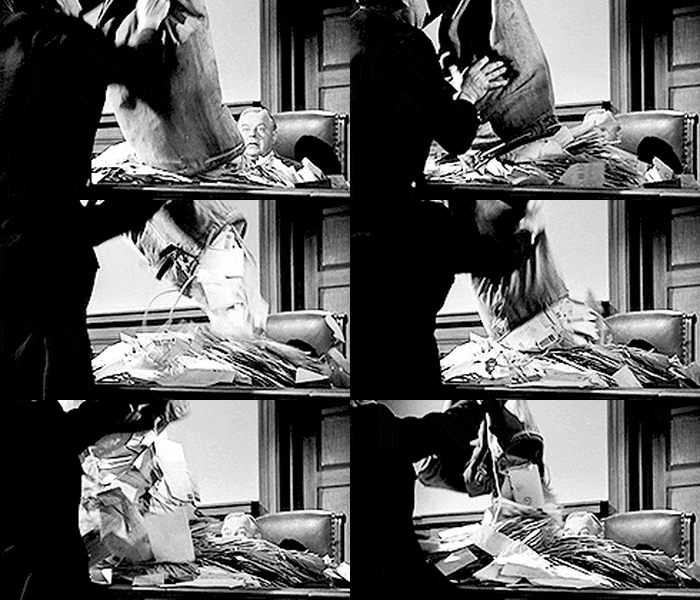
M   Media hysteria, shocking court hearings, dubious political dealings and suspicious mass mail drops prove to be the makings of...a Christmas miracle?! The 1947 classic Miracle on 34th Street somehow manages to piece together these elements and more to relate a fable for our times. The film follows a department store Santa (who just might be the real thing) whose innocent efforts to spread Christmas cheer place him both under psychiatric evaluation and in front of a judge. Beneath its warmth and whimsy this heartwarming holiday tale relates lessons in decency, resilience, and faith that resonate now more than ever.

The story begins on Thanksgiving with Macy's event director Doris Walker struggling to salvage the store's parade after the Santa she had hired arrives for work drunk. Fortunately, concerned bystander Kris Kringle appears on the scene and offers to stand in for the inebriated employee. Kris' performance during the parade proves so successful that he is hired as the store's Santa for the remainder of the season. Throughout his employment, Kris is nothing less than delightful as he entertains the store’s customers and teaches Doris’ mature daughter, Susan, the joys of being a kid. Cynical Doris, however, decides that the old man is taking the Santa act too far and tries to fire him for fear that he is unstable and a company liability. When Mr. Macy himself advises her against the decision she instead recommends that Kris schedule an appointment with the store's on-staff psychiatrist. The appointment results in a series of misunderstandings that result in Kris being committed to Bellevue Hospital’s psychiatric ward. Doris’ neighbor, lawyer Fred Gaily, then takes it upon himself to defend Kris at a sanity hearing by proving that Kris is not only perfectly sane, but also the real Santa Claus.

B    The film's infectious cheer has mesmerized generations, but it is its call to faith and integrity in a cynical age that has earned Miracle on 34th Street a place in cinema history. Throughout the film those who remain true to their beliefs and fail to adhere to popular norms are dismissed as misguided or even unstable. In an era in which media members, medical experts, and political leaders dictate a firm but not necessarily factual narrative Kris' plight eerily reflects that of millions who have been silenced, derided, and even persecuted for questioning the powers that be. Even when all hope seems lost, however, Kris never loses sight of his beliefs or waivers in his determination to remain true to them. In this way, Kris elevates Santa Claus beyond a benevolent fairy tale figure to a role model we all could learn from.

     When Fred offers to take Kris' case he defends his decision by saying "It's not just Kris that's on trial, it's everything that he stands for. It's kindness and joy and love and all of the other intangibles". After a year of political, economic, social, and personal upheaval those 'intangibles' that Fred refers to seem better suited for the fairy tales that Susan dismisses than real life. Yet it is in times of struggle and division such as these that those intangibles matter most. It is these invisible ties of joy, love, hope, and faith that bind us together even as everything around us seems set to tear us apart. As the holiday season descends upon us once again it is imperative that we find light in the midst of the darkness surrounding us and remember that those little intangibles truly are the only things worthwhile.  


Just ordinary election-I mean trial- procedure...

The film comes to vibrant life thanks to the warmth and wit of its cast. Philip Tonge is riotous in his turn as anxiety ridden toy department manager Mr. Shellhammer. Gene Lockhart infuses his performance as Judge Harper with wisdom and decency. William Frawley is memorable in his brief appearance as Judge Harper's cynical but savvy political strategist, Charlie Halloran. Porter Hall is a villain viewers will love to hate as self-important bureaucrat Mr. Sawyer. In her first major role Natalie Wood displays a subtlety, nuance, and realism in her performance as precocious Susan that foreshadows her later screen success. John Payne personifies honesty and idealism and makes for a charming romantic lead as Fred Gailey. Maureen O'Hara is captivating in her portrayal of the well-meaning, but world weary Doris. Edmund Gwenn shines in a performance that exudes such kindness, cheer, and warmth that viewers will be left wondering if he might really be Santa Claus off-screen as well as on.

 Miracle on 34th Street is a holiday tale that is guaranteed to warm your heart throughout the year. Through its equal parts warm and witty script and infectious performances the film weaves a spell that is nothing short of cinema magic. In a year in which so many of us could use a Christmas miracle have a little faith and join Fred, Doris, Susan and Kris in Miracle on 34th Street.


Sunday, December 6, 2020

Classics: A Review of My Cousin Vinny By Lauren Ennis

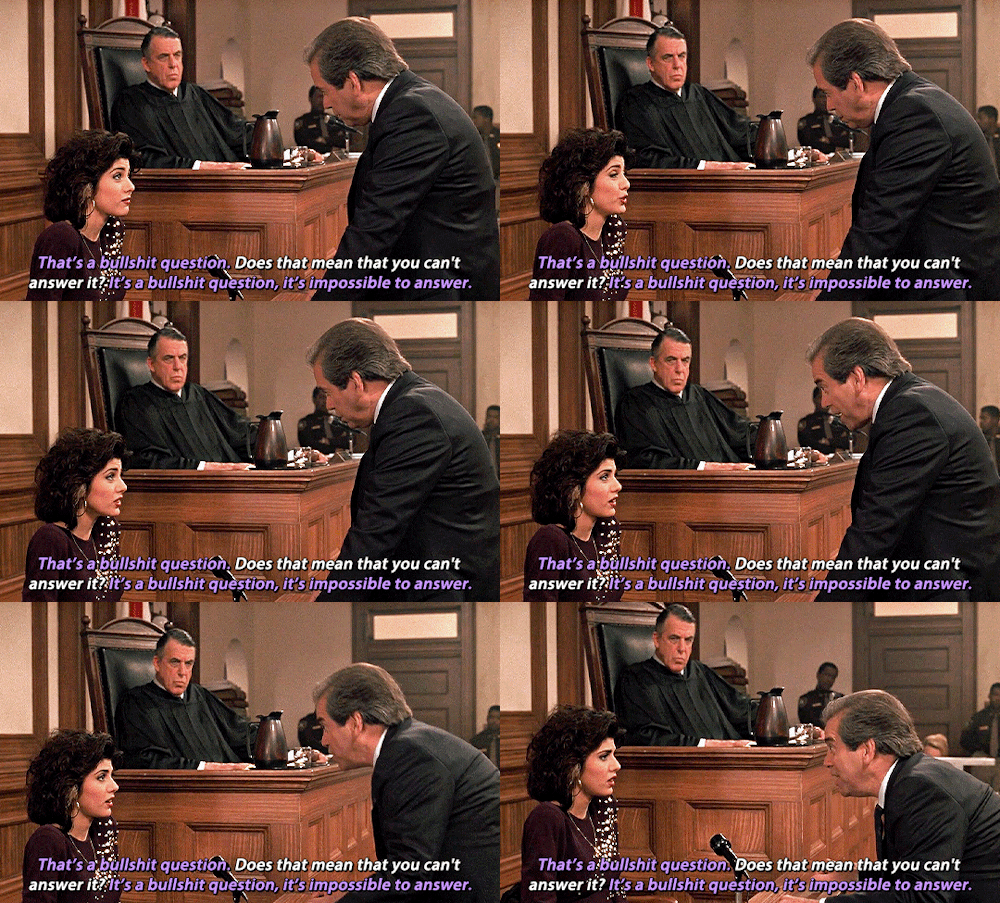
The court system is known as one of the most sacred institutions in America. It is within the hallowed halls of the nation's court rooms that life and death and guilt and innocence hang in the balance. Who would have thought that these same halls would also be ripe for comedic potential? The 1992 film My Cousin Vinny combines the familiar elements of classic court room drama with fish-out-of-water comedy and then subverts both genres with hilarious results. Through its focus upon the inner workings of the law the film sends up the legal profession with a wit and charm that is certain to leave even the most hardened of litigators laughing. Nearly thirty years after its release My Cousin Vinny continues to make the case for its status as a comedy classic.

The story begins with two New York college students, Billy and Stan, taking a trip below the Mason Dixon line where they immediately realize that they are both fish out of water and completely over their heads. After inadvertently shoplifting in an Alabama convenience store the duo are arrested, not for theft but murder. Desperate to defend themselves against capital charges, the boys enlist the help of Billy's cousin, recent law school graduate Vinny. Wise guy Vinny soon arrives in Alabama armed with zero courtroom experience, a hair-trigger temper, and a tough talking fiancée. The film then follows his increasingly outrageous attempts to remain one step ahead of the defense in a case that places his career, his relationship, and his cousin's life on the line.

The film's original poster reads "There have been many courtroom dramas that glorify the Great American Legal System. This is not one of them", that tagline is correct, My Cousin Vinny, does not glorify the American legal system; it does something infinitely more interesting. Rather than following courtroom drama clichés the film instead chronicles the inner workings of one criminal case. As a result, the film lends viewers apt insight into the crucial, but less than exciting, aspects of legal work that Hollywood all too often leaves out. In this way the script pays homage to the men and women of the legal profession without glamorizing them and ensures that the film remains firmly within the realm of reality. 

Even in the midst of so much legal drama the film successfully delivers one laugh after another. The film aptly utilizes its 'fish out of water' premise with culture and personality clashes that are played to maximum comedic effect. The film particularly succeeds by presenting seemingly stereotypical characters and then subverting those same stereotypes. For example scrappy and streetwise Vinny begins the case as arguably the most incompetent attorney to enter a courtroom only to eventually prove himself a formidable litigator. Similarly, Vinny's seemingly ditzy fiancée, Lisa, ultimately outwits attorneys for both the prosecution and defense. The film also succeeds through its ability to present viewers with outrageous characters with such affection and humanity that viewers will be hard pressed not to relate to and root for them. Through its winning combination of law and laughs My Cousin Vinny takes any semblance of order out of the court. 

The film's colorful array of characters come to whimsical life thanks to the work of the expert cast. Ralph Macchio and Mitchell Whitfield convey a believable sense of camaraderie and make for a likeable duo as Billy and Stan. Lane Smith oozes smarmy charm as slick prosecutor Jim Trotter. Fred Gwynne infuses his role as Judge Chambers with a dignity and dry wit that ground much of the film's proceedings. Marisa Tomei steals each scene in which she appears, more than earning her Oscar win for her turn as Vinnie's equal parts smart and smart mouthed fiancée, Mona Lisa Vito. Even in the midst of expert comedic performances the film belongs to Joe Pesci who lends what is easily his most complex performance as larger than life underdog Vinny.

Plenty has changed since 1992, but My Cousin Vinny still garners just as many laughs as it did upon its initial release. The script's balance between the realistic and the ridiculous ensures that each punch line still packs a powerful punch. The cast brings the script to life with an expert comedic skill that many comedies could take a cue from today. The verdict is in, My Cousin Vinny is a comedy that is guaranteed to leave the defense, the prosecution, and everyone in between laughing out loud.


Monday, November 9, 2020

Classics: A Review of Cobra Kai By Lauren Ennis

With a final infamous crane kick The Karate Kid concluded one of the great underdog stories and a cinema legend was born. The franchise then went on to follow its unlikely hero, Daniel Larusso, as he faced enemies both at home and abroad to become "the best around". In 2018 the franchise returned to follow an arguably even more unlikely hero; The Karate Kid's original villain, Johnny Lawrence. In the hit series Cobra Kai Johnny returns to reclaim his place both on and off of the mat and turns out some of the most surprisingly compelling television in recent memory along the way. 

No mercy

The story begins thirty-five years after Daniel defeated Johnny in the All-Valley Under Eighteen Karate Tournament with the two effectively switching roles. Former underdog Daniel is now an all around success enjoying a happy family life while owning a profitable chain of car dealerships. Johnny, meanwhile, has taken the opposite trajectory and is now divorced, estranged from his son, and reduced to working odd jobs to make ends meet. When bullied teen Miguel moves into Johnny's apartment complex history repeats itself and before you can say 'wax on, wax off' Johnny becomes the boy's sensei and reopens his old dojo, Cobra Kai. Old rivalries are reignited when Johnny crosses paths with Daniel who has (unknowingly) begun training Johnny's estranged son, Robby. After the two face off in an all too familiar tournament at the end of season one the second season adds even more drama as Daniel opens his own dojo and the senseis' bitter rivalry carries down to their students. By the second season's conclusion the past and present collide in a stunning finale that leaves the future of Johnny, Daniel, and their dojos hanging in the balance and is certain to leave viewers begging for more.

Through its combination of heart, humor, and action Cobra Kai kicks the competition. The series successfully strikes a balance between paying apt homage to the original films and building an original story. Rather than merely acting as a nostalgic rehash of the franchise the series instead adds depth and nuance to returning characters while introducing plenty of fresh faces. The series particularly succeeds in adding shades of grey to the black and white characterizations in the original films, enabling the series to function equally well as a character study and a sports drama. Best of all, the series invests in each of its characters in a way that ensures that viewers will remain on the edge of their seats as they watch each of its diverse plot lines unfold. Even as the script delves into domestic and sports drama the series uses its cross-generational tale to highlight and poke fun at the norms of both the 1980's and today with uproarious results. In this way the series ensures that the proceedings never veer into melodrama and that its story has something to offer the entire family. Striking an ideal balance between comedy, and drama Cobra Kai offers something for Gen X, Gen Z, and everyone in between for some of the best viewing around. 

Balance is key

The world of The Karate Kid is brilliantly revived thanks to the butt-kicking performances of the series' ensemble cast. Newcomer Xolo Mariduena makes for a welcome addition to the franchise as he expertly portrays Miguel's journey from bullied underdog to conflicted Cobra Kai champion. Similarly, Tanner Buchanan aptly depicts bad-boy Robby's efforts to reinvent himself under Daniel's guidance. Mary Mouser conveys infectious charm as Daniel's daughter and the object of both Miguel and Robby's affections, Samantha. Peyton List captures each scene in which she appears as Samantha's magnetic rival in karate and romance, Tory. Martin Kove seamlessly returns to his role as John Kreese, and recaptures his performance as the original bad sensei in all of its smarmy, sinister, glory. Even in the midst of impressive ensemble performances, however, the series undoubtedly belongs to William Zabka and Ralph Macchio as they brilliantly reprise their roles as rivals Johnny and Daniel. Zabka infuses Johnny with a world weariness, earnestness, and humor that is certain to leave viewers rooting for the former bully. Similarly, Macchio's performance showcases new dimensions and complexity as he aptly portrays Daniel's struggle to reconcile his past and present.

Even as its heroes struggle to find their inner balance Cobra Kai strikes an ideal balance between laughs, cheers, and even the occasional tear. At once refreshingly original and warmly nostalgic the series relates a unique tale that perfectly completes The Karate Kid franchise. Through its endlessly entertaining script and enormously engaging performances the series provides just the kick that audiences have been waiting for. For a true knockout of a series start training with Cobra Kai.