Friday, June 5, 2020

Classics: A Review of The Dark Knight By Lauren Ennis

Corruption, fear, and violence are just another day in the life in the crime infested streets of Gotham City. In this city in which law and order are ideals rather than realities a dark figure emerges to ensure that justice prevails and crime does not pay. He may not be the conventional hero that the people of Gotham City want, but Batman is the avenger that they need. In 2008's The Dark Knight Batman is put to the ultimate test in a battle of wills against the anarchistic Joker which eerily mirrors society's ongoing struggle against the forces of chaos.

Holy Oscars Batman!

The film begins with Gotham in a state of relative calm thanks to the efforts of Batman and Commissioner Gordon. Meanwhile, the arrival of idealistic District Attorney Harvey Dent promises a brighter future for the city and leaves Bruce Wayne wondering if the time has come for Batman to finally hang up his cape and cowl. Just as peace finally seems to be within the city's reach, however, a new threat appears in the form of the Joker. Through his singular pursuit of social anarchy the Joker plunges the city's law abiding citizens and criminals alike into a state of perpetual chaos, and pushes Batman and his allies to the very edge of darkness.

Easily the darkest and most complex entry in the Batman franchise The Dark Knight portrays the utter chaos of a world at war with itself. Through his central struggle against the Joker Batman is forced to confront numerous ethical questions which call his moral code into question. These same questions surrounding law enforcement, citizen surveillance, and vigilante justice particularly resonated with viewers at the time of the film's release during the War on Terror, and have gained even greater relevance in the midst of today's social unrest. In the wake of the tragic murder of unarmed civilian George Floyd at the hands of police cities around the world have seen protesters filling their streets to demand justice. What began as peaceful protests has in many cities, however, descended into violence, destruction, and mayhem. The rioting, looting, and attacks on both law enforcement and civilians does nothing to further racial equality or to ensure that Floyd's killer is brought to justice. What this wanton destruction does do is perpetuate further injustice as it plunges city streets into the same sort of chaos and anarchy that the Joker brings to Gotham. Those responsible for this mayhem, whether they be opportunistic criminals, extremist Antifa militants, or members of the Black Liberation Army and Weather Underground inspired group Black Lives Matter, may claim to be seeking justice, but are in fact only ensuring that the world around them burns. This unrest leaves us grappling with many of the same questions that Batman faces as he struggles to uphold the law even as the forces around him push him ever closer to breaking it himself.  These are indeed some of the darkest days in recent memory, but as Harvey Dent assures the citizens of Gotham City "the night is darkest just before dawn", and if we stand together in unity against these agents of chaos and demand that our leaders stand with us against this destruction dawn will come.


Gotham City and its enduring struggle against evil is brilliantly brought to life thanks to the superb work of the film's cast. Maggie Gyllenhaal is a welcome addition to the cast, replacing Katie Holmes as Assistant District Attorney Rachel Dawes. In Gyllenhaal's capable hands Rachel is transformed from stock love interest to a fully realized heroine in her own right. Aaron Eckhart shines as Gotham's charismatic 'White Knight' Harvey Dent and portrays Harvey's transformation into ruthless vigilante Two-Face with tragic anguish. Gary Oldman perfectly captures Commissioner Gordon's essential honesty and growing world weariness as he struggles to remain morally upright in a world of corruption. Morgan Freeman and Michael Caine aptly fill dual roles as both Bruce Wayne's and the films' consciences in their portrayals of Wayne Enterprises' CEO Lucius Fox and Bruce's best friend and butler, Alfred. Christian Bale and Heath Ledger dominate the film in their portrayals of Bruce Wayne/Batman and the Joker. Ledger is nearly unrecognizable as he transforms into the personification of chaos in the form of the Joker. The performance is more than worthy of his posthumous Oscar for Best Supporting Actor as he infuses his every gesture with a manic energy and underlying menace. Bale turns in an iconic performance that surpasses any in the Batman franchise and perhaps even in the entire superhero genre as he expertly captures the dark knight's reluctant heroism even as he struggles to battle his inner demons. Together, the two engage in a battle of the wills that is the stuff of cinematic legend.


Tragic, twisted, tumultuous, and ultimately triumphant The Dark Knight is more than just a super hero movie, it is a story for our times. Through its brilliant script and magnetic performances the film breathes fresh life into the Batman franchise while paying apt homage to the films and comic books that came before it. The film's gritty portrayal of the timeless struggles between good and evil and chaos and order make it both timeless and eerily timely in today's current state of unrest. In this uncertain time now more than ever we could all use, "a silent guardian, a watchful protector, a dark knight".

Friday, May 22, 2020

Back to Business: Three Films that Make the Case for Reopening the World Economy By Lauren Ennis

For several weeks citizens across the globe have been instructed to 'stay home and save lives'. The reasoning behind this global shutdown was that if the coronavirus' spread was slowed each nation's healthcare system would remain intact and able to provide patients with the care that they need. As the weeks pass into months, however, it has become increasingly obvious that this effort to confront the pandemic has given rise to another, equally threatening crisis; an economic crisis. While it is universally acknowledged that private enterprise is the backbone of a modern economy, business is so much more than just a method for making money. Businesses great and small provide countless individuals with employment and allow employees and owners alike to pursue financial stability, self-improvement, and self-fulfillment. As the shutdowns in various states and countries continue, however, the doors of numerous businesses remain firmly shut, leaving business people stranded without a source of income. The longer that lock-downs remain in place the more difficult that it will be for businesses to reopen, and all too many may be forced to permanently closed. In a show of solidarity with businesses around the world and in an effort to remind those in power of the crucial role that business plays in society I'll be turning the spotlight on three films that highlight the crucial role that  business plays on an individual, societal, and cultural level.
Harry Selfridge: revolutionizing retail since 1909

Mr. Selfridge: At Selfridge's department store shopping was thrilling and work was fulfilling. Based upon the real life story of American entrepreneur Harry Selfridge, ITV's Mr. Selfridge invited viewers to become part of the Selfridge's team and reminded us all that the value of a job well done extends far beyond a paycheck. Through its portrayal of Selfridge and his employees the series highlighted the ways in which careers can transform lives. For example, in its depiction of shop-girl turned department manager, Agnes, the series shows the ways in which economic opportunity allows people to transcend their circumstances. At the series' start Agnes and her younger brother, George, find themselves trapped in a cycle of abuse and poverty. When both siblings find positions at the store, however, they are presented with the opportunity to rise above their troubled pasts and eventually make their own way to find success in both work and life. Similarly, ambitious waiter Victor utilizes his position at the store's restaurant to learn his trade and later fulfill his dream of owning his own restaurant.  Later in the series both single mother Tillie and scandal ridden divorcee Mae defy social stigmas and use their positions at the store to provide for and reinvent themselves. While the series explores numerous story lines and historical topics, its overarching theme is the enduring promise of the American dream, albeit in a London department store. Much like in the real life Selfridge's (where employees were regularly provided with then unheard of advancement and educational opportunities), in the world of the series anyone can create a better life for themselves and their families through hard work and ingenuity. It is the desire to make a better life that drives the series' fictional characters just as it has driven countless business owners and employees throughout history. As shutdowns continue in various states and countries, however, this desire is being discouraged and even punished. As long as businesses remain shuttered it is not just merchandise that is being shelved, but also the incomes, hopes, and dreams of business people. This is not to say that safety should be sacrificed in favor of financial stability, but instead that, just as the Selfridge's team so often did, it is time for leaders and businesses alike to adapt and innovate in order to move forward. The real life Harry Selfridge once said, "there are no hard times for good ideas". While the days ahead may be some of the hardest that we've known our leaders would do well to take a lesson from Mr. Selfridge and allow businesses to put their many good ideas regarding reopening the economy safely into action.
It's a lockdown life for us...

The Pursuit of Happyness:
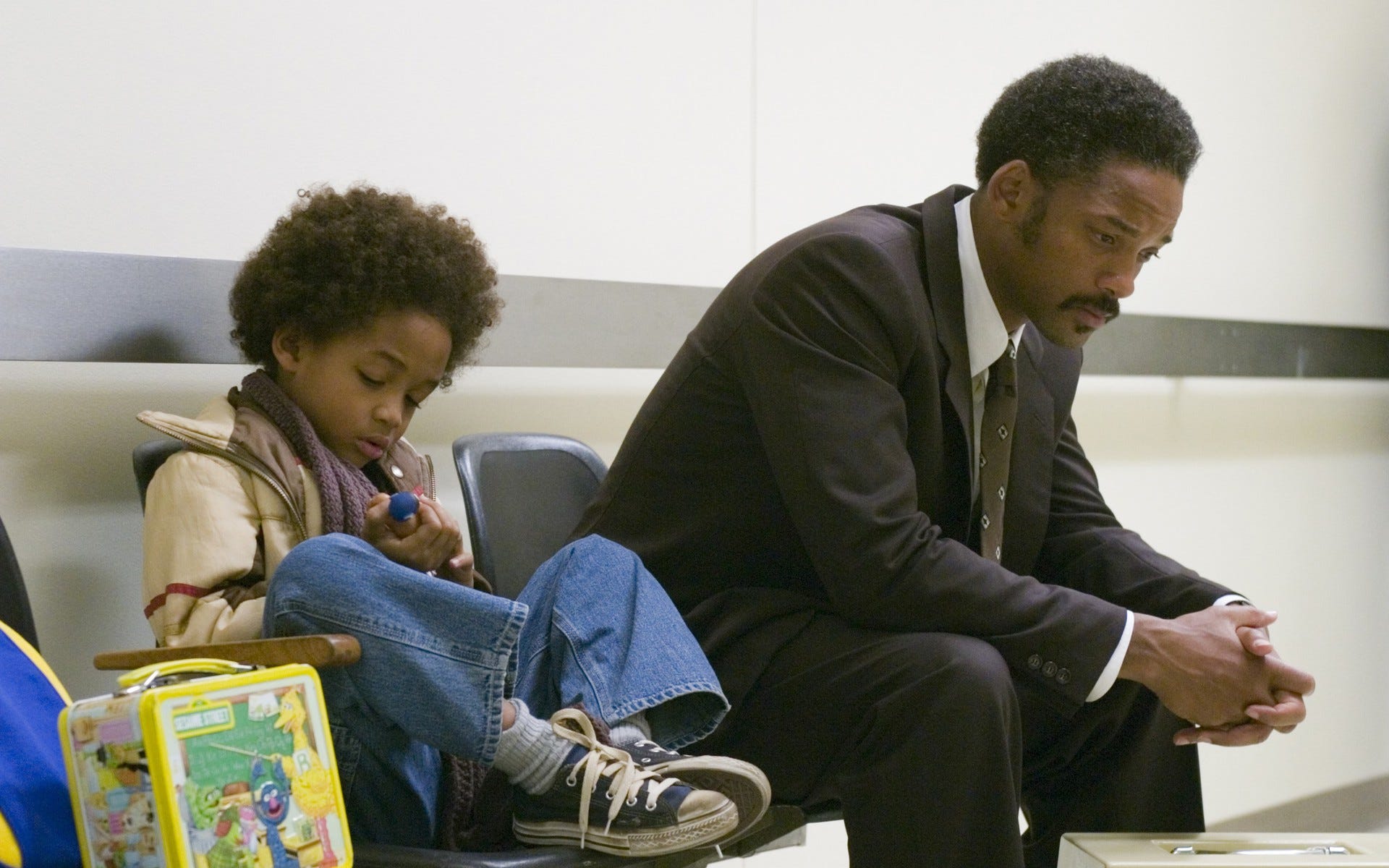
Few films capture the individual toll of unemployment and lack of economic opportunity as well as the 2006 drama The Pursuit of Happyness. Based upon the autobiography of stockbroker Chris Gardner, the film relates a tale of one man's journey from poverty to prosperity. The film begins with Gardner struggling to make ends meet meet selling medical scanners that most hospitals deem an unnecessary luxury. Despite his best efforts he, his wife, Linda, and their young son, Christopher, continue to live a 'hand to mouth' existence. Their financial struggles strain the couple's marriage until Linda finally walks out, leaving Chris to raise his son alone. As Chris' finances continue to deteriorate he and Christopher face eviction and finally homelessness. When Chris is offered an internship at prestigious brokerage firm Dean Witter Reynolds he recognizes the unpaid position for the opportunity that it is. Through the ensuing months he is determined to prove himself as both an employee and a father as he struggles to balance his work and family responsibilities, all while navigating life in the shelter system. Although the film ultimately reaches a triumphant ending, it never shies away from the all too real trials that Chris and his son faced, and that millions continue to face today. Throughout the film the script emphasizes the damaging effects of poverty upon the characters' lifestyles and relationships. For example, although Chris and Linda were shown to enjoy a loving, happy, relationship early in their marriage years of financial instability ultimately drive the couple to a bitter divorce. Similarly, the film aptly highlights the ways in which Chris' lack of economic opportunity leads him into a downward spiral that ultimately culminates in his being evicted and forced to stay in one of the city's overcrowded homeless shelters. The film's depiction of poverty's effect upon children is particularly poignant as it unflinchingly shows the ways in which the struggles of one generation inevitably carry on to impact the next generation. Some critics have contended that the film places too high of an emphasis upon Chris' pursuit of wealth, but those critics have missed the point of the film. While Chris' journey does include his struggle to earn an income in order to provide a healthy and stable life for his son, his success is not one that can be measured in dollars and cents. Instead, his success is best measured in the opportunities that he was able to obtain for both himself and his son. At one point in the film Chris tells his son, "Don't ever let anybody tell you that you can't do something...You got a dream you gotta' protect it. If you want something go get it. Period". In the midst of economic shutdown local, state, and national governments are in fact telling businesses and workers that they cannot pursue their professional goals, protect their dreams, or even do their jobs. As Chris notes throughout the film the Declaration of Independence does not guarantee happiness, but it does designate the pursuit of happiness as an unalienable right to all Americans. By keeping the economy shut down leaders are also shutting down the most crucial rights of citizens to liberty and the pursuit of happiness.

Well said, Madam

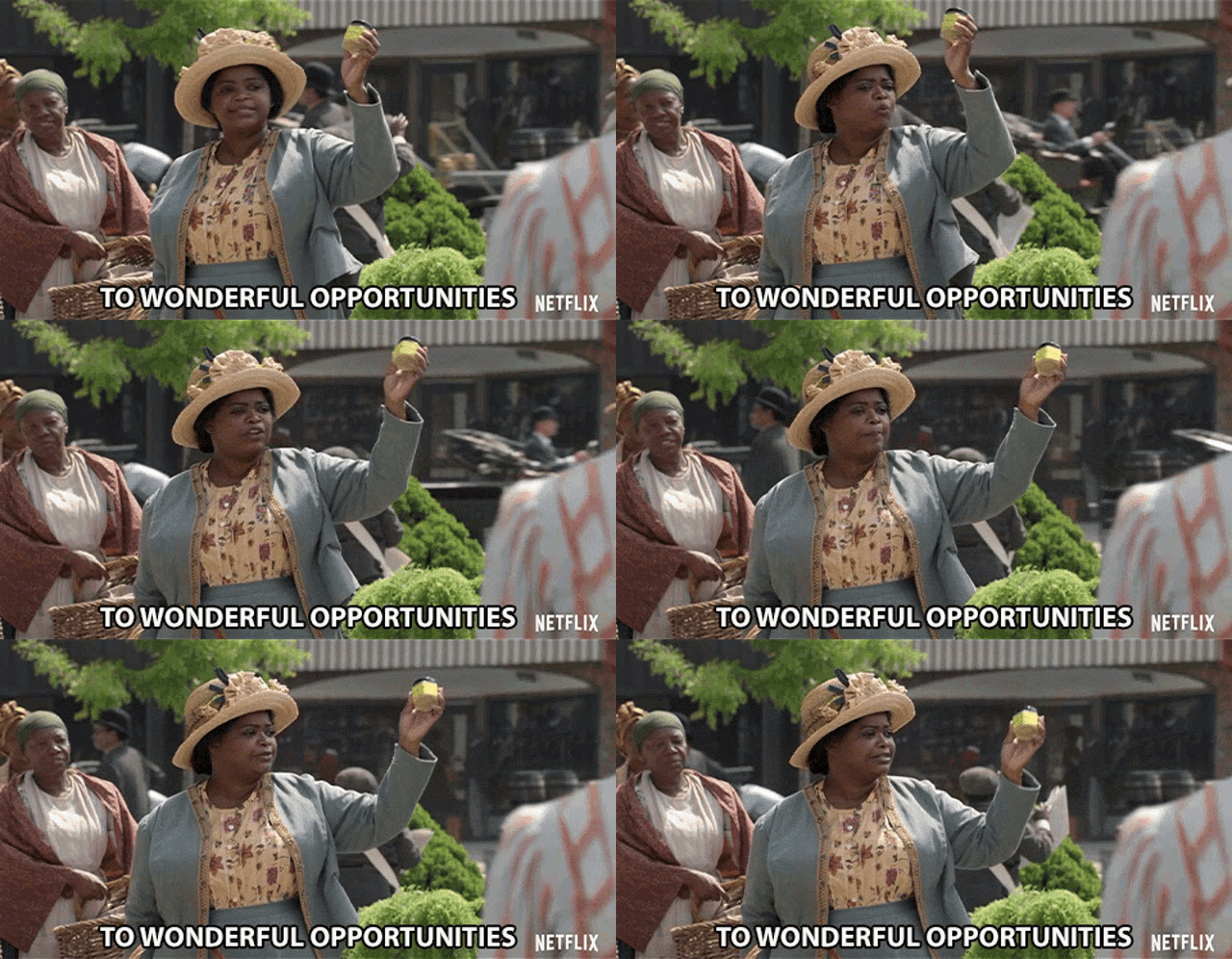
Self-Made: Netflix's recently released miniseries Self-Made tells the larger than life tale of hair-care tycoon Madam C.J. Walker and shows us all how one person's dream can benefit an entire community. Born the child of slaves in 1867, orphaned at age seven, and widowed by age 20 Sarah Walker's beginnings were rife with strife and struggle. Her story is not one of tragedy, however, but instead one of incredible triumph as she rose to not only become one of America's first female self-made millionaires, but also a shining example of philanthropy and political activism. The series depicts the ways in which Walker's entry-level job in a local salon allowed her to leave her back-breaking job as a laundress behind and still provide for herself and her daughter. The series then shows how her entrance into the beauty industry renewed her confidence and sense of purpose. Even more significantly, this position also gave her the vital inspiration to embark upon her own career manufacturing hair care products to other women of color. She then began what would ultimately become more than just a business; the Madam C.J. Walker hair-care empire. Rather than merely concentrate upon profits and expansion, Walker constantly sought ways to use her business to give back to her community. Initially, she sought to provide other women of color with employment opportunities that would help them to escape poverty and provide them with employment options beyond domestic work. As her success grew, however, she recognized the ways in which her public role as a businesswoman could be used as a political platform. She then began using her business as a means to advocate for civil rights and women's suffrage, while donating her profits to the anti-lynching movement and educational organizations . Over one hundred years after her company was founded Sarah Walker's story remains a remarkable tale of the ways in which doing well allows us to also do good. Today businesses continue to follow Walker's example and serve the community at large, but they cannot do so if they are not permitted to open. Reopening businesses will revive communities so that together we can not only survive but thrive both during this pandemic and long after the last cases are reported.

Friday, May 8, 2020

Classics: A Review of Dallas Buyers Club By Lauren Ennis

What would you do if you were told that you had just thirty days left to live? In the Dallas Buyers Club Ron Woodruff is faced with that very question when he is diagnosed with AIDS. Although his diagnosis is functionally a death sentence, Woodruff refuses to accept defeat and begins what will prove to be the fight of his life as he embarks upon a battle against cultural stigmas, medical bureaucracy, and his illness. His real life efforts ultimately allowed him to live seven years-2,525 days longer than his original thirty day prognosis-before he succumbed to AIDS related complications in 1992 and helped pave the way for today's "right to try" laws.

The story begins in 1985 with Woodruff enjoying a risky lifestyle of riding bulls, snorting cocaine, and hiring prostitutes. His entire world screeches to a halt, however, when he consults a doctor regarding his persistent cough and fainting episodes and learns that he is not only HIV positive, but is suffering from AIDS. Desperate for more time, he arranges to illegally buy the experimental drug AZT after he is deemed too ill to take part in a clinical trial. When AZT proves toxic to his immune system, however, he learns of other drugs being touted as potential cures around the world which are not available in the US. With the help a disgraced doctor he then begins smuggling these alternative treatments into the US. When his symptoms begin to improve he realizes the lucrative potential of his new venture and begins selling treatments to other desperate AIDS patients, beginning what becomes known as the Dallas Buyers Club. Through this enterprise he offers his fellow AIDS sufferers "all the drugs you could want" in exchange for the hefty price of $400 per month. While his motives are initially strictly financial, as time goes on he witnesses the ways in which the regulations of the FDA and the medical establishment are inflicting almost as much damage on patients as the virus itself. He then springs into action and embarks upon a one-man crusade to secure patients' rights to have a say in their own treatment.

Dallas Buyers Club is a film that is every bit as unconventional, innovative, and ultimately empowering as the man and movement that inspired it. The film perfectly captures the anxiety, desperation, and despair that permeated the atmosphere of the AIDS crisis with an unflinching honesty. Through its portrayal of Woodruff's struggle to treat his illness the film also raises vital ethical questions about modern medicine. Throughout the film, Woodruff and his associates are treated as criminals for trying to have a say in their own treatment, and essentially told that the  medical establishment know best. As the story unfolds, however, his interactions with physicians and members of the medical and pharmaceutical industries consistently indicate otherwise. When he is first diagnosed with AIDS he is told that he has thirty days to live and instructed to "get your affairs in order" rather than provided with information about his illness or any alternative to passively accepting death. Similarly, when he raises concerns about AZT's toxicity his claims are dismissed in spite of the FDA and NIH's corroborating data. It is only when he travels to Mexico and receives treatment at the underground clinic of Dr. Vass that Woodruff is provided with what he needs to fight his illness; knowledge and hope. Throughout the film, the so-called experts characterize Woodruff as a reckless outlaw and even go so far as to refer to him as "a common drug dealer", but as he bluntly reminds them, it is these same experts who are knowingly providing terminally ill people with drugs that have the potential to cause irreparable harm. Even the judge presiding over his lawsuit against the FDA agrees that "If a person has been found to be terminally ill they ought to be able to take just about anything that they feel will help" before lamenting, "But that's not the law" when he is ultimately forced to rule in favor of the FDA. Ron Woodruff's struggles to determine his own treatment highlight the ways in which the pharmaceutical industry and government bureaucracy have all too often placed profits and prestige above patient welfare and denied countless people the right to maintain control over their own lives and bodies. While in recent years "compassionate use" or "right to try laws" have been implemented which allow terminally ill patients greater agency in their own treatments, these laws still require patients to obtain approval of their physician, the FDA, the company producing the drug, and their physician's institution.  Although it has been nearly thirty years since his passing, Woodruff's story remains strikingly relevant as the debate over experimental drugs to treat COVID-19 rages, with patients once again caught in the political and bureaucratic crossfire.

The film transports viewers back to the height of the AIDS crisis thanks to the superb work of its cast. Jennifer Garner exudes girl next door charm in her portrayal of conflicted physician Eve Saks and makes a perfect foil to Denis O'Hare's callous Dr. Sevard. Jared Leto is a revelation in his nearly unrecognizable performance as Ron's unlikely business partner, drug addicted transgender AIDS patient Rayon. Leto's performance goes beyond his physical transformation, which is impressive enough, as he fully embodies Rayon with wit, world weariness, and aching vulnerability. Matthew McConaughey is a force of nature as Woodruff, combining his signature southern charm with a cool charisma worthy of Paul Newman and a vital, poignant, desperation. In his hands Woodruff's journey from self-absorbed bigot to renegade activist avoids typical cinema cliches and acts as an apt tribute to the man behind the movement.

In its depiction of Ron Woodruff's life and legacy Dallas Buyers Club relates a story that is nothing short of inspiring. Through its equal parts gritty and intelligent script the film aptly portrays the devastation that was the AIDS pandemic while raising moral and ethical questions that remain strikingly topical in today's health crisis. The uniformly superb work of the film's cast brings Woodruff and his colorful cohorts to vivid life and pays fitting tribute to the millions who were and continue to be impacted by HIV. For must see viewing join Matthew McConaughey and Jared Leto in the Dallas Buyers Club.


Friday, April 24, 2020

Banned in Beijing: Three Films that the Chinese Communist Party Doesn't Want You to See By Lauren Ennis

In recent weeks the world has become engulfed by one story; the spread of the novel coronavirus also known as COVID-19. The virus was first detected in the Chinese city of Wuhan, where it wreaked utter devastation upon the local population before rapidly making its way across the globe. In the months since the virus was first detected the Chinese Communist Party (CCP) has launched a massive campaign of censorship and misinformation against any who dare question its botched efforts to contain and conceal the virus. Despite the CCP's attempts to suppress any reports of the virus, several heroic individuals risked their freedom and lives to ensure that the truth would be known.

Dr. Ai Fen shared her revelations concerning the emergence of a new SARS like virus in Wuhan with colleagues and was reprimanded by state authorities. She later related her story to China's People (Renwu) magazine in an article entitled "The One Who Supplied the Whistle". The article was quickly deleted and she is now missing, presumed to be in state custody. Her colleague, Dr. Li Wenliang reported Dr. Ai's findings to colleagues and patients in an effort to warn them of the epidemic, but was detained by authorities along with eight other medical professionals. Dr. Li later contracted the virus from a patient and died on  February 7, 2020.

Law professor Xu Zhangrun published an essay criticizing the state's actions regarding the crisis and was placed under guarded house arrest under the pretense of a 'medical quarantine'. While his house arrest was later lifted his internet access remains restricted.

In late January lawyer and citizen journalist Chen Quishi arrived in Wuhan to cover the outbreak, posting over one hundred videos of footage and interviews to Twitter and Youtube. His posts ceased on February 6, and no one has been able to contact him since; his friends and family believe that he is in state custody.

Textile trader Fang Bin returned to his hometown of Wuhan after receiving news of the outbreak and took on the role of citizen journalist. Like Chen he posted videos on Youtube and Twitter, including one particularly damning video showing patients dying of the virus while body bags piled up outside of a Wuhan hospital. He was detained late on the night of February 2 and released the following morning only to be arrested one week later on February 9; he has not been seen or heard from since.

On March 31 real estate tycoon Ren Zhiqiang published an essay in which he criticized Chinese president Xi Jinping's handling of the crisis and both he and his son went missing shortly thereafter. The CCP has since filed charges of "serious violations of discipline and law" against him in an effort to explain and justify his disappearance.

Li Zehua, a reporter for a state run television station quit his job and took it upon himself to travel to Wuhan and cover the outbreak. During his stay in the city he posted numerous videos chronicling the effects of the outbreak, including his final video of his own arrest on February 26. He is reported to have resurfaced on April 22, his tone markedly different from his earlier videos as he described his government ordered quarantine.While Li's sudden reappearance and subsequent praise of the CCP may seem surprising at first glance, activists and critics of the regime have been released in the past on the condition that they cease their activities and provide a false confession which often includes praise of the CCP.

The CCP's efforts to silence the whistle blowers of Wuhan, while brutal, are neither new nor surprising. Since its formation in 1949 the People's Republic of China has regularly suppressed any information that is critical of or contrary to its communist policies, including news media, art, and film. This week, in an effort to pay tribute to the whistle blowers of Wuhan and the countless others who have sacrificed their freedom and lives in the fight against tyranny I'll be turning the spotlight on three films that remain banned in mainland China to this day.

Oh, go fly a kite!
The Blue Kite: This 1993 film has gained the status of an international classic, but has yet to be viewed in mainland China. The film follows a young boy, Tietou, as he comes of age amidst the upheaval of Chairman Mao Zedong's Great Leap Forward of the 1950's and Cultural Revolution of the 1960's. The deceptively simple story focuses upon ordinary people struggling to lead some semblance of a normal life amidst some of the darkest chapters in China's history. While the film avoids any outright criticism of Mao or his policies, its depiction of those policies' impact upon countless lives is nothing short of damning. Even though Tietou's parents consider themselves proud and loyal communists, his father is named as a traitor and condemned to a work camp after his employer is forced to meet government mandated quotas for naming 'rightists' . Soon after, his uncle's fiancee, a proud member of the People's Liberation Army is arrested when she refuses to fulfill her 'duty' and act as an escort for high ranking military officials. Later, when he grows into a rebellious teenager Tietou witnesses his school close and his teachers rounded up as counter revolutionaries. Rather than defend his teachers, he instead follows the dictates that the communist party has laid down for him and his fellow students and gleefully participates in beating his teacher. The film also highlights the ways in which no one, not even supposed high ranking party members, was safe during this time when Tietou's prominent stepfather is arrested during one of Mao's purges. The film ends bleakly with Tietou beaten as he watches his stepfather and mother be dragged away by a mob of Red Guard cadres. The final shot of Tietou's blue kite from his childhood, a symbol of hope throughout the film, stuck in a tree and damaged beyond repair serves as a heartbreaking reminder of the lives lost and hopes shattered under Mao's regime. Although the film offers an unflinching portrayal of the suffering that the CCP inflicted upon its own people its most subversive element may be its depiction of the bond between Tietou and his mother, which surpasses political loyalties and survives personal disaster. Nearly thirty years after its release The Blue Kite is more than just a classic film, it is a testament to the human spirit and a tribute to the resilience of the Chinese people.


The Eight Hundred: This 80 million dollar war epic was scheduled to be released in July, 2019, but has yet to be seen by audiences either in China or abroad. Marketed as a "Chinese Dunkirk", the film relays the true story of 400 hundred grossly outnumbered Chinese soldiers and their four day battle to defend Shanghai's Sihang Warehouse from invading Japanese troops in 1937. The soldiers' efforts ultimately allowed the main Chinese forces time to escape further into the mainland and to this day their story remains a patriotic rallying cry in China. Given its budget and subject matter the film seemed to be destined to become a national blockbuster. So why then was this surefire hit shelved? The answer is surprisingly simple; because the 400 soldiers were members of China's Kuomintang or Nationalist forces. It was these same forces that Mao Zedong's Communist Party later defeated in 1949 to form the People's Republic of China. Any positive portrayal of the Kuomintang would be subject to controversy in modern China, but the fact that the film was scheduled to be released mere months before the 70th anniversary of birth of the People's Republic of China was deemed grounds for censor. The film's censure highlights the fact that despite the CCP's carefully constructed public image life in the People's Republic of China remains one oppression and suppression. With its all star cast and crew, substantial budget, and winning story The Eight Hundred had the potential to become an international blockbuster, but thanks to the efforts of government censors it just might be the best war movie never seen.
Who thought history could be too hot to handle?

Ben-Hur: This 1959 biblical drama seems like a unlikely candidate for censure in 2020...except in mainland China. The film was officially banned by state censors for "objectionable superstitious parts" due to its depiction of Christ, but upon closer observation the film likely owes its censured status as much to its political stance as to its religious content. The story follows Judah Ben-Hur, a Judean prince who is wrongfully imprisoned after he refuses to collaborate with occupying Roman forces. While the film is set in first century Judea, its message of freedom and resistance resonates in any era in which tyranny holds sway. When he is asked by his childhood friend, Messala, to act as an informant for Rome Judah rejects the offer without hesitation saying, "Rome is an affront to God. Rome is strangling my people and my country...the day Rome falls there will be a shout of freedom such as the world has never heard". Although the quote is specifically about the Roman Empire it applies as much to any number of oppressive regimes, including the Chinese Communist Party, and recalls the pro-democracy slogans of protesters in the 1989 Tianamen Square Massacre. When Messala reminds him of the danger of defying Rome Judah offers a particularly powerful retort by saying, "You may conquer the land, you may slaughter the people. That is not the end. We will rise again", an apt reminder that even in the most adverse of circumstances there will always be courageous individuals willing to fight and sacrifice for freedom. This tale of freedom, revenge, and redemption is regarded as a cinema classic in the West, but gains new poignancy and relevance when viewed within the context today's Hong Kong protests and Wuhan's missing whistle blowers.

Classic or subversive?

Saturday, April 11, 2020

Classics: A Review of Howards End By Lauren Ennis

Ah the British period piece; a nostalgic look back to a gentler time and place. These cinematic staples are the perfect antidote to the hustle and bustle of modern living as they transport viewers back to a time when everyone and everything was in its proper place and the tea was always served on time...except for when they don't. The 2018 miniseries adaptation of Howards End takes the peace out of period piece as it uses its historical context to explore such contemporary issues as class division, evolving gender roles, and sexual double standards. This version of the classic tale is more drama than costume drama, functioning equally well as both a character study and an exploration of the ways in which the conflicts of the past paved the way for the present.

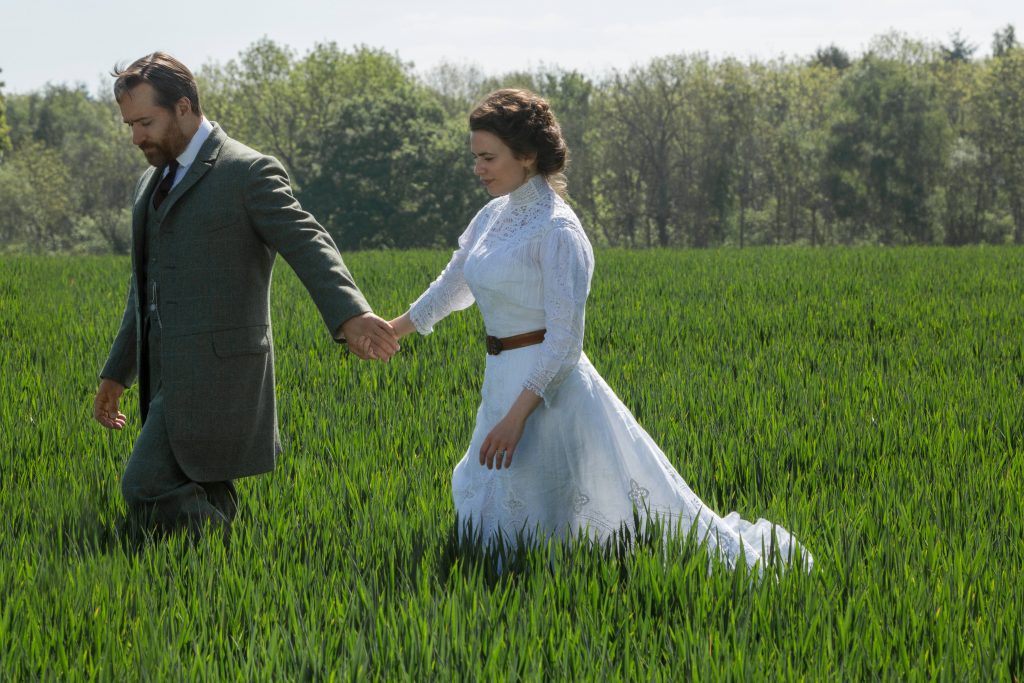
The story follows the interactions between two very different families as they struggle to navigate the rapidly changing landscape of turn of the century England. The series begins by introducing viewers to the orphaned Schlegel sisters, Meg and Helen, who through their independence and intellectualism personify the modernity overtaking London. The forward thinking pair stand in stark contrast to the  traditional Wilcoxes who, despite their immense wealth, are struggling to maintain their place in a changing society. What begins as a friendly acquaintance quickly develops into something more complicated when Helen embarks upon a comically disastrous romance with young Paul Wilcox while Meg forms a fast friendship with Wilcox family matriarch Ruth. Upon Mrs. Wilcox's sudden death revelations are made that will determine the fate of both families as well as that of their mutual acquaintances, the working class Basts.

Adapted from E.M. Forster's classic novel, the miniseries showcases all of the requisite eye candy (enviable costumes and breath taking scenery) associated with a British period piece, but beneath its glossy exterior is at heart a biting social commentary befitting our own era. Through the contrasting depictions of the Schlegels, Wilcoxes, and Basts, the series highlights the class, gender, and ideological conflicts of Edwardian England. As the series unfolds, however, these same conflicts become more then mere historical footnotes as the characters find themselves faced with moral and ethical questions that remain provocative today. None of the characters are either entirely wrong or completely right, and as they maneuver life's grey areas each of them are ultimately forced to question their own values as well as their impressions of each other. By the series'  bittersweet conclusion each of the characters has learned valid lessons in life, love, and the need to embrace our differences. The series expertly combines the historical backdrop of the novel with surprisingly fast paced drama, all while offering a bit of sly social commentary that is sure to leave viewers pondering plenty of questions of their own. For a period piece with a contemporary twist pay a visit to Howards End.

The series transports viewers back to the cobble stoned streets of Edwardian London thanks to the superb work of its cast. Julie Ormond lends dept to what easily could have been a stock role by infusing Ruth with warmth and quiet strength. Matthew MacFayden portrays Henry Wilcox with the perfect balance between blunt practicality and guarded vulnerability in his charismatic performance. Tracey Ullman and Alex Lawther prove to be comic delights in their supporting roles as Helen and Margaret's overbearing aunt and eccentric younger brother. Joseph Quinn achingly portrays ambitious but ultimately tragic Leonard Bast. Rosalind Eleaazar shines in her sympathetic portrayal of Leonard's neglected mistress, Jackie. Helen Schlegel leaps off off the page and onto the screen in all of her impulsiveness and vivacity thanks to the work of Phillipa Coulthard. Hayley Atwill is nothing short of brilliant in her nuanced portrayal of the ever ahead of her time Meg.

Over the course of its four episodes Howards End takes viewers on a journey into a past that proves not so very different from our present. Through its expertly crafted script the series more than does justice to its source material as it relates a tale every bit as warm, witty, and thought provoking as the original novel. The cast lend each of their roles a depth and nuance that ensures that each of Forster's many characters are vividly and memorably brought to life. For a viewing experience that you won't want to end join the Schlegels, Wilcoxes, and Basts in Howards End.


Sunday, March 29, 2020

Classics: A Review of AJ and the Queen By Lauren Ennis

In a world of bad relationships, broken dreams, empty wallets, and absent parents life isn't easy. Throw in a pair of bumbling villains, a broken down RV, and a sassy stowaway, and life becomes an absolute drag. In Netflix's uproarious road comedy AJ and the Queen when the going gets tough the tough strut their stuff and walk it off in high style. This equal parts outrageous and inspiring adventure from the mind of drag icon Rupaul Charles serves as an entertaining ode to resilience, optimism, and all things fabulous.
This looks like the beginning of a beautiful friendship

The story begins with Robert a/k/a drag queen Ruby Red announcing his plans to retire from performing and open his own club. When the time comes to close on the purchase of the club, however, Robert's boyfriend and business partner, Hector, is nowhere to be found. Robert's personal and professional dreams are then shattered in one devastating blow when he learns that Hector is actually a grifter named Damien who has disappeared along with Robert's life savings. Things go from bad to worse when Robert returns home only for his neighbor's neglected daughter, AJ, to break into his apartment in an attempt to rob him. Although he is able to apprehend AJ and retrieve the money she had stolen she quickly disappears before he is able to return her to her foster family. The next day, he resolves to start his life over and resume performing. He then packs up his trusty RV and sets off on a national tour, unaware of the stowaway hiding among his dresses and wigs.

Combining elements of classic comedy with a millenial sensibility AJ and the Queen is a comedy for the ages. Following in the buddy comedy tradition, the series juxtaposes drag queen Robert with tomboy AJ with equal parts hilarious and insightful results. What begins as a simple buddy comedy quickly ups its ante when the unlikely pair hit the road and encounter an array of colorful characters. These interactions form both the emotional and comic core of the series as Robert and AJ embark upon one misadventure after another, all while learning vital lessons. Much like drag comedy classic To Wong Foo, Thanks for Everything Julie Newmar the series utilizes its fish out of water protagonists to remind viewers of the importance of both embracing our differences and celebrating our common bonds. The duo's efforts to overcome the adversity in their lives also highlights the power of optimism while also serving as a surprisingly inspiring example of resilience. For a comedy with a heart of gold hitch a ride with Ruby and AJ in AJ and the Queen.


The wild world of AJ and Ruby comes to sparkling life thanks to the stellar work of the talented cast. Josh Segarra strikes the perfect balance between sinister and charming as duplicitous Damien. Tia Carrere makes for a hilariously memorable villain (and a fashion statement of bedazzled eye patches) as Damien's partner in crime, Lady Danger. Katerina Tannenbaum infuses her role as AJ's drug addicted mother with vulnerability and humanity. Michael-Leon Wooley runs away with each scene in which he appears as Robert's best friend and fellow drag performer Louis/Cocoa Butter. Izzy G convincingly balances her portrayal of AJ between street smart precociousness and childish innocence. Rupaul Charles reminds us all why he is the reigning queen of drag in his by turns glamorous, slapstick, and ultimately heartfelt portrayal of Robert/Ruby. Together, Charles and G make for a team that is the stuff of comedic gold as they play off of one another with a chemistry that carries the series from one misadventure to the next.

Whimsical, heartfelt, and utterly fabulous, AJ and the Queen is a re comedy that truly has something for everyone. The series' high hair and hijinks proves to be a winning combination as it continuously delivers more than enough laughs to go around. Through its expert comedic performances and witty script the series successfully takes viewers onto a wonderfully wacky journey into the depths of the human heart. When life starts dragging you down walk it off with AJ and the Queen.


Saturday, March 14, 2020

Classics: A Review of Babylon Berlin By Lauren Ennis

Unemployment is rising, morals are plummeting, and politics continue to divide, my how the twenties roar; the nineteen twenties that is. Few eras continue to hold public fascination like the nineteen twenties, and few cities embodied that era of the beautiful and damned with the reckless abandon of Weimar era Berlin. The hit series Babylon Berlin explores the gritty reality behind the glamorous myth of the roaring twenties through its portrayal of a city hovering on the edge of disaster in a time and place in which life is anything but a cabaret.
Let's party like its 1929

The story begins with police inspector Gereon Rath being transferred from his hometown of Cologne to the gritty streets of Berlin. While the pornography/blackmail case that he is assigned to investigate initially seems open and shut, he quickly learns that not everything is as it seems. He soon finds himself ensnared in a convoluted web of political intrigue and personal greed that is guaranteed to leave even the most savvy of viewers guessing. He finds an unlikely partner in the form of aspiring detective turned call girl Charlotte. Together, the two uncover a series of sinister plots that take them from the city's back allies to the upper echelons of high society, and ultimately lead to the contents of a mysterious Soviet freight train. As they struggle to stay one step ahead of the criminals that they're pursuing, the pair face a series of revelations and betrayals that leave them wondering who, if anyone, they can trust, including each other.

Deftly merging elements of historical drama, political thriller, and police procedural, Babylon Berlin resurrects Weimar Berlin in all of its grit and glory, showcasing a dizzying array of details that even the most astute of historians would approve of. The sets and costumes highlight the extremes of a society torn between its past and present and divided between wealth and poverty. Rather than approaching its setting from a modern perspective and focusing upon the rise of the Third Reich, the series instead explores the ways in which Berlin, like much of Europe, was already engaged in a war within itself long before the Nazis came to power. In this Berlin, communist factions clash with one another in the streets, while rival criminal gangs unleash their own reign of terror, and nationalist groups seek to restore the monarchy at any cost. In this Babylon of a city it is not a question of 'us against them', but of every man, woman, and child against the world. Through its portrayal of an era in which merely surviving one day to the next was a matter of struggle and compromise the series reveals how Germany was already set on a course headed straight for disaster. Even as it portrays conflicts unique to the twentieth century, however, the series remains startlingly relevant through its depiction of issues that continue to resonate today including substance abuse, economic instability, PTSD, and political corruption. Despite its historical setting, the plot's maze of twists and turns serves up thrills that are sure to keep even the most seasoned of modern viewers on the edge of their seats. Although the sixteen episodes of the first two seasons are tightly paced, the series develops each of its numerous characters with a complexity and nuance that ensures that even the most brief of roles avoid cliches and stereotypes.
Toto, I have a feeling that we aren't in Cologne anymore

Weimar era Berlin roars to life thanks to the mesmerizing work of the series' talented ensemble cast. Liv Lisa Fries is captivating in her equal parts steely and effervescent portrayal of Charlotte. Volker Bruch conveys a world weariness worthy of Humphrey Bogart in a complex performance straight out of a classic noir. Peter Kurth steals each scene in which he appears, infusing his role as Gereon's corrupt colleague, Bruno, with charisma and humor. Severija Janusauskaite channels Marlene Dietrich in her smoldering turn as calculating nightclub performer turned Russian agent Svetlana. Anton von Lucke conveys warmth and boyish charm as Bruno's diligent assistant, Stefan. Leonie Benesch is appropriately vulnerable as innocent gone astray Greta. These are just a few of the cast of colorful characters that are certain to leave you binge watching.

Babylon Berlin is more than just a television series, it is a non-stop thrill ride through one of history's most explosive, fascinating, and ultimately ominous chapters. Through its absorbing script and enthralling performances the series relates a tale of intrigue, corruption, and desperation that is eerily resonant in our own era. Season three has just premiered, so start your own unforgettable journey into the Weimar Republic in Babylon Berlin.

PS Good luck trying to get the soundtrack out of your head