Friday, April 30, 2021

Classics: A Review of Grey Gardens By Lauren Ennis

Each year we devote one day to honoring the women who set us on our fist steps of life's journey; our mothers. For better or for worse our mothers shape who we are and inspire who we ultimately become. Few stories capture the impact of maternal love in all of its complexity as that of mother and daughter 'Big Edie' and 'Little Edie' Beale. The 1975 documentary Grey Gardens catapulted the duo to a fame bordering upon  notoriety the likes of which would not be seen again until the advent of reality television. The film depicted the pair in their full co-dependency and eccentricity but left viewers begging the question of how did these two women plummet from the echelons of high society to abject squalor. The 2009 HBO film Grey Gardens answers just that question and more as it relates a tale "oozing with romance, ghosts, and other things". 

Staunch women....S-T-A-U-N-C-H

The story begins in 1975 with mother and daughter living in squalor in their dilapidated Hamptons mansion. After the pair's famous cousin, Lee Radziwell, abandons her plan for a documentary chronicling the entire Bouvier clan, the film's makers Albert and David Maysles set their sights on the Beales. The Maysles see the bizarre existence of Big Edie and Little Edie as having cinematic potential and approach the pair about starring in their own documentary. The Edies gleefully accept the offer and begin the process of making the cult classic Grey Gardens. The series then flashes back to reveal the story behind the story as it chronicles Big Edie's fall from socialite to recluse and Little Edie's descent from daring debutante to repressed spinster. Over the ensuing decades the women endure disillusionment, heartbreak, and the torment of wondering what might have been, but through it all they remain devoted to one another and firm in their belief that "when we are together we know we are where we belong".

When HBO first announced their plans audiences wondered why the network would make a movie about two women who were already the subject of a documentary and a Tony Award winning Broadway musical. As soon as the film enters its first flashback to the 1930's, however, it becomes apparent that the original documentary only scratched the surface of the stranger than fiction story of the Beales. Through a series of flashbacks the film reveals how Big Edie and Little Edie began as a pair of endearingly eccentric socialites who personified the culture and class of pre-war high society. While the pair's lifestyle glittered to outsiders, however, the film reveals that behind closed doors the Beales' lives were less than golden. The film then goes on to chronicle the ways in which the women suffered personal heartbreaks, professional disappointments, and financial losses that upended their very existence. Even as they struggled to adjust to personal traumas the pair were set further adrift by the tumult of the Great Depression and World War II, which rendered the lives of leisure and luxury that they enjoyed obsolete. Rather than adapt to personal and social changes, however, mother and daughter retreated into  their relationship with each other until they became an entire world unto themselves. The film then follows the ways in which their relationship evolved from close to codependent with their bond playing the dual role of refuge and prison. Through its multi-faceted portrayal of the pair's unusual relationship the film offers a fascinating portrait of maternal love that is every bit as by turns  tragic, triumphant, and ultimately unforgettable as the Beales themselves. Make life a song this mother's day with Big Edie and Little Edie in Grey Gardens. 

Mother and I are very entertaining, that's true...

The stellar cast brings both the iconic scenes of the original documentary and the story behind the camera to vivid life. Malcolm Gets is a delight in his Gene Kelly-esque turn as Big Edie's best friend and piano instructor Gould. Ken Howard garners sympathy as practical and put upon Phelan Beale. Jeanne Tripplehorn imbues her performance as Jacqueline Kennedy with a world weariness, elegance, and mystique worthy of the iconic first lady. Daniel Baldwin strikes an ideal balance between sleaze and suave as Little Edie's married lover, Julius Krug. Arye Gross and Louis Ferreria aptly convey the Maysles' dismay and fascination as they witness Grey Gardens in all of its grotesque splendor. Even in the midst of an exemplary supporting cast Jessica Lange and Drew Barrymore dominate the screen as Big Edie and Little Edie. During Big Edie's younger years Lange imbues her with a socialite's charisma while hinting at the mental illness and dependency lurking beneath the surface. As Big Edie ages Lange recreates scenes from the documentary with eerie accuracy without sacrificing any nuance or emotion. Barrymore is the ultimate ingenue in the scenes depicting Little Edie's youth as she perfectly captures Little Edie's eager naivete with infectious charm. In the scenes depicting Little Edie's later years Barrymore transitions to a darker, more complex performance as she effortlessly portrays the bitterness, regret, and longing of a woman whose life seems to have passed her by. Together the pair make a formidable team guaranteed to have viewers soft shoeing right along with them. 

HBO's Grey Gardens reveals the story behind the infamous cult classic documentary and pays apt homage to motherhood in all of its complexity and grey areas. The script offers valid insight into the inner workings of Big Edie and Little Edie and approaches both women with empathy without losing sight of their flaws. The performances revive scenes from the original documentary with eerie accuracy while still adding new depths to each of the characters. For the mother of all mother daughter tales enjoy tea for two with Big Edie and Little Edie at Grey Gardens.
A revolutionary costume


Tuesday, April 13, 2021

Classics: A Review of Gaslight By Lauren Ennis

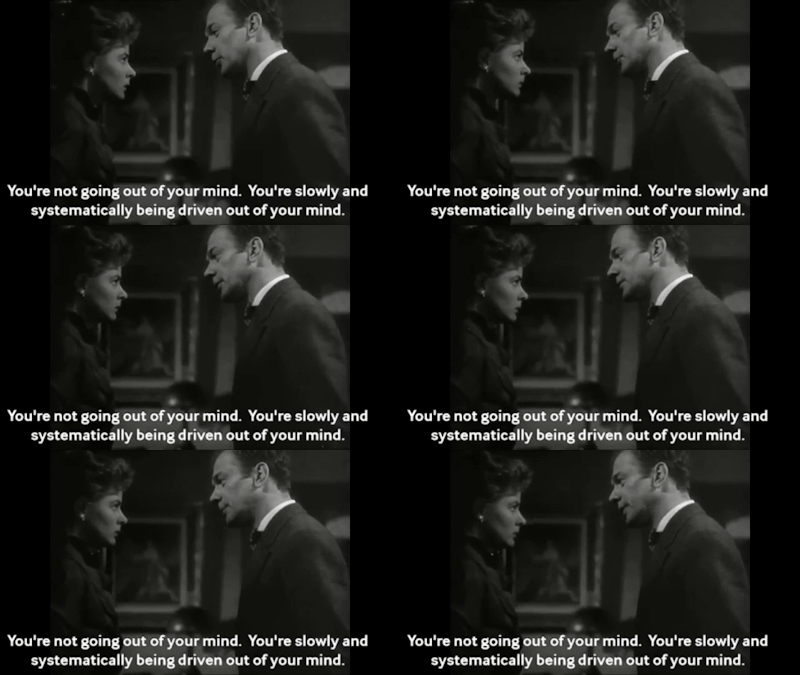
Gaslighting is a term used to describe a form of psychological abuse in which a victim is deliberately and gradually manipulated into doubting their own sanity. The 1944 suspense drama Gaslight explores this phenomenon through its portrayal of a man's efforts to drive his wife out of her mind. Through its masterful blend of psychological thriller and character study the film takes viewers on a chilling journey to the brink of madness. For a film that just might leave you sleeping with the lights on turn on Gaslight.
But I thought that you said that the laptop wasn't Hunter's...

The story begins with British orphan Paula being sent abroad in the wake of her aunt's brutal murder. Years later, Paula is following in her aunt's footsteps as she trains for a career as an opera singer. Before she can take to the stage, however, she embarks upon a whirlwind romance with the mysterious Gregory. The two are quickly married and she reluctantly agrees to return to London with him to live in the very townhouse where her aunt was murdered. Soon after their arrival the couple's' marriage becomes strained as Gregory flirts with their maid and explores the city, while insisting that Paula stay at the house alone in order to calm her agitated nerves. When he is gone she notices a number of seemingly inexplicable phenomena occur throughout the house as portraits disappear, footsteps echo from the roof, and the gaslights dim and brighten of their own accord. While she struggles to find an explanation for these occurrences Gregory accuses her of absentmindedness, theft, and finally madness. What follows is a masterful game of cat and mouse as Paula fights her husband's machinations even as her sense of reason comes ever closer to unravelling. 

Gaslight offers a portrait of manipulation and madness so chilling that it has earned a place in the modern vernacular. While the plot focuses upon an abusive marriage, the film's depiction of psychological abuse applies equally well to machinations conducted by co-workers, friends, relatives, and even public institutions. Over the course of the past year the American public has been subjected gaslighting on a national scale. With the emergence of the coronavirus social media and legacy media colluded with health organizations such as the CDC, NIH, and WHO to form a narrative that would promote isolating lockdown policies, and dismiss China's role in the spread of the virus. Even now, as new data continues to emerge, the media relentlessly censors, de-platforms, and defames any private individuals, journalists, or even medical experts who dare to contradict the accepted narrative. In the midst of their distorted coverage of the pandemic big tech and the media subjected the public to even further manipulation by maintaining that the 2020 BLM and Antifa riots were "peaceful protests", and refusing to acknowledge the billions of dollars in damages and dozens of deaths that the riots left in their wake. This coverage sharply contrasted with that which was afforded to the January 6, 2021 riot in Washington D.C., which the media continues to insist was a massive insurrection that posed a direct threat to American democracy despite evidence to the contrary. Five months after the 2020 presidential election those who dare criticize election practices, let alone question election results, continue to be censored and denounced.  Meanwhile the media and big tech continue to engage in actively avoiding, distorting, and concealing the new administration's mounting scandals.

In each of these instances those who defy the accepted narrative are ostracized, censored, and denounced in a manner that is eerily similar to the ways in which Gregory isolates, silences, and dismisses Paula. In the midst of such relentless psychological abuse it is all too easy for Americans to find themselves emulating Paula by questioning their knowledge, beliefs, and even their own mental health. When Paula finally learns the truth about her husband she wearily notes that, "this will be a long night". Like Paula, America finds itself in a dark chapter to which there seems to be no end in sight. As Detective Cameron aptly observes, however, "It will end...when the sun rises sometimes it's hard to believe there ever was a night". This night too will eventually end, but in the meantime it is up to those of us with dissenting voices to make our voices heard and spread the light of the truth to guide our way through this darkness.


The film comes to eerie life thanks to the outstanding work of its cast. Barbara Everest infuses Gregory and Paula's cook, Elizabeth, with warmth and strength. Angela Lansbury (in her screen debut) steals each scene in which she appears in her charismatic turn as saucy maid Nancy. Joseph Cotton conveys intelligence, honesty, and charm as dogged detective Brian Cameron. Charles Boyer is the perfect blend of suave, sinister, and sleazy as treacherous Gregory. Ingrid Bergman more than earned her Best Actress Oscar in her portrayal of Paula's harrowing journey from vivacious young bride, to traumatized victim, to resilient survivor.

Gaslight leads viewers through a maze of deception that will take them to the edge of insanity and back again. The film's intricate plot presents audiences with a fascinating puzzle, while its dynamic characters lend drama that is sure to keep viewers on the edge of their seats. The stellar cast shine in performances that remind us what was so classic about classic Hollywood. For a suspense drama that is sure to leave you guessing turn on Gaslight.


Thursday, April 1, 2021

Classics: A Review of The Aristocats By Lauren Ennis

 A sudden change to an elderly matron's will, a sinister servant, and a mysterious disappearance set the stage for...a delightful children's film? Disney's 1970 madcap musical The Aristocats blends these elements with a toe-tapping score, enchanting animation, and a cast of colorful characters to create a film that is as light and enjoyable as a Parisian soufflĂ©. Through its combination of mystery, adventure, and music the film offers a delightful slice of the city of lights that is guaranteed to leave even the dog lovers in the audience wanting to be a cat. For a film that is certain to show the whole family a swinging time join The Aristocats.


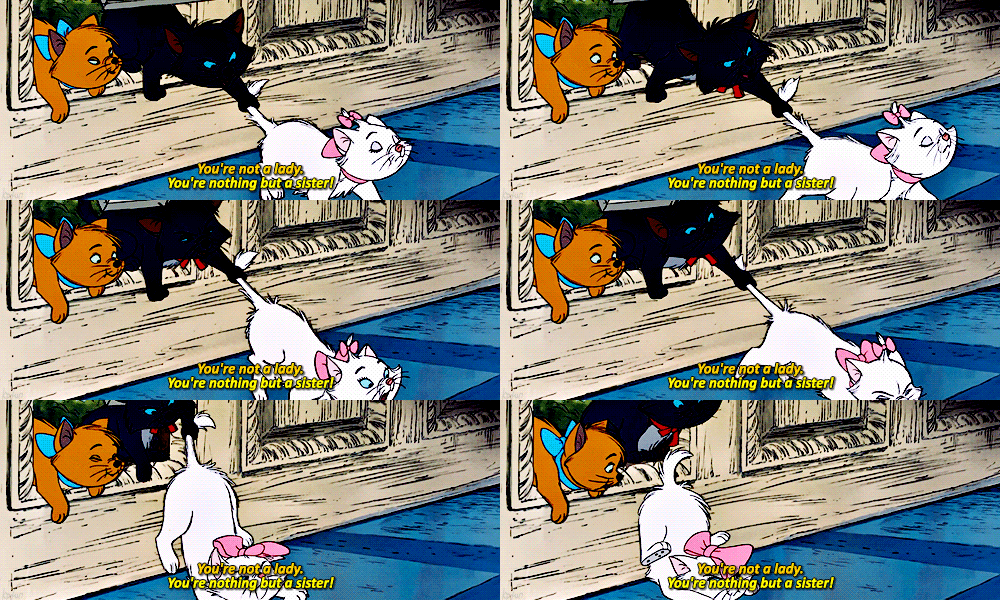
The story begins in 1910 Paris with Duchess and her three kittens, Marie, Toulouse, and Berlioz, enjoying a life of luxury with their mistress, a retired opera singer known as Madame. To ensure that her feline friends are cared for in the event of her death, Madame bequeaths her entire estate to her cats with the intention that the cats' inheritance then be passed on to her butler, Edgar. When Edgar overhears this plan he decides that the lifespan of Duchess and the kittens is too long to wait for his share of the estate. He then hatches a plan to drug and drown the cats and stage a fake 'catnapping' to ensure that Madame does not suspect his involvement. Before he can carry out the final stage of his deadly plot, however, he is attacked by a pair of dogs. In the ensuing chaos he flees, leaving Duchess and her kittens alive, but stranded in the French countryside. Fortunately for the feline family, help soon arrives in the form of roguish alley cat Thomas O'Malley who offers to escort them home. The cats then embark upon an adventurous journey back to Paris with plenty of joie de vivre along the way.

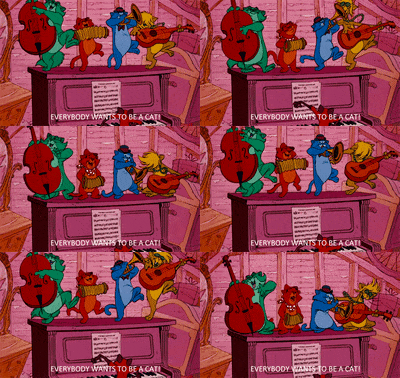
The film's combination of dazzling visuals and dizzying jazz tunes brings Disney's whimsical vision of Paris to vibrant life. The film's animation captures the glamour of Paris and the charm of the French countryside with equal skill, and ensures that every frame of the cats' adventure is signature Disney. The animators portray the human and animal characters with realism while lending each character unique expression and style of movement. The soundtrack aptly propels the story forward while also revealing insight into each of the characters' distinct personalities. Each of the film's tunes contains an infectious quality that is guaranteed to leave viewers humming for days, with the swinging finale 'Everybody Wants To Be a Cat' maintaining a well earned place in the studio's storied songbook. To enjoy a feast for the eyes, ears, and ultimately the heart hit the road with The Aristocats.


The voice performances infuse the dialogue with an energy, humor, and emotion that ensure that each member of the colorful cast of characters virtually leaps off of the screen. Hermione Baddeley conveys Madame's sophisticated refinement with ease while still imbuing her with lovable quirkiness and warmth. Charles Lane is uproarious in his turn as Madame's eccentric attorney, Georges. Roddy Maude-Roxby strikes an ideal balance between menace and comedy as hapless villain Edgar. Gary Dubin, Liz English, and Dean Clark nearly steal the film in their endearing, but never cloying, turns as Duchess' precocious kittens Toulouse, Marie, and Berlioz. Eva Gabor personifies elegance in a vocal performance that exudes grace and charm while still conveying maternal warmth and dry wit. Phil Harris masterfully blends suave with swagger in his roguish turn as the alley cat with a heart of gold Thomas O'Malley. Together Harris and Gabor convey a chemistry so believable that it almost makes the viewer forget that they are rooting for a romance between a pair of cartoon cats. 

The Aristocats showcases some of the most charming, elegant, and ultimately heartwarming family entertainment ever put to celluloid. Through its captivating animation, catchy songs, and memorable characters the film treats the entire family to a fun filled adventure of the first order. To learn why everybody wants to be a cat join the hepcats of The Aristocats.


Friday, March 19, 2021

Classics: A Review of The Book Thief By Lauren Ennis

The suppression and destruction of the written word has been the hallmark of totalitarian regimes throughout the ages. One of the most brutal and infamous examples of such censorship was the book burning conducted in Nazi Germany. The 2013 drama The Book Thief tells the story of a young girl who finds solace in the very books that she is told to destroy as she comes of age under the shadow of the Third Reich. This tale of hardship and hope is a love letter to literature that is guaranteed to have you rushing to the nearest library and reaching for a pen and paper. 


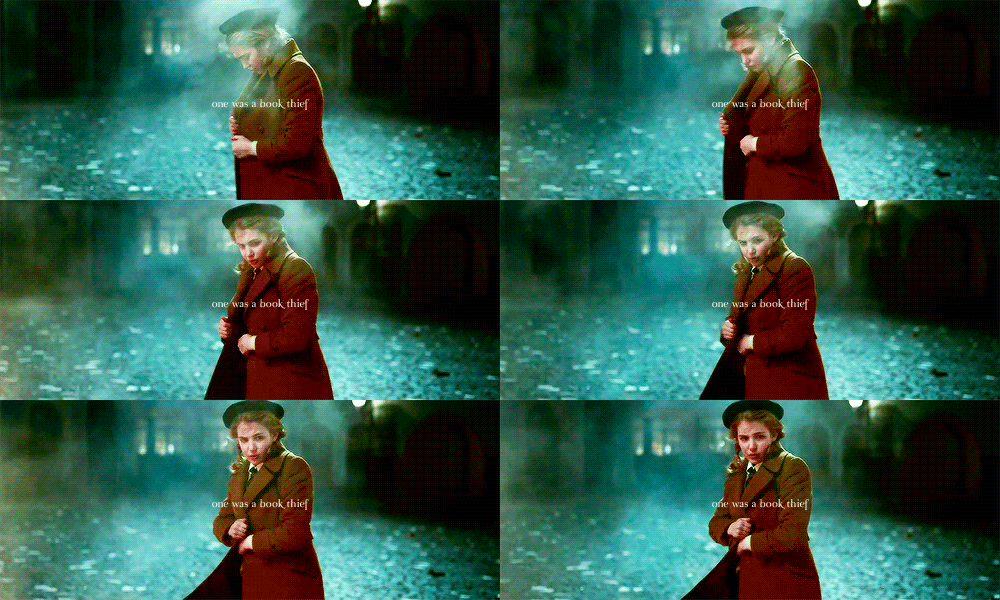
The story begins in 1938 Germany as Liesel Meminger travels to meet her foster parents following the arrests of her communist parents and death of her younger brother. Fortunately she quickly forms a bond with her foster parents, gruff but loving laundress Rosa and gentle painter Hans. When she is bullied at school for being illiterate, Hans begins teaching her to read and she quickly develops a passion for literature. To escape the political oppression surrounding her she escapes into the freedom of stories. She then risks her own safety by stealing books from the town's book burnings and borrowing censored books from Rosa's customers. When Hans and Rosa hide a Jewish teenager, Max, in their basement Liesel is mortified to discover the full horror of the regime that she and her family are living under. Even as darkness closes in all around her, however, she uses the power of stories to make her own light and share it with those around her.  

In the classic film Dead Poets Society Robin Williams famously declared that "words and ideas can change the world", a message that The Book Thief illustrates in each moment of its over two hour running time. While the books that Liesel reads do not change the devastating reality unfolding around her they do provide her with the tools necessary to survive that reality with her integrity and humanity intact. Through the stories that she reads she finds an escape from the cruelty around her and gains vital insight into a world beyond the Third Reich. In this way, she is able to access ideas that directly counter the indoctrination that she is subjected to and learn to see the world as something other than the Nazis' sinister vision. Similarly, books provide her with a community beyond the reach of the state as she bonds with Hans, Max, and even the mayor's wife, Elsa over their shared love of reading. When she begins to create her own stories Liesel employs the lessons that she has learned to create a new, more just, world of her own which she uses to inspire those around her. In one of the film's most poignant moments Max credits Liesel's stories and friendship with keeping him alive. Through their ability to inform, inspire, comfort, and bind us together stories have the power to help us not only survive but thrive even in the most adverse of circumstances. It is this power that makes the written word so vital and so dangerous. Book burnings may have ended but the instinct behind them remains all too present. With each passing day more books are being suppressed before they can even be published while beloved stories are being banned by the shelf full. There are indeed dangers hidden between the pages of these titles, but not the dangers of violence and hate that the censors claim to be protecting us from. The threat that these modern book burners fear is the same one that drove their predecessors; the power of literature to free the mind. Even as books burnings have returned in a new form,  however, so too have a new generation of book thieves. It is time that the woke mob awakened to the knowledge that pages may burn but, as Liesel reminds us, the ideas that they express can never be fully canceled.

Thanks to the work of its stellar cast the film manages to relate an inspiring tale even as it transports viewers to the darkest days of the twentieth century. Nico Liersch is a delight in his endearing performance as Liesel's best friend and would-be suitor, Rudy. Ben Schnetzer lends gravitas to the proceedings in his world weary turn as the Jewish refugee who becomes Liesel's mentor, Max. Emily Watson steals each scene in which she appears in her by turns humorous and heartbreaking portrayal of the prickly Rosa. Geoffrey Rush infuses Hans with a warmth, wisdom, and moral uprightness to rival Atticus Finch. Sophie Nelisse carries the weight of the film upon her young shoulders as she expertly personifies Liesel's trauma, passion, resilience, and optimism in a mature performance that belies her years.

At one point in the novel The Book Thief Liesel wonders "when the books and the words started to mean not just something, but everything". Through its engrossing script and engaging performances The Book Thief highlights the vital role that stories play in bringing people together even as everything around them threatens to tear them apart. In its inspiring portrayal of one girl's resilience in the midst of oppression the film offers vital insight into the past and a dire warning for the future. After just one viewing your heart is guaranteed to have been stolen by The Book Thief.


Friday, March 5, 2021

Classics: A Review of The Queen's Gambit By Lauren Ennis

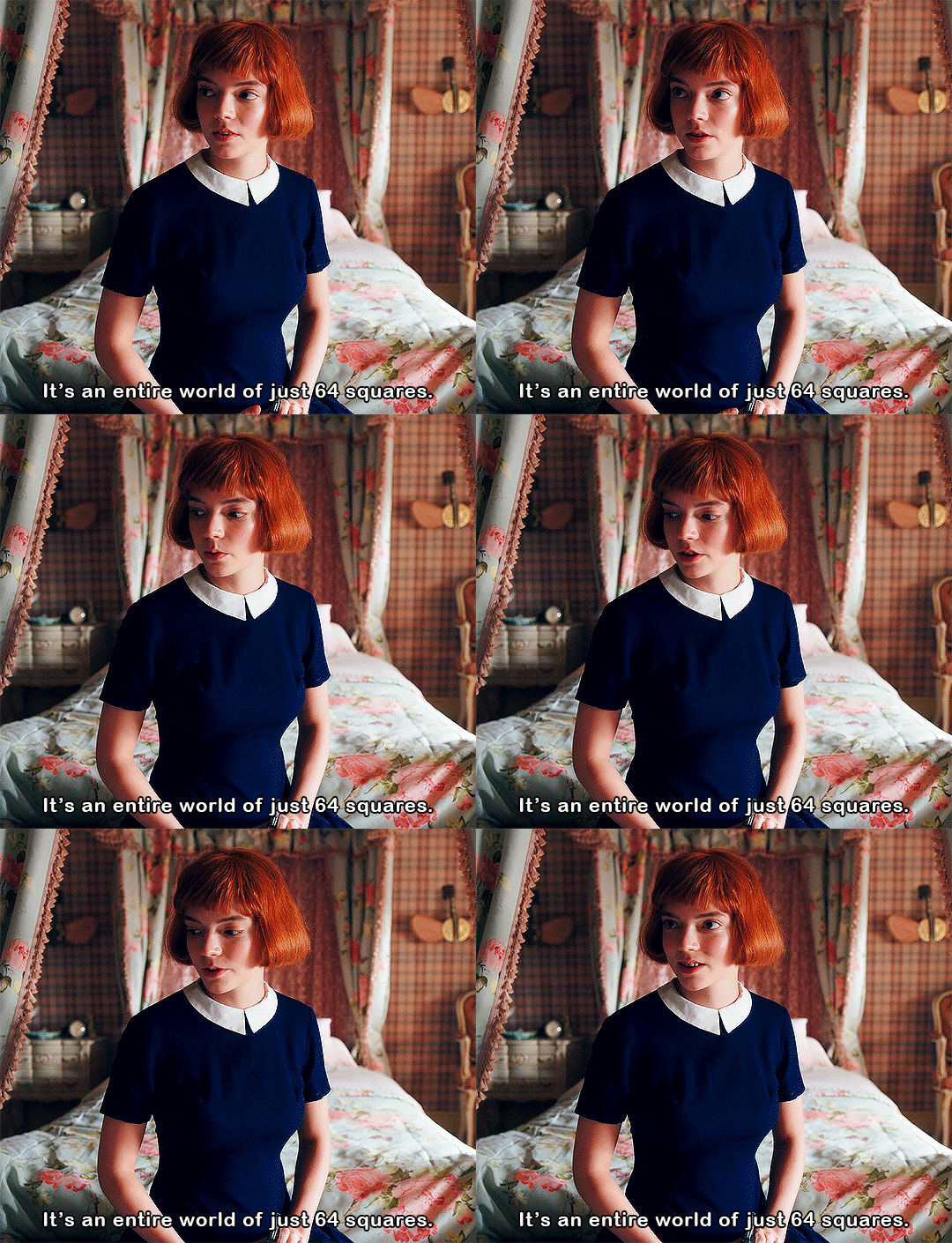
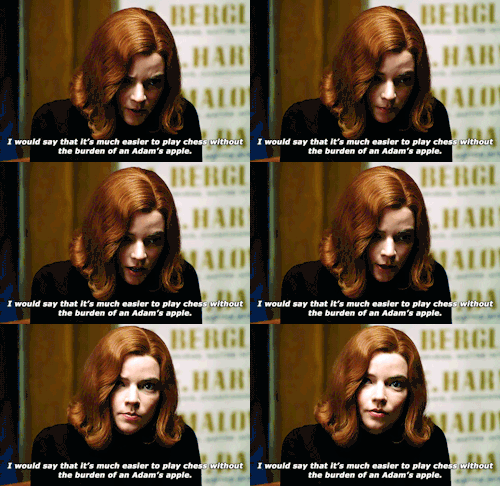
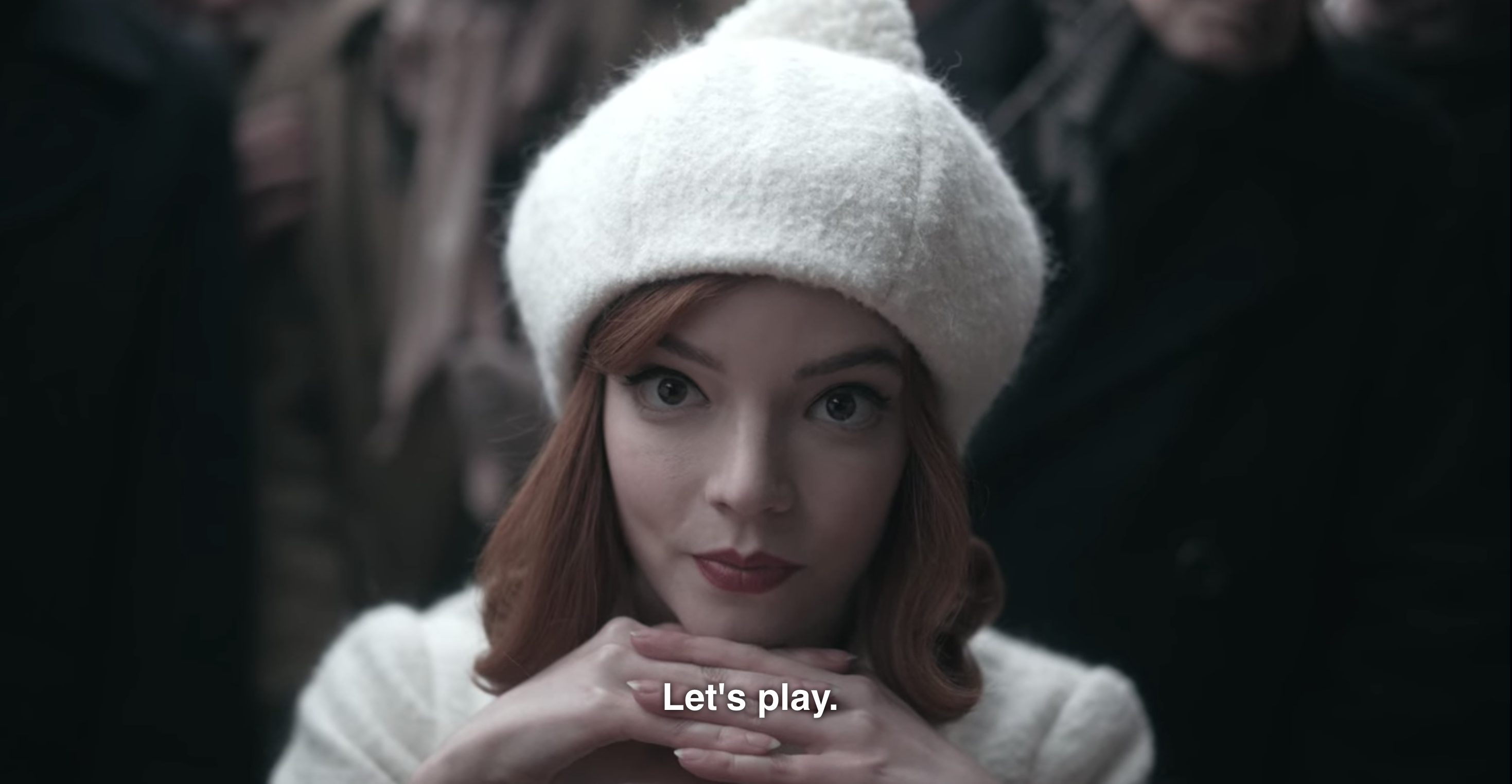
 Chess is a game made up of sixty-four squares, thirty-two pieces, and infinite possibilities. After nearly a millennium chess remains arguably the world's most complex and challenging mental game. For young Beth Harmon, however, this daunting world of knights and queens is nothing short of beautiful. Netflix's breakout hit miniseries The Queen's Gambit follows a chess prodigy as she navigates all sixty-four squares of the chess board while struggling through trauma, loss, love, addiction, and obsession. Part sports drama and part coming of age story The Queen's Gambit is entirely unexpected, original, and thrilling.

The story begins in the mid-1950's when nine year old Beth Harmon is left orphaned after her mother drives their car over a bridge. She is then placed in the custody of the Methuen Home for Girls outside of Lexington, Kentucky. Along with room, board, and an education the staff also provide the girls with a steady diet of tranquilizers to 'even their disposition'. Even as she finds herself falling under the addictive spell of the tranquilizers she is mesmerized by an obsession that becomes a life long passion; chess. After watching the orphanage's janitor, Mr. Shaibel, practicing chess in the basement she begs him to teach her the game and proves herself to be a chess prodigy. Six years later she is adopted by a local couple and enters the world of competitive chess. She then endures the trials and triumphs of growing up against the backdrop of a rapidly changing '60's America. Just as she reaches the brink of personal fulfillment and professional success, however, the demons of her past return to threaten her future.

The series successfully blends the elements of coming of age stories, sports dramas, and period pieces to relate a tale as unique and captivating as its heroine. Through its depiction of Beth's personal evolution the series explores such timeless themes as trauma, loss, addiction, family, and friendship in a way that modern audiences will be hard pressed not to identify with. Simultaneously the series uses its 1950's and 1960's setting to optimal effect by highlighting the ways in which the era's political climate and changing sexual and gender norms impact her both personally and professionally. As a result, her journey tells a universal coming of age story, while still remaining firmly within the context of it's historical setting. While chess is not what comes to many viewers' minds when they hear the word 'sport', The Queen's Gambit earns its place alongside the best of cinema's sports dramas.  Through its depiction of Beth's development from child prodigy to mature grand master the series aptly portrays the highs and lows of competition as well as the work and sacrifices behind each match. Although the series does explain the basic rules of chess it uses the characters' facial expressions and body language to convey the drama and meaning of each move rather than inundating viewers with facts and statistics. In this way, the series frames each chess match with the action of a boxing match and the subtlety of a ballet performance. As a result, viewers feel the disappointment of loss and the triumph of winning right along with Beth regardless of their knowledge of or experience in chess. If you're looking for your next binge watch brush up on your strategy with Beth in The Queen's Gambit.

The film brings the elusive world of competitive chess to life thanks to the uniformly mesmerizing work of its cast. Marielle Heller is equal parts warm and wounded as Beth's loving but troubled adoptive mother, Alma. Bill Camp makes a lasting impression as Beth's mentor of few words, Mr. Shaibel. Moses Igram is electric in her performance as Beth's charismatic friend at Methuen, Jolene. Thomas Brodie-Sangster exudes cool in his magnetic turn as bad boy chess champion Benny. Harry Melling aptly portrays local chess champ Harry Beltik's evolution from entitled to endearing without missing a beat. Jacob Fortune Lloyd infuses Beth's unrequited love, D.L. Townes with an irresistible combination of intelligence and boyish charm. Even in the midst of the exemplary performances surrounding her the series belongs to Anya Taylor-Joy as she portrays Beth's tumultuous journey with a blend of vulnerability, resilience, intelligence, and intensity that is nothing short of riveting.

Benny Watts defines chess as a world of "sacrifices and drama", a description that equally applies to The Queen's Gambit. With Beth Harmon as its guide the series immerses viewers in that world of drama in a way that will have even those with no knowledge of or interest in chess on the edge of their seats. Through its deftly written script and compelling performances the series treats viewers to seven of the most captivating hours of television in recent memory.  For a series more addictive than any tranquilizer join Beth in The Queen's Gambit.


Thursday, February 18, 2021

Classics: A Review of Gorky Park By Lauren Ennis

 Political oppression, personal corruption, and murder are just a walk in the park for a Soviet detective. 1983's crime thriller Gorky Park deftly interweaves political drama and police procedural to form a mystery that continues to mesmerize long after the fall of the Berlin Wall. Through its razor sharp writing and engrossing performances the film provides viewers with a glimpse into the waning days of the Soviet Union that will keep them guessing until its final reveal. Heat up your winter night with Cold War thrills in Gorky Park. 

From Russia, with love

The story begins with Detective Arkady Renko being called to the scene of a gruesome triple murder in Moscow's Gorky Park. In an effort to ensure that the victims could not be identified the killer removed their faces, teeth, and fingertips. The killer's careful efforts to prevent identification of the victims leads Renko to suspect that the murders are the work of the KGB. The case becomes further complicated when forensics indicate that one of the victims was an American and another victim's ice skates are traced back to an alluring political dissident. As he continues to pursue the killer Renko finds himself drawn into a web of corruption, intrigue, and greed that leads from Moscow's slums to the inner circles of the Soviet elite.

In keeping with the Cold War tensions that dominated the day's headlines Hollywood released a series of films set in the Soviet Union throughout the 1980's. While many of these films served as galvanizing propaganda Gorky Park set itself apart through its refusal to paint either side of the conflict in black and white terms. Over the course of Renko's investigation each of the film's characters is revealed to be flawed and compromised to varying degrees. As a result, both the Soviets and the Americans that they interact with are portrayed as fully developed people rather than political symbols. The film also lends an original twist on Cold War tensions by having its Russian hero join forces with a New York detective in an effort to track a killer with allies on both side of the political divide. Through its layered depiction of an investigation conducted under the ever present watch of the Soviet state the film portrays the devastating reality of life under communism with a rare nuance and depth. For a political thriller that transcends its politics join Detective Renko for a walk through Gorky Park

Round up the usual suspects!

The film transports viewers into the heart of Soviet Moscow thanks to the stellar work of its cast. Niall O'Brien is appropriately imposing as KGB investigator Agent Rurik. Alexei Sayle lends comic relief in his role as sleazy black market racketeer Fyodor Golodkin. Michael Elphick infuses his performance as Renko's partner and best friend, Pasha, with warmth and humor. Brian Dennehy steals each scene in which he appears in his gritty turn as gruff American detective William Kirwill. Lee Marvin strikes an ideal balance between cool charisma and menace as American business tycoon Jack Osborne. Joanna Paducah is equal parts sultry and haunting as tormented dissident Irina Asanova. William Hurt is a noirish hero worthy of Robert Mitchum as conflicted cop Arkady Renko.

Murder, duplicity, greed, romance, mystery and more await around every corner of Gorky Park. Through its intricately plotted script and intelligent performances the film relates a Cold War mystery that does anything but leave viewers cold. The film aptly portrays the last days of the USSR while still relating a timeless mystery that continues to thrill decades after its release. For a murder mystery worth solving take the case with Detective Renko in Gorky Park

Leave the gun take the shapka hat


Monday, February 8, 2021

Classics: A Review of The Wedding Singer By Lauren Ennis

Even as the winter winds blow hearts everywhere are set aglow, signaling that Valentine's Day is upon us once again. In keeping with the holiday, this week I'll be turning the spotlight on one of modern cinema's most endearing and entertaining romantic comedies; 1998's The Wedding Singer. This joyride through 1980's New Jersey offers first class comedy while relating a love story that is sweeter than a box of drugstore candy. Warm your heart on a cold winter's night this Valentine's Day and curl up with The Wedding Singer.


The story begins with small town wedding singer Robbie Hart preparing for his impending nuptials. His dreams of marital bliss are quickly dashed, however, when his fiancée leaves him jilted at the altar. Despite his best efforts he spirals into a depression that threatens to end his career until his co-worker, Julia, enlists him to help her plan her wedding. As the planning gets underway it becomes obvious to everyone except them that the pair are perfect for each other. When he learns that Julia's fiancée is unfaithful, Robbie becomes determined to tell her how he really feels. It's then up to Robbie and his friends to stop the wedding and save the day.

The Wedding Singer is that rarest of films; a romantic comedy that evokes laughter and sentiment in equal measure. While the film delivers plenty of Adam Sandler's signature slapstick it infuses even its most absurd moments with an unexpected tenderness and sincerity. Similarly, the film aptly balances the racy humor typical of the genre with the essential wholesomeness of its leading couple. Although the characters showcase outrageous behavior, the emotions and situations that they are coping with are all too familiar. As a result, viewers will be hard pressed not to root for Robbie and Julia finding their happy ending regardless of what shenanigans they face along the way. As an additional bonus the film also makes the most of its 1985 setting by paying loving homage to all things '80's to uproarious effect. For a romantic comedy that is certain to have you laughing and get your toes tapping hit the dance floor with Robbie and Julia in The Wedding Singer.


The film transports viewers back to the awesome '80's thanks to the work of its cast. Angela Featherstone is the ultimate 80's bad girl as Robbie's equal parts sultry and selfish fiancée, Linda. Matthew Glave would fit right in on Gordon Gekko's Wall Street as Julia's philandering stock broker fiancée, Glenn. Allen Covert is riotous in his macho turn as Robbie's best friend, limo driver Sammy. Alexis Arquette nearly steals the show as Robbie's Boy George obsessed backup singer, George. Christine Taylor infuses her role as Julia's sexy cousin, Holly, with a humor and charm that is nothing short of infectious. Drew Barrymore sheds her wild child persona and exudes girl next door wholesomeness in her beguiling turn as Julia. Adam Sandler lends what is arguably is best performance as loveable but lovelorn Robbie. Together the two form one of modern cinema's most endearing couples, showcasing a sparkling chemistry that lights up the screen.

The Wedding Singer contains all the romance of a wedding ceremony and the fun of the reception party. The by turns hilarious and heartfelt script and expert comedic performances is guaranteed to melt even the hardest of hearts. For a romantic comedy to grow old with join Robbie and Julia in The Wedding Singer.

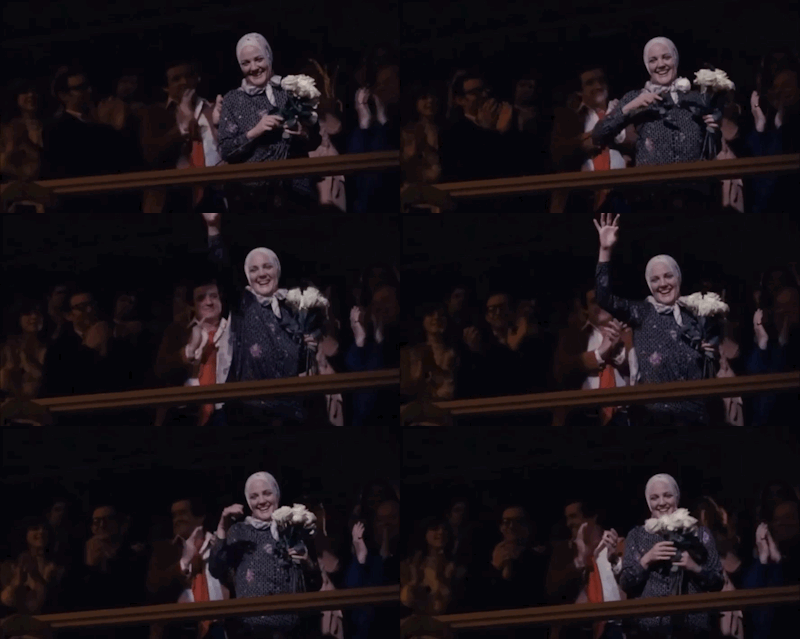
And that is what they call 'church tongue'