Saturday, August 18, 2018

Classics: A Review of the Guernsey Literary and Potato Peel Pie Society By Lauren Ennis

Throughout the ages stories have brought people together, even as everything around them threatens to tear them apart. In the recently released The Guernsey Literary and Potato Peel Pie Society, it is the shared passion for books that binds a local club together and provides them with strength and solace as they endure enemy occupation. Over the course of the film, the characters find friendship, love, courage, and redemption all between the covers of the books that they share with one another. The Guernsey Literary and Potato Peel Pie Society, is an uplifting tale of the importance of stories and the power that they hold when we share them with one another.
I don't think we're at Downton anymore, Toto
The story begins with writer Juliet Ashton (Lily James) enjoying literary success in post-World War II London. Despite her new found wealth and commercial popularity, however, she yearns to write something serious that will address the war-time traumas that she and those around her continue to cope with. she soon finds a kindred spirit with the arrival of a chance letter from Dawsey Adams (Michiel Huisman), a pig farmer living on the island of Guernsey and fellow book lover. Inspired by the tales of her new pen pal's struggles during the German occupation of Guernsey she travels to the island with the hope of meeting Dawsey and the colorful members of his local book club, the Guernsey Literary and Potato Peel Pie Society. Upon arriving she is dismayed by the guarded reception she receives from the society and the ways in which the island remains haunted by the impact of war. In an effort t shed light upon the trials and resilience of the people of Guernsey she resolves to write about the occupation. During her research she stumbles upon the disappearance of the society's founding member, Elizabeth McKenna (Jessica Findlay Brown). As she becomes embroiled in the mystery surrounding Elizabeth's disappearance Juliet becomes drawn into the lives of Elizabeth's fellow society members, in whom she finds a community of both fellow book lovers and fellow survivors. By the end of her visit Juliet learns invaluable lessons in life, love, and literature that allow her to move forward with a life in which she neither forgets the toll of war nor allows herself to be defined by it.

Through its portrayal of the fictional Guernsey Literary and Potato Peel Pie Society, the film showcases the all too real tragedy of the occupation of Guernsey while reminding us all of the universal power of books to shed light even in the darkest of times. Through the experiences of its eclectic cast of characters the film explores both the immediate and lasting effects of World War II in England ranging from poverty and wreckage to broken families and shattered lives. While the film conveys the horrors of both the London blitz and the occupation of Guernsey the script remains firmly focused upon not upon the atrocities committed by the Nazis but instead upon the resilience and courage of the British people. As a result, the film acts not as a bleak chronicle of the traumas of war, but instead as an inspiring testament to the ability of the human spirit to rise above that trauma.
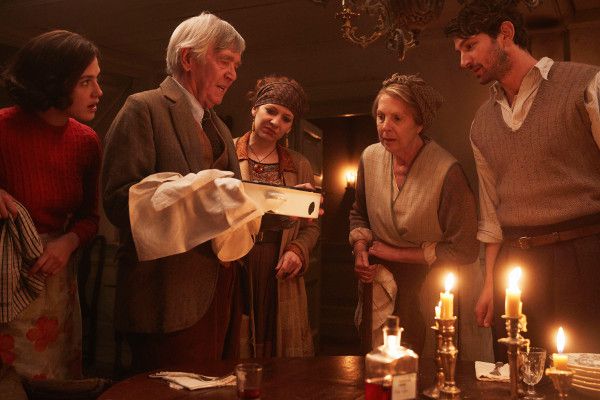
Now that's my idea of a book club!

The film also compellingly relates the power of books. For both Londoner Juliet and the residents of Guernsey books provide a refuge and a community. During the war both Juliet and the society look to literature for an escape from the outside world that is crumbling all around them. It is within the pages of books that they each find the hope, strength, and courage to carry on. For the society, books also provide a crucial sense of camaraderie and community amidst the isolation of occupation, which continues to bring them together after the war. It is this same community spirit that draws Juliet out of her solitude in London. Through the simple act of enjoying and sharing stories each of the characters is able to sustain their own inner light while inspiring one another to stand in solidarity against the darkness surrounding them. At once a tribute to the resilience of one group of people in the face of war and a universal tale of the power of literature, The Guernsey Literary and Potato Peel Pie Society is an inspiring story to share with your own community.

The film brings the best-selling novel it is based upon to vibrant life through the uniformly excellent performances of its ensemble cast. Lily James personifies loveliness as she aptly captures Juliet's warmth and intelligence. Michiel Huisman makes for an admirable hero as morally upright and self-sacrificing Dawsey. Jessica Findlay Brown is nothing short of inspiring as the passionate and courageous Elizabeth. Penelope Wilton movingly conveys the toll of war as the steely but damaged Amelia. Tom Courtenay and Katherine Parkinson are delightful in their comic turns as irreverent Eben and eccentric Isola.

The Guernsey Literary and Potato Peel Pie Society is compelling testament to the power of sharing both written and personal stories to bring and keep people together even in the most adverse of circumstances. A historical film with lessons that hold resonance today, the film takes viewers onto an enlightening journey into the hearts of its characters. Through an intelligent and emotionally resonant script and superb performances, the film weaves a masterful tale tat will remain with viewers long after the final credits fade. For an uplifting journey with inspiration to spare, enroll in The Guernsey Literary and Potato Peel Pie Society.


Sunday, August 5, 2018

Classics: A Review of Lust for Life By Lauren Ennis


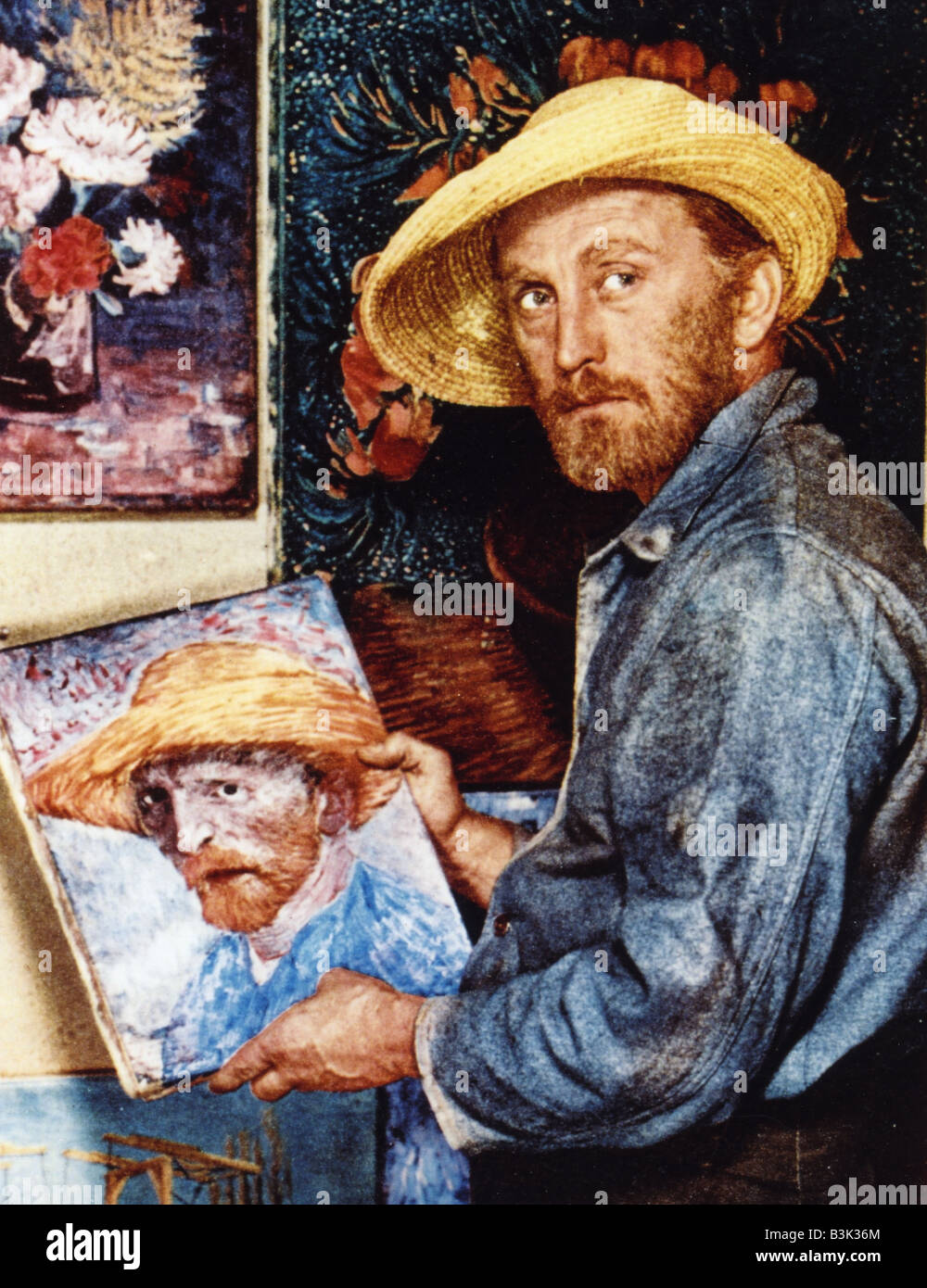
One of popular culture’s most enduring images is that of the tormented artist. As a result, it comes as little surprise that one of Hollywood’s best biographies chronicles the life of one of the most iconic tortured artists; nineteenth century painter Vincent van Gogh. Famous for his art and infamous for his struggles with mental illness, van Gogh’s tragic life is brilliantly brought to the screen in the 1956 Oscar winning film Lust for Life. A true feast for the eyes, Lust for Life is at once a testament to the artistic spirit and an apt portrait of one of the men who personified it.

Now where have I seen that face before?
The film begins not with van Gogh’s art, but instead with his early efforts to resist becoming an artist. After suffering a humiliating failure when he attempts to follow in his clergyman father’s footsteps as a minster he finally becomes determined to serve humanity through his art. The film then chronicles his efforts to establish himself as a painter and his introduction to the dazzling world of the belle époque art scene. As his skill on the canvass increases, however, his personal life deteriorates into a downward spiral of mental illness. Throughout the tumultuous phases of his life, however, one constant remains; his fundamental belief in the beauty of the world around him and his inherent need to capture that beauty on canvass.

Although the film follows the standard biography format it stands apart from other biopics in its complex approach to its subject. While many biopics will glorify a subject and minimize their flaws Lust for Life maintains a firm focus upon van Gogh the man rather than van Gogh the artistic icon. As a result, the script’s van Gogh is a man audiences can immediately relate to and sympathize with as he struggles against everyday obstacles ranging from unrequited love, to mounting debt, to his inability to launch a successful career. The portrayal of the artist’s often fraught personal relationships particularly resonate in their refusal to present him as either a victim or a villain. Similarly, his struggles with mental illness are rendered with a surprisingly modern sensitivity and nuance. Perhaps the script’s greatest strength is its emphasis upon van Gogh’s work and the dazzling visuals which highlight the sources of inspiration surrounding him. In this way, the film brings the world of the artist to vivid life while reminding viewers why his work has continued to endure into the twenty-first century.

No one paints the town red quite like an artist
The uniformly excellent work of the film’s cast brings the world of van Gogh to vibrant life. Kirk Douglas is a revelation in his layered portrayal of the complex, contradictory, and all too human artist. Anthony Quinn is a force of nature as van Gogh’s brash colleague and rival Paul Gaugin. Pamela Brown perfectly captures the world weariness that has hardened van Gogh’s prostitute love interest, Christine. James Donald and Toni Gerry keep the often larger than life van Gogh grounded as his understanding brother and sister-in-law.

Through its subtle portrayal of the complex personal and professional tapestry of van Gogh’s tumultuous existence Lust for Life breathes vital life into its historical subject. As an apt portrait of both van Gogh the artist and van Gogh the man the film is a true work of art. Through its compelling script and engaging performances the film brings the life and times of van Gogh to the screen with all the vibrancy and emotion of one of his paintings. For a true cinematic masterpiece look no further than Lust for Life.

Studios are for slackers

Saturday, July 21, 2018

Classics: A Review of To Wong Foo, Thanks for Everything! Julie Newmar By Lauren Ennis


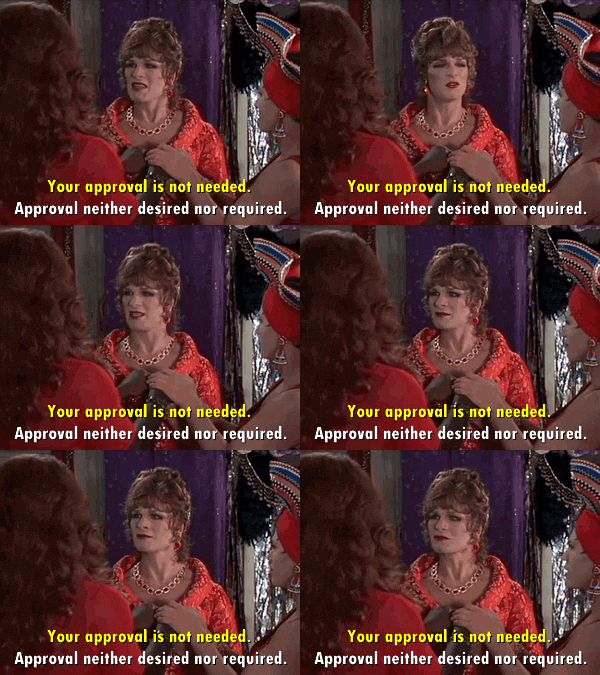
Three friends, thousands of miles, and one national drag competition; what could possibly go wrong? It is this very question that is the premise of the 1995 cult classic To Wong Foo, Thanks For Everything! Julie Newmar. The film hilariously follows the hijinks that three very different New York drag queens find themselves in when they hit the open road only to be stranded in the heart of the midwest. While time has made the story’s shenanigans more sweet than subversive, the film’s humor remains every bit as infectious as the day that it reached number one at the box office. For a frothy cocktail of friendship, laughter, and compassion viewers can thank the film’s stars, Patrick Swayze, Wesley Snipes, and John Leguizamo…and maybe Wong Foo.

The story begins with drag queens Vida Boheme (Patrick Swayze) and Noxeema Jackson (Wesley Snipes) tying for first place in the “Drag Queen of the Year” competition, winning a trip to Hollywood to compete in the “Miss Drag Queen of America” pageant. Along the way they meet inexperienced and despondent would-be drag queen Chi Chi Rodriguez (John Leguizamo). Vida, determined to help Chi Chi reach her full drag queen potential, takes Chi Chi under her wing and persuades Noxeema to let the newcomer join them on their trip. The three form a fast friendship that is quickly tested when their car breaks down, stranding them in an ultra-conservative Midwestern town. The trio then embark upon an adventure that is equal parts hilarious and heartwarming as they teach the residents lessons in tolerance, empowerment, and pizzazz.

Through its fish out of water tale the film confronts viewers with vital lessons in tolerance and empowerment without missing a single comedic beat. The focus upon its three heroines provided 1990’s viewers with an, empathetic if exaggerated, glimpse into the LBGT community. While the film was a far cry from the heavy hitting dramas that would tackle this subject in the future, it still succeeded in shedding light upon a community that film and television had largely ignored. The film particularly stands out for the depth with which each of its very different leading ladies is portrayed, as each struggles with her own search for her place in the world without falling into stereotypes or caricature. As a result, the film’s portrayal of its leads as admirable, likeable, and relatable characters acts as an apt call to tolerance without reducing the script to heavy-handedness or lecturing. Similarly, the film aptly portrays the struggle of modern women as the local ladies that our heroines encounter are continually faced with the limits of gender roles, sexual harassment, and domestic abuse. While the inclusion of these obstacles highlighted vital social issues, the film is at its most empowering when Vida, Noxeema, and Chi Chi embrace their own unique selves and inspire their new friends to do the same. In this way, the film encourages viewers to not only strive beyond their own limits but to also help those around them do the same. Thus, while its story may be slapstick on the surface, To Wong Foo, Thanks for Everything! Julie Newmar is a film with crucial messages that will resonate long after the laughs fade.

The films shines thanks to the brilliant work of its cast. Jason London is endearing in his chivalrous turn as Chi Chi’s small-town admirer, Bobby Ray. Stockard Channing imbues her role as abused housewife Carol Anne with an essential resilience and sympathy. Jennifer Milmore is a delight as Carol Anne’s sheltered daughter, Bobbie Leigh. Chris Penn is an ideal villain in his equal parts bumbling and brutal portrayal of bigoted Sheriff Dollard. Even in the midst of stellar supporting performances, however, the film’s crowning achievements belong to Swayze, Snipes, and Leguizamo who carry their unusual roles with infectious charm. Wesley Snipes is superb in his role as sassy Noxeema as he plays her cynical persona and inner idealism with equal aplomb. John Leguizamo infuses sultry Chi Chi with particular depth as he portrays her struggles to navigate both the drag subculture, and her fraught love life. Patrick Swayze brings Vida to vibrant life as he imbues her every larger than life action and gesture with just the right dash of 1990s girl power.

As one of the most wonderfully whimsical films of the 1990’s To Wong Foo, Thanks for Everything! Julie Newmar more than earns its status as a cult classic. Through its by turns slapstick and heartfelt script and engaging performances the film is guaranteed to leave you with a smile on your face. Hit the road with Vida, Noxeema, and Chi Chi for a viewing experience that you will be sure to thank yourself for.

Sunday, July 8, 2018

Classics: A Review of Lilo and Stitch By Lauren Ennis


After nearly a century of animated adventures Walt Disney Studios has become synonymous with the magic of childhood. While the studio is best remembered for its beloved, but often formulaic tales of larger than life heroes and beautiful princesses the studio has also released numerous more original, if less renowned, efforts. One of the studio’s most unique but unfortunately unsung releases is the endearingly offbeat tale of an eccentric girl and her unusual pet; 2002’s Lilo and Stitch. At once a break with the conventions that the studio is best known for and a return to its roots, Lilo and Stitch is an ode to childhood that puts the ‘family’ in ‘family film’.

Ohana means family; family means nobody gets left behind or forgotten
The story starts with a truly out of this world beginning as an inter-galactic council decides the fate of genetic experiment number 626; a furry weapon of mass destruction gone adorably awry. The council ultimately sentences 626’s creator to prison while 626 himself is placed on death row. Fortunately for viewers if not for the council, 626 is far more resourceful than his wide eyes would suggest, and he quickly escapes to the distant planet earth.  After crash landing in Hawaii, 626 bides his time hiding in an animal shelter where he is mistaken for a dog. Meanwhile, unconventional young Lilo and her older sister, Nani, struggle to cope with the recent deaths of their parents. When Lilo’s oddball behavior derails the pair’s interview with a street-smart social worker, Nani desperately searches for a way to manage her sister and make their empty house back into a home. This search ultimately leads the sisters to the local animal shelter where Lilo immediately attaches herself to its most notorious animal; none other than 626 whom she dubs ‘Stitch’. The unlikely trio then embark upon an series of madcap adventures as Stitch tries to stay one step ahead of galactic bounty-hunters while Lilo and Nani struggle to win over their social worker. Over the course of the film both Lilo and Stitch take a journey into the deepest depths of the human heart as they learn the true meaning of family.

Released between the end of the ‘Disney Renaissance’ of the 1990’s and the rise of Pixar’s now dominant computer animation, Lilo and Stitch arrived at a time when Disney had reached a crucial crossroads. When the fairytale formula that the studio had come to rely upon began to lose its luster the studio was forced to re-evaluate its position in a changing market. During this period of transition the studio needed to find a way to break new ground without alienating its established fan base. In an effort to strike this difficult balance the studio looked both ahead to the futuristic adventures of sci-fi while simultaneously seeking inspiration from some of its own pre-1990’s classics. The result was a film that remains unlike anything else in the Disney cannon.


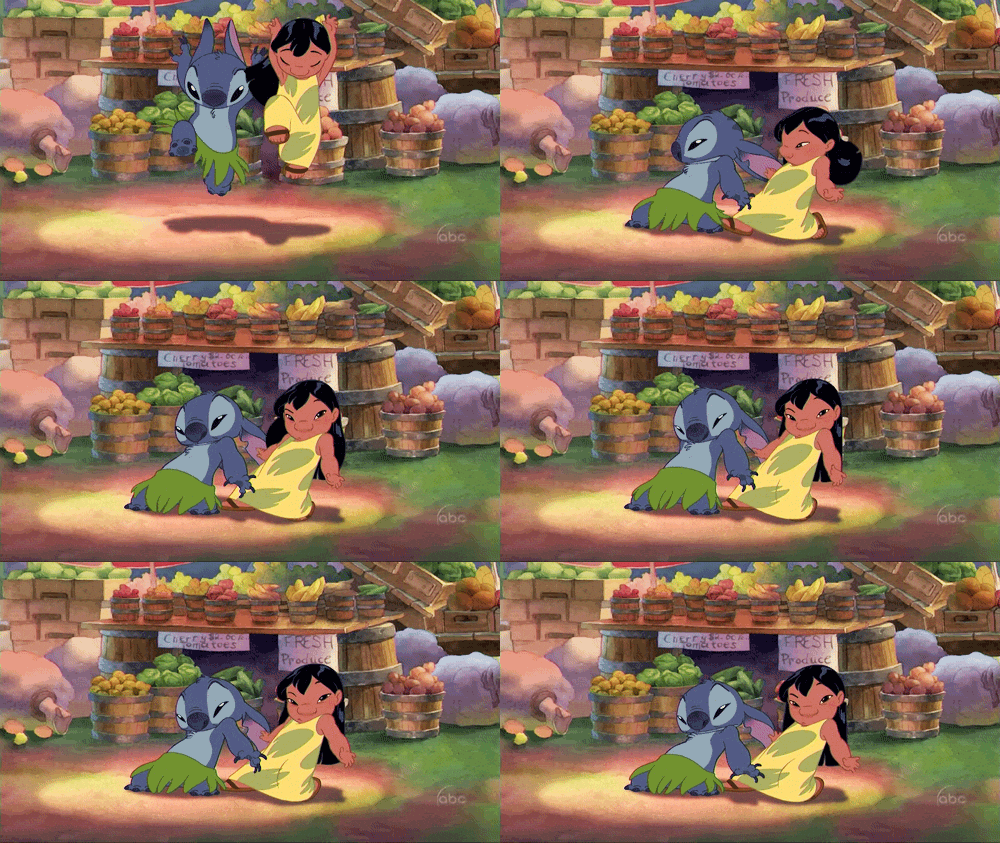
I bet Lassie doesn't have those moves
The film’s greatest strength lies in the way in which it takes the familiar Disney elements that fans know and love and subverts them into something entirely unique. For example the use of traditional watercolor animation brilliantly captures the lush landscapes of modern Hawaii, while harkening back to such pre-computer studio classics as Dumbo. Simultaneously, however, the animators also lend the visuals a refreshingly modern twist through the character designs, with heroines who have realistic proportions and curves that are a stark departure from the studio’s Barbie-esque princesses. Similarly, the plot merges both the old and new by juxtaposing the science fiction action of Stitch’s adventure with the timeless tale of a lonely child and her pet to create a story that will have something for the entire family. Even the film’s soundtrack, a toe-tapping blend of modern Hawaiian and classic Elvis, adds a unique dynamic as it transports viewers into the characters’ world and mentality (grieving Lilo seeks solace in the music of her hero, Elvis), while breaking with Disney’s tradition of Broadway style show-tunes. The script’s greatest departure from studio tradition lends the film its most endearing aspect; the depth and realism of its characters. Unlike traditional Disney characters who were designed to provide young viewers with idealized role models, Lilo, Stitch, and Nani are characters who children can relate to rather than merely aspire to. While all of the characters prove likeable, each possesses flaws and quirks, which in turn keeps their often outlandish journey grounded in realism. As a result, viewers will be bound to see many of their own experiences reflected in misunderstood Lilo, stressed-out Nani, and destructive Stitch, and can easily find inspiration in the characters’ eventual triumphs. Originally advertised as Disney’s ‘black sheep’, this story of a girl and her ‘dog’ gleefully dances to the beat of its own ukulele, earning it a place amongst the best in American animation.

Easily one of the most original films released by Disney, Lilo and Stitch is an ode to anyone who couldn’t fit in because they were born to stand out. Through its breathtaking animation, infectious music, and engaging voice performances, the film weaves a fantastic tale that pays apt tribute to the best Disney classics while still breaking new ground in family animation. For an animated adventure with a little more action, join Lilo and Stitch for a truly out of this world animation experience that is guaranteed to satisfy.

Now that is what I call a rockin' soundtrack

Friday, June 22, 2018

Classics: A Review of Sons of Liberty By Lauren Ennis


This July 4th will mark two-hundred and forty two years since the Declaration of Independence was signed and a new republic was born. In recognition and celebration of the innovations and sacrifices of our founders, this week I’ll be turning the spotlight on a miniseries that puts the rebel in rebellion; 2015’s Sons of Liberty. Easily one of the grittiest portrayals of colonial America, the series chronicles the events leading up to the American Revolution with all of the suspense, romance, and raw emotion that your history class left out.

The original Boston Strong
The story begins with Boston in a state of upheaval as the streets descend into poverty, gang violence, and a crime epidemic under the by turns indifferent and brutal rule of colonial England. Amidst this tumult, local tax collector Sam Adams (Ben Barnes) attempts to help those in need by using his own limited funds to pay the tax debts of friends and local business owners. Despite his good intentions, Adams’ attempts at philanthropy leave him unable to pay his own taxes, leading the British authorities to issue a warrant for his arrest. When his failed arrest prompts a riot that destroys the governor’s mansion, he quickly finds himself the unlikely center of a local movement. Meanwhile, local businessman John Hancock (Rafe Spall), Sam’s cousin, lawyer John Adams (Henry Thomas), and Doctor Joseph Warren (Ryan Eggold) each find themselves at a crossroads as events unfold that force each of them to question the status quo and choose which side of history they want to be on.

When the series debuted, the History Channel promoted it with the tagline; “there’s the revolution you know. And the one that’s about to begin”. Through its unique approach the series more than lived up to its promotion by providing an insider’s look at the conflicted and complicated men behind the American Revolution. In this way, the series helps breathe new life into the events of 1776 in a way that highlights just what was so revolutionary about the ideals that the colonists were fighting for. Critics and historians rightly cited the series’ tendency to place entertainment value above historical accuracy. The series’ makers defended their work by insisting that their primary goal was to capture the spirit of the era rather than document it; a goal that they certainly achieved. Although the series more aptly serves as an engaging overview than a history lesson, it aptly portrays brings colonial America to gritty life for a new generation. For a viewing thrill ride that will teach you a few things along the way, ship up to Boston with the Sons of Liberty.

Don't tread on me!
  The cast bring colonial America to vibrant life through their stellar performances. Ben Barnes’ roguishly charming performance transforms Sam Adams into a colonial Robin Hood as he rises up against the British ruling class for his fellow colonists. Rafe Squall is an ideal underdog as reluctant rebel John Hancock, and portrays Hancock’s surprising journey with a nuance that ensures his performance is as believable as it is entertaining. Henry Thomas is a perfect foil to Barnes’ reckless Sam in his turn as Sam’s upright but conflicted cousin, John. Ryan Eggold is a story-book worthy hero in his portrayal of noble Doctor Warren. Martin Csokas is an ideal villain in his portrayal of chillingly brutal British general Thomas Gage. Emily Berrington infuses her role as Gage’s battered wife turned Warren’s illicit love interest, Margaret, with an intelligence and spunk that will endear her to audiences as much as they do to the good doctor.

Sons of Liberty aptly brings the American Revolution to life with a modern flair. Through its gritty portrayal of the events leading up to the revolution the series provides viewers with essential insight into the founding fathers’ motives, sacrifices, and truly revolutionary ideas. The series’ combination of an intelligent script and engaging performances will leave even those who hated history class wanting more. For a mini-series that puts the drama in historical drama settle down for a Boston-style tea party with the Sons of Liberty.

Oh say does that star-spangled banner yet wave...

Monday, June 11, 2018

Classics: A Review of An American Rhapsody By Lauren Ennis


One generation’s sacrifices and hopes all too often prove to be the restraints and burdens of another. This is particularly true in immigrant families, as the traditions and struggles of one generation collide with the aspirations of another. The universal clash between parents and children is explored with particular poignancy in the 2001 drama An American Rhapsody. Although inspired by the real-life experiences of director Eva Gardos and her parents, who fled the oppression of life behind the Iron Curtain, An American Rhapsody is a universal tale of identity and family that will resonate with children and parents alike.

Get the hankies ready
The story begins in 1950’s Budapest as Margit (Natassja Kinski) and Peter Sandor (Tony Goldwyn) plan to escape from Soviet-occupied Hungary with their two young daughters. When their plan goes heart-wrenchingly awry, Margit’s mother is imprisoned for her role in aiding the family’s escape and the couple’s youngest daughter, Suzanne, is left behind to be raised by a couple in the Hungarian countryside. Although Margit and Peter maintain contact with Suzanne’s foster family, she spends her first six years largely unaware of her biological family’s existence. After years of struggling, Margit and Peter are finally reunited with their daughter in the United States, but the reunion proves far more complicated than anyone anticipated as Suzanne continues to long for the only life and family that she has ever known. Cultures and generations clash as Suzanne grows into a rebellious teenager and continues to reject her biological family, who she can neither understand nor forgive. When tensions between mother and daughter finally bring the family to their breaking point, Suzanne makes a life-altering journey back to Hungary where she uncovers vital truths about both of her families and herself.

An American Rhapsody follows in the tradition of such family dramas as The Joy Luck Club and The Namesake in its tale of one family’s struggle to bridge the gap between drastically different cultures and generations. The film aptly portrays the oppression that the Sandors face in Communist Hungary, where they lose their successful publishing company to the control of the state and loved ones to the horrors of the gulags. The film avoids the trap of idealizing the family’s new life in the U.S., however, by depicting their struggles to fit into their new home amidst the conformity and anti-communist sentiments of 1950’s America with equal skill.  The script cleverly juxtaposes the gritty reality of Peter and Margit’s Budapest with the idealized childhood fantasy of Hungary that Suzanne nostalgically longs for. Simultaneously, the film also conveys the family’s very different perceptions of their new home, which Peter and Margit view as the land of opportunity and Suzanne sees as a gilded prison. Through its dual perspectives the film aptly conveys the complex reality of the family’s unusual situation, in which there are no easy answers amidst years of misunderstandings and missed opportunities. It is through this subtle portrayal of cultural and generational conflict that An American Rhapsody relates a tale which is sure to resonate with children and parents across America and beyond.

Back in the USSR...
Through its uniformly excellent performances, the film weaves a tapestry of love and heartache that spans across cultures and generations. Natassja Kinski turns in an achingly real performance as she captures Margit’s longing for the daughter who remains just beyond her reach. Tony Goldwyn aptly portrays Peter’s internal conflict as he struggles to build and maintain a better life for his family amidst personal and political tumult. Zsuzsa Czinkoczi and Balazs Galko are the personification of a loving family in their by turns endearing and anguished performances as the couple who love Suzanne as their own, only to ultimately lose her to her biological family. Scarlett Johannsen perfectly captures Suzanne’s angst and alienation as she grows from a confused and lonely child into a willful and headstrong teen. The supporting cast provide equally strong performances that are engaging from the film’s opening credits to its final fade.

At once a deeply personal story of one family and a universal tale of family life, An American Rhapsody is essential viewing for the entire family. Through its intelligent script and emotionally engaging performances the film captures the conflicts that threaten to break families apart and the love that binds them together. For a viewing experience that will take you inside the complex and contradictory rhapsody that is a family tune in to An American Rhapsody.

Not so different after all

Sunday, May 27, 2018

Classics: Another Memorial Day Salute By Lauren Ennis


Originally a Southern event designated to honor Confederate veterans of the Civil War, Memorial Day went on to become a nationally recognized holiday in the United States, which now honors all American veterans. While today the true meaning of the holiday is too often lost amidst the barbeques, beach days, and block parties that it has since become associated with, it remains at its heart a commemoration of the bravery and sacrifice of our men and women in uniform. Below are three films that celebrate and honor America’s men and women in arms and all that they stand for.

You say you want a revolution...
The Patriot: The best place to start with America’s military history is at the beginning, and the 2000 historical war drama The Patriot does just that through its wrenching tale of one man’s struggle to protect his family amidst the American Revolution. The story begins with emotionally scarred French and Indian War veteran Benjamin Martin (Mel Gibson) attempting to maintain neutrality in an increasingly conflicted world. While his war-time trauma and the death of his wife leave Benjamin determined that his family remain safely out of the bloody events surrounding them, his pacifism places him in direct conflict with his headstrong eldest son, Gabriel (Heath Ledger). Benjamin is eventually forced to choose sides when Gabriel defies him by enlisting in the Continental Army and is later arrested. The arrest sets off a brutal chain of events that ultimately lead father and son on a quest for more than mere revenge as they devote themselves to the colonies’ struggle for independence. Following in the footsteps of Mel Gibson’s earlier hit, Braveheart, the film portrays the harrowing reality of war and the heavy price paid by those caught in the cross-fire. In this way, the film not only pays homage to the courage of the Continental Army and its supporters, but also serves as an apt tribute to the sacrifices that they made in their pursuit of freedom. Perhaps the film’s greatest strength is its morally conflicted approach, which emphasizes the plight of the colonies under British rule without glorifying the gruesome reality of their fight for independence.  While the film serves as much to entertain as to educate it provides viewers with an introduction to the American Revolution and brings the historical events it portrays to life with equal parts gritty realism and emotional resonance. For a revolutionary way to honor Memorial Day look no further than The Patriot.

It's the eye of the tiger, it's the thrill of the fight...
Glory: The American Civil War is most often portrayed on-screen as the struggle between north and south over the abolition of slavery. What such narratives all too often fail to acknowledge, however, is the role that African-Americans played in the fight for emancipation. The 1989 film Glory, presents a more complex portrayal of the Civil War from the unique perspective of an all-black regiment and their abolitionist leader. Inspired by a true story, the film follows the real life 54th Regiment Massachusetts Volunteer Infantry, one of the Union Army’s first all-black regiments, as they face adversity both on and off the battlefield. The film begins with Boston abolitionist Captain Robert Gould Shaw (Matthew Broderick) being promoted to the rank of colonel for valor at Antietam and receiving orders to lead the 54th regiment. To the credit of the film’s writers, the script approaches the characters as an ensemble cast, giving full weight to the men who comprised the regiment rather than merely focusing upon Shaw’s leadership. The film is made up of a variety of three-dimensional performances rather than mere types, with standout performances from Matthew Broderick as Shaw, Morgan Freeman as insightful John Rawlins, and Denzel Washington as rebellious Silas Tripp. The film relates a more complicated tale than most war movies as it portrays its heroes’ efforts to struggle against racial discrimination in their own army in the midst of their larger battle against the Confederacy. The film is made even more complex by its bittersweet ending, as the majority of the regiment ultimately fall in the assault on Fort Wagner even as their valor prompts the Union Army to accept the enlistment of thousands of African-American soldiers. Through its engaging performances and intelligent script the film offers more than a mere history lesson and serves as a solemn tribute to the soldiers of the 54th regiment and those who followed after them.


Some of the grittiest stuff this side of 1950
The Best Years of Our Lives: While war dramas have graced cinema screens since the silent era, few films capture struglle that soldiers continue to face after the gunfire stops quite like The Best Years of Our Lives. Released in the immediate wake of World War II, The Best Years of Our Lives stands out from the plethora of war films released in its era for is stark portrayal of lingering trauma. The film follows three soldiers as they return to civilian life in the same Midwestern town while they continue to grapple with the traumas that they have suffered. The script aptly portrays the ways in which the war impacted people of all walks of life as middle-aged banker Al (Frederic March) returns home to a family who no longer know him, ambitious Fred (Dana Andrews) wrestles with both the plummeting job market and his broken marriage, and former high school athlete Homer (Harold Russell) adjusts to life with a disability after losing both hands in combat. The script approaches each of its characters and their individual journeys with an essential sensitivity and subtlety that provides apt insight into the trials of soldiers returning home not just from World War II but from every war. The film particularly stands out for its refusal to follow the propaganda film trends of its era in its focus upon the heavy price of freedom rather than limiting itself to the Allied victory. For one of the most emotionally resonant and honest film going experiences of your life look no further than The Best Years of Our Lives.