Sunday, March 22, 2015

Classics: A Review of Broken Embraces By Lauren Ennis

Film noir is a genre that has become synonymous with the 1940’s and 1950’s. When they were first released, the thrillers, mysteries, and melodramas that compose the versatile genre were often pushed aside as ‘popcorn fare’ that were only produced to satisfy studio budgets. As time wore on, however, the gritty style and moral complexity of those forgotten films was finally recognized by new generations who saw the anxieties and broken hopes of their own era reflected back at them on the black and white screens of the past. Today, the genre has been hailed as both cutting edge and classic and is regularly, though rarely successfully, imitated. One film that successfully manages to blend the moral crises and dark sensibilities of noir with the issues and norms of contemporary society is the 2009 Spanish neo-noir Broken Embraces.
So familiar, but I can't think why....

The story begins with blind screenwriter Harry Caine (Lluis Homar) learning about the death of the producer of one of his films, tycoon Ernesto Martel (Jose Luis Gomez). Soon after this revelation, Harry’s agent approaches him with a new client, an amateur director known only as ‘Ray X’ (Ruben Ochandiano). Harry later realizes that Ray X is actually the alias of Ernesto Martel’s son, Ernesto Jr. The film then launches into a flashback to the early 1990’s when Harry still possessed his sight and was a director named Mateo Blanco who wrote screenplays under the pseudonym Harry Caine. Mateo is approached by Ernesto, who agrees to finance Mateo’s latest project, a comedy called “Girls and Suitcases”, in hopes of securing a role for his secretary turned mistress, Lena (Penelope Cruz). Mateo reluctantly allows Lena to audition only to find himself almost instantly captivated by her, and despite her lack of professional experience, he immediately casts her, leading the two to quickly embark upon an affair. Suspecting that something is amiss, Ernesto enlists the aid of his film loving son to spy on the pair under the guise of filming a documentary about the making of “Girls and Suitcases”. Ernesto Jr. soon finds the evidence that his father is seeking, leaving Lena to face the wrath of the increasingly abusive Ernesto Sr. The film then chronicles the tragedy that results when the lives of Mateo and his cast and crew intersect with those of the Martels.

Director Pedro Almodovar expertly pays tribute to film noir without resorting to blatant imitation. The film’s tone appropriately alternates between suspenseful and mournful, while still maintaining moments of wry humor. Rather than the stereotypical lights and shadows associated with the genre, Almodovar instead infuses the film with explosions of vibrant color. In this way, the film follows in the footsteps of such classics as 1945’s Leave Her To Heaven in its portrayal of the evil that lurks within broad daylight. The characters follow noir archetypes while still remaining entirely modern and believable. For instance, Lena enters the film with a femme fatale’s allure, but is later revealed to be using that same sensual charm to mask her tortured past and prison-like present. Similarly, Mateo, while an unabashed ladies’ man is decent at heart, and like many a noir hero, finds himself lost in the world of love, lust, and obsession that Lena’s presence transforms his life into. Finally, the ruthless Ernesto’s inhuman cruelty and all too human motivations earn him a place alongside the most infamous villains in the genre. The film also pays tribute to classic films outside of noir with Lena donning costumes that are direct references to such icons as Audrey Hepburn and Marilyn Monroe and Mateo viewing films that feature such classic stars as Ingrid Bergman and Jeanne Moreau. The story also includes a sly nod to Almodovar’s own early work with “Girls and Suitcases” serving as a clever stand-in for his hit comedy Women on the Verge of a Nervous Breakdown, making the film a treat for cinephiles both classic and modern.

Rainy days and Mondays always get them down

The cast provide uniformly excellent performances that weave an edgy mystery with a retro twist. Lluis Homar makes for an effective leading man, serving as the voice of reason in the film’s twisted tale, while still portraying his character’s unique blend of world weariness and charisma. Jose Luis Gomez is an excellent counter to Homar’s Mateo as he perfectly embodies the desperation that his obsession with Lena reduces the otherwise successful and powerful Ernesto to. Penelope Cruz shines in her role as the enigmatic Lena, proving that she can play far more complex and compelling characters than the pretty faces that she is too often limited to in American films. Blanca Portillo, Tamar Novas, and Ruben Ochandiano lend apt support in their roles as Mateo’s agent, Judit, Judit’s college student son, and Ray X, each excellently portraying characters who are not what they seem.


Broken Embraces is a film that blends the best of classic and modern cinema to tell a truly unique tale. Its winding story relates a powerful mystery that highlights the ways that art and creativity help us to find meaning in life despite its many obstacles. The dynamic performances and razor-sharp script perfectly merge to create an enticing film that could convert even the most staunch of film critics into cinema devotees. Whether you like your films at the forefront of innovation or bask in the nostalgia of screenings past, your heart is bound to break for Broken Embraces.
Proving that even call girls have professional limits
If you enjoy noir, check out my full-length noir style play, Call It Even http://www.jacpub.com/Full-Length/Ennis_CallItEven.htm

Monday, March 9, 2015

Classics: A Review of The Lives of Others Revisited By Lauren Ennis

Early in our lives we are taught how to protect ourselves. As children at school we learn to avoid strangers, lock our doors, and look both ways before crossing the street. As valuable as these lessons are, however, they do little to protect what is perhaps our most valuable possession; our privacy. In a world in which our personal information is available with the click of a mouse and nearly every form of communication has been revealed to be subject to government surveillance the question remains; how much of our lives are solely our own? The 2006 political thriller The Lives of Others explores how citizens of the former German Democratic Republic of East Germany grappled with that same question while maneuvering through the intrigues of daily life under the ever-watchful eyes of the secret police.


The story begins as Stasi officer and college professor Gerd Weisler (Ulrich Muhe) teaches a class about the ways to interrogate a suspect. In the lecture, he chillingly reveals the methods that the Stasi uses to manipulate and coerce suspected "enemies of the state" until they finally break down and confess. Although the recruits are skeptical of the Stasi's much touted ability to determine true confessions from false ones, Weisel remains fully confident in his expert judgment, as does his colleague Anton Grubitz (Ulrich Tukur), who approaches him after class with a specially ordered surveillance assignment. The assignment, collecting information on supposedly loyal playwright Georg Dreyman (Sebastian Koch), at first intrigues Weisel, who is excited by the challenge. As the assignment carries on, however, Weisel's once iron-clad faith in the GDR is shattered when he learns that the assignment is really a means with which prominent party member Minister Hempf (Thomas Thieme) hopes to eliminate Dreyman in order to pursue Dreyman's live-in girlfriend, actress Christa-Maria Seiland (Martina Gedeck). With each new revelation of the true nature of the Stasi's surveillance, Weisel becomes convinced that the only way to maintain the ideals he has devoted his life to is to sabotage the efforts of the very establishment that he once believed personified them.

Although The Lives of Others is a period piece, the same dilemmas that the characterss face in the 1984 GDR remain timely and relevant thirty years later. The film's central conflicts are Dreyman's  moral need to take action despite the repercussions he will face if he is caught, and Weisel's desire to help Dreyman even though doing so would mean risking his position and freedom. Although the crises of conscience that both men face could easily stand in for a myriad of moral dilemmas, these conflicts are particularly resonant in the wake of the United States' NSA Scandal. In that political scandal, National Security Agency employee Edward Snowden was hired to collect information about average citizens across the U.S. through surveillance of citizens' online and telephone activity. After witnessing the repeated violations of citizens' constitutional rights, Snowden reportedly reached a point at which he could no longer remain silent. In a maneuver that dominated international headlines, he went on to publicly expose the NSA for intercepting the communications of private citizens and political leaders from across the globe. Although he was hailed as a hero by many, there were just as many who viewed him as a traitor, including the United States' government, whose threat of prosecution lead him to flee to Russia. Both Weisel and Snowden were ultimately forced to give up what they held most dear for the crime of trying to protect the right to keep one's private life private. Though one is a recent reality and the other is historical fiction, both examples present us as individuals with the fundamental question of what we would do if we found ourselves in Snowden or Weisel's position. Days after watching this film, I am still pondering how much action I would be willing to take in such a situation and questioning just where the line is at which proactive national defense ends and blatant abuse of authority begins.
It's not as if we're interesting enough to listen in on...right?

The superb work of the film's cast transports viewers into the the bleak heart of the Soviet bloc. Ulrich Muhe is truly dynamic in his turn as Gerd Weisel, as he allows the audience to witness his character's transformation from idealistic but unknowing tool of the state to jaded vigilante. Similarly, Sebastian Koch holds his own in the equally complex role of conflicted playwright Georg Dreyman. Martina Gedeck excellently rounds out the central cast in her haunting performance as tormented actress Christa-Maria Seiland. Ulrich Tukur and Thomas Thieme also lend excellent support as Grubitz and Hempf, adding just the right amounts of entitlement, greed, sleaze, and menace to their roles as top Stasi officials.

The Lives of Others is truly an example of what a well made historical film should be. The story works equally well as a journey into the past and a dire warning for the future, all while maintaining a core of genuine emotion. The intelligent script by fist time screenwriter and director Florian Heckel von Donnersmarck and multi-faceted performances merge to tell a heart-wrenching tale of duty, love, betrayal, and sacrifice that is as powerful today as it would have been in the midst of the Cold War. For a glimpse into a 1984 that is even more chilling than anything George Orwell could write, look no further than The Lives of Others.


FOR MORE ON LIFE IN EAST GERMANY DON'T MISS MY SCREENPLAY IRON WILLED http://offthewallplays.com/2015/05/31/iron-willed-world-war-2-movie-script/

Wednesday, March 4, 2015

An Important Message from Miss E.

Hello and thanks for following the blog to all my readers!

I regret to inform you that as much as I love working on Confessions of a Film Junkie, I will no longer be able to maintain my previous weekly output. I have recently obtained a second job along with night courses and an internship which would make it difficult to continue writing a new blog each week. In order to avoid sending out rushed articles that would sacrifice quality for quantity I will instead have a new blog available every other week instead. I appreciate your readership and will continue to take requests. Please be sure to check in next week for a review of the 2006 political thriller The Lives of Others.

Thank you and see you next week!

Lauren

Tuesday, March 3, 2015

A review of "Random Acts of Violence"

Confessions of a Film Junkie: A review of “Random Acts of Violence”

By: Brian Cotnoir


     It’s not always easy coming up with an original film idea.  I mean just look at the stuff put out by The Asylum (no groundbreaking ideas coming from there).  This is nothing new of course to the world of film, when one studio has a good idea every other studio—big or small—has to try to copy it.  However, when a smaller Independent studio tries to copy a popular Big Budget Big Studio production, they’re going to fall flat in some places.  Today we are taking a look at one of those films, the Independent Dark Comedy, “Random Acts of Violence”.                
    “Random Acts of Violence” plot is basically “American Psycho” meets “How to be a Serial Killer”, the plot revolves around an English national living in New York City, named Malcolm.  Malcolm is the star of a documentary where he goes around New York City murdering random people and trying to kick-start a “revolution”.  The documentary shows us an intimate look at Malcom’s personal life and how he blends in with normal society as he commits his random acts of violence.                   
This film was written/ directed/ produced/ edited/stars Ashley Cahill, who plays the titular Malcolm.  He spends the whole movie talking with a fake-a$$ British accent being as pretentious as humanly possible, while his friends follow him around with a video camera.  He is not charming, he is not likeable, in fact; he does very few things of interest throughout this film.  His motivation seems entirely flawed; he keeps talking about “starting a revolution” by committing these horrendous acts of murder, but he doesn’t explain why he wants to start a revolution or even why he feels there is a need for revolution.  The “Murder-For-Revolution” doesn’t even seem like a valid motive, because the people he chooses to kill for the most part all seem to be random victims: he kills one person at random, he kills another person for being rude, he plans to kill a woman because he finds her annoying, he even murders his best friend because she said that she didn’t like his spaghetti sauce!  There is little to no consistency in Malcolm’s motivation.       
Malcolm Sucks so Hard!
You get the vibe from the film that Cahill intended to write Malcom’s character as an anti-hero, but trust me you will not be pulling for him in this film.  Unlike other movie self-absorbed serial killer anti-heroes like Patrick Bateman and Alex DeLarge, Malcom comes off as dislikeable and overly pretentious!  Does Mr. Cahill think just because he made himself the star of the film that we have to like his character and root for him? If so he fails on a massive scale!  Also, if his character was raised in England for the first 10-15 years of his life as he states in the film, then why don’t either of his parents have English accents? A little inconsistency, eh?                
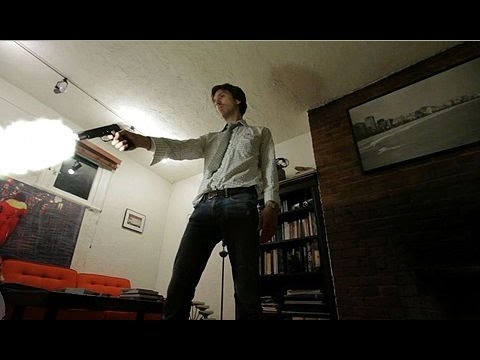
Dirty Harry, he aint.
Not only that, but for me the “Found Footage Mock-umentary” film is a major put off.  As if that wasn’t bad enough, they break the biggest rule of doing the “Mock-umentary” film: Don’t make your shots look staged! For most of the film the camera angle is Point-of-View, but there a few times they break that rule.  There’s one scene where the camera is shown filming a woman walking down the sidewalk, and then Malcom walks up behind her and shoots her in the back of the head (he was mad at the girl for giving him chlamydia).  Other than looking totally fake there are other problems with this scene.  If you were to stand in front of a person with a camera, it would be near impossible for them to not notice you, and most likely they would turn around to see if you were filming behind them!  Even Kirsten Dunst noticed the camera pointing right at her in this film...oh Yeah, that’s something else I wanted to talk about in this film.  The only interesting worth mentioning about this film is that it features a brief—involuntary—cameo by Kirsten Dunst. Yeah, there’s a scene where Malcom and the documentaries director are waiting in an elevator and Kirsten Dunst just happened to be where they were filming. At one point she even asks them to put the camera away.  Worst. Cameo. Ever.                 
     I would not recommend the film “Random Acts of Violence”, its cheap and overly-pretentious rip-off of two already better films. The characters range from forgettable to annoying, and I can’t think of anyone who would actually enjoy this film (that’s not Ashley Cahill).

Monday, February 23, 2015

Classics: A Review of Amadeus By Lauren Ennis

One of the most popular topics for artists to explore is the topic that they perhaps know best; art and the artistic process. Works that are built around this concept often focus upon the struggles and heartaches that make up the artistic process, while still reminding audiences of the satisfaction that makes it all worthwhile. Some works, however, delve into the dark side of the artist’s life and chronicle the devastating effects of a life devoted to an unappreciated or failing craft. One such work is the 1984 biography Amadeus. While the film was marketed as a historical work about the life of the prophetic composer Mozart, the film is one of the most remarkable portrayals of the artist’s life from its euphoric highs to the consuming effects of its devastating lows.
Genius does not guarantee fashion sense

The story begins with once renowned composer Antonio Salieri (F. Murray Abraham) living out his final years in obscurity at a hospital in Vienna. Sensing that his time may be running short, Salieri summons a priest to read him his last rights, but is mortified when the priest treats him no differently than the other patients. Confronted with his own anonymity, he reveals that confession is the sacrament that he is truly interested in as he reflects upon the events that brought him from rising star to aging unknown in the film’s central flashback. He begins his tale during his childhood when he became fascinated by music and received a vision that convinced him that he was chosen by God to pursue a career in music. In order to become worthy of his perceived destiny, he devotes himself to hard work and abstains from any and all forms of vice as he grows older. After years of diligently studying and working to make a name for himself, Salieri finally attains success after gaining the notice of Emperor Franz Joseph (Jeffrey Jones) and the royal court of Vienna. Just as he begins to grasp his goals, however, another artist arrives on Vienna’s music scene; prodigy Wolfgang Amadeus Mozart (Tom Hulce). Despite his natural gifts, Mozart is shown to have more in common with a modern-day fraternity member than a musical genius as he seems to spend just as much if not more time drinking, carousing, and spending his limited funds as he does writing the works that will make him famous. Regardless of his personal habits, Mozart’s talent, while in many ways ahead of his time, cannot be denied and he quickly begins to win the favor of the same patrons that Salieri has spent years trying to impress. Determined to maintain his success, Salieri completely devotes himself to his craft, only to have Mozart effortlessly best him at every turn. After losing his commissions, status, and finally his muse and the object of his secret infatuation to Mozart, Salieri takes on a new mission in life; to destroy Mozart’s career at any cost. So begins a descent that proves the desperate lengths an artist will go to in pursuit of ‘success’ and the all too high price that some will pay for a chance at immortality.

Although excellent entertainment, Amadeus is not a film that is known for its historical merit. Rather than a traditional biography, the film was adapted from the Broadway play of the same name, which chronicled the rivalry between Salieri and Mozart and explored the popular legend that the vengeful Salieri was responsible for Mozart’s death. Much like purported historical dramas such as JFK, Amadeus uses the basic facts of its character’s lives to tell its own story. Unlike JFK, however, the film does not alter history in an effort to promote its theory or push forward a revisionist agenda. Instead, the film follows in the tradition of such historical tales as Spartacus and The Crucible by using its historical story to analyze and comment upon themes that still resonate today. For example in Spartacus, Kirk Douglas’ rebellious slave stood in for people unjustly persecuted during the McCarthy era much in the same way that Hulce’s Mozart serves as a metaphor for true art and genius. Likewise, Abraham’s Salieri provides an excellent foil as a symbol of popular mediocrity that is unable to resonate beyond its initial hype. Through its portrait of artists as rivals Amadeus reveals the ways in which art, often touted as one the most redeeming and pure aspects of culture, can be just as corrupt and jaded as any other aspect of society. The juxtaposition of Mozart and Salieri excellently portrays both the awe of true genius and the sense of both injustice and inadequacy that it inevitably inspires in those who strive to but cannot achieve it. The evolution of Salieri from dedicated composer to thief, saboteur, and assassin in the name of success also provides apt insight into the ways in which the standards of society (both then and now) can consume, delude, and ultimately break the many people who struggle to keep up with its ever increasing demands. The film also succeeds where many other art themed films fail in that it portrays its central characters as people who, although fully three dimensional, aren’t so different from viewers, rather than as mythic figures whose lofty profession makes them impossible to relate to. As a result, while it may not be a reliable historical source, Amadeus remains an excellent source of thought, debate, and of course inspiration.
Mediocrity in its natural state; self-righteous indignation

The cast and musical score combine to bring this historical tale to life in a way that spoke to viewers upon its initial release during the 1980’s and continues to do so today. As Salieri, Abraham seamlessly transforms from disillusioned everyman to ruthless psychotic in such a way that he reminds the audience of the darkness lurking within our own petty jealousies. Similarly, Hulce grows with his character as his Mozart enters the story an overgrown child, but eventually develops into a sympathetic family man struggling to balance his artistic ambitions and domestic responsibilities. The reversal that the two lead performances develop is truly thought provoking in the way that it forces viewers to question the preconceived notions and biases that they entered the film with. Elizabeth Berridge and Roy Dotrice lend apt support as the two diverging influences in Mozart’s life; his free spirited wife and stern father. The film’s score provides an excellent backdrop to the plot’s proceedings and adds a distinct sense of atmosphere and place to the story. The music also allows audiences to experience the power of Mozart’s work first-hand, which effectively speaks for the composer’s genius without forcing the characters to constantly reiterate it.


Amadeus is truly one of the most innovative and unique takes on the historical drama. The well-drawn characters and relevant themes bring the complexities of Mozart’s world to life while still evoking genuine emotion from modern audiences. While I would not recommend this film for historical purposes, I wholeheartedly recommend it to any viewers interested in well executed drama and anyone who has found themselves caught in the timeless struggle to ‘be somebody’ in an anonymous world. Inspired by this film, the 1986 pop hit “Rock Me Amadeus” describes Mozart as a ‘superstar’ and ‘rock idol’; one viewing  and even the most modern of music fans will be tempted to describe the classical icon the same way.
Time to party like its 1789!

Monday, February 16, 2015

Love Hurts: The Dark Side of Romance in the Movies By: Lauren Ennis

Last week's review celebrated Valentine's Day with a tribute to romance in the movies. As classic as those films of last week's review may be, there is no denying that they are glamorous and romanticized in ways that make real-life relationships pale in comparison. In reality, romance is more confusing, complicated, and painful than most of what we see onscreen. As a result, most of us have spent more Valentine's Days arguing with our significant other or spending a solo night on the couch than experiencing an evening worthy of Hollywood magic. Regardless of how your Valentine's Day turned out this year, however, this week's countdown is guaranteed to make you feel better about your own relationship, or single status. Without further ado, here three of the most sleazy, contemptuous, and disturbing classic cinematic takes on romance that I've seen.

1. Lolita: Based upon 1955 Vladimir Nabokov novel of the same name, this movie's as controversial as classic and even modern cinema gets. The story focuses upon a middle-aged professor's obsessive love for his pre-teen stepdaughter. The story begins with Humbert Humbert (James Mason) arriving at the home of writer and pornographic film-maker Clare Quilty (Peter Sellers) and declaring his intention to kill Quilty in retaliation for Quilty's sexual corruption and abuse of underage Lolita Haze (Sue Lyon). The film then launches into a flashback which reveals that Lolita had suffered sexual abuse long before her meeting Quilty; at the hands of her stepfather, Humbert. While sexual abuse has been a topic explored in both real-life headlines and popular fiction, Lolita stands out for its attempt to tell its tale from the abuser's perspective. Throughout the film, Lolita is shown strictly from Humbert's perverse viewpoint, which in turn places her in a sexually charged and often antagonistic light. In following Humbert's view, Lolita is shown to be an underage femme fatale who is fully aware of her actions as she uses her charms to take anything that she wants from the men around her.  In stark contrast, Humbert is portrayed as the bumbling would-be hero of his sordid tale who, despite his despicable behavior, is portrayed as utterly devoted to Lolita and willing to do anything to keep her near him. Despite the disturbing nature of it, the co-dependent relationship that develops between the two is played for laughs in what is certainly the darkest take on the romantic comedy genre. By the finale, this twisted relationship ultimately proves damaging to both parties as Lolita becomes so desperate to end the abuse that she runs away with Quilty, unaware that he intends to feature her in his films, and Humbert is left a broken man who descends into the madness of his own delusions. The film's tagline read, 'how did they ever make a movie out of Lolita?'; even forty-three years of cultural changes later that is still a valid question.
Pedicures were never so perverse

2. Gaslight: Many a film has shown marriage to be the ultimate goal in the pursuit of happiness. For newlywed Paula (Ingrid Bergman), however, her traumas have only just begun when she says 'I do'. Entrusted to her aunt's care following her parents' deaths, young Paula experienced yet another loss when her aunt was brutally murdered in a robbery attempt gone wrong. Years later, she tries to leave her troubled past behind and start over by marrying the charming Gregory (Charles Boyer) after a whirlwind romance. All seems to be blissful for the couple until they move into the house Paula inherited from her aunt, and Paula's mental state inexplicably begins deteriorating. Rather than trying to help his wife, Gregory continually belittles even the smallest action she takes and discredits her at every turn, further adding to her mental descent. SPOILER ALERT Eventually, it is revealed that Paula is not just going insane but being systematically driven insane by her husband's machinations. The lost items, moved furniture, and flickering lights that she has been told are imagined are not only real but are all efforts by him to make her doubt her own sanity. Paula's entire world is revealed to be a well orchestrated lie and her quick courtship and strained marriage just steps in Gregory's plan to finish what he started in her aunt's house years earlier. Released in 1944, Gaslight is distinctive for its exploration of verbal and psychological abuse in an era when marriage was considered a sacred institution. The film also successfully portrays the dangers of relying upon romantic ideals as Paula risks her finances, freedom, and sanity when she impulsively marries Gregory based upon an adolescent infatuation. The film earned Ingrid Bergman a Best Actress Oscar and brought the word 'gaslight' into popular slang where it remains synonymous with psychological manipulation. For a psychological thriller that will leave you guessing at the plot and the merits of marriage at every turn look no further than the flicker of Gaslight.
Till criminal sentencing do us part

3.  The Blue Angel: This 1930 German film made Marlene Dietrich an overnight international success and cemented her place as one of Hollywood's first sex symbols. The story focuses upon the destructive effects of an opposites-attract relationship between an aging professor and a promiscuous showgirl. The film begins with prudish Professor Rath punishing his students for frequenting the decadent nightspot The Blue Angel to see the performances of sexy cabaret singer Lola Frohlich. The professor goes to the club to catch his students in the act next time they try to attend and instead meets Lola herself backstage and is instantly smitten. When her manager tries to pimp her out to a customer Rath,defends her honor and makes it his personal mission to ensure that she is never degraded again. After word spreads of his spending the night at Lola's apartment, however, his reputation is soon ruined and he is promptly fired from his position. Certain that he is acting for the greater good, he proposes marriage, hoping to keep her off the street and out of the club's scandalous review. After their wedding, however, their relationship quickly disintegrates as their association holds him back from finding another teaching job and she resumes her former life. Humiliated by the failure of his career, Rath is further demoralized by Lola's resentment, which she makes a point of constantly reminding him of. After years of struggling to please the ever fickle Lola, Rath finally reaches his breaking point when he joins her revue and performs an embarrassing routine only to find her backstage with another man. The way that the professor ultimately succumbs to his fate after accepting the loss of his marriage, career, and principles is nothing short of tragic. This film is often cited as an example of the femme fatale at her finest, but upon closer observation the story better serves as an exploration of the demoralizing effects of unrequited love. Although she may be an unlikable character, Lola never tries to hide what she is and early in the film tries to dissuade the professor from becoming involved with her. As a result, Lola cannot be held entirely to blame for a situation that she warned the professor was doomed from the start. In Rath's eyes Lola's behavior can be justified by her circumstances if she will only let herself be cured by a respectable life. What he cannot forgive is her inability to reciprocate his love for her. When he realizes that she never did or could love him the professor finally understands how it was his unattainable dream rather than the woman he fashioned it around that was his true undoing. "Falling in love again, never wanted to", Lola sings, and after viewing this film you might reconsider doing so yourself.


Even in garters and panties she still wears the pants in the relationship


Tuesday, February 10, 2015

An Important Message from Das Film Junkie

Hey All,

It's Das Film Junkie here, with an important update about the blog.  First of all, I would like to thank everyone for their continued support and comments to the blog.  Some of you may have noticed the consistency and quality of my blog has begun to dwindle.  Part of the reason why is  because I have been working multiple jobs since late Summer/Early Fall,  in order to make ends meet.   Some weeks it can get to be quite draining (both physically and mentally).  Up until last year, I would watch an average of 3-4 new movies a week and write 2-3 film reviews, I always had a steady supply of material and more than enough time to write, edit, and perfect every review.

Lately, I've been lucky to be able to watch one film a week, and even after that, I rarely have an opportunity to write a decent film review.  Personally, I am tired of writing half-a$$ed reviews because they don't live up to the higher standard that I am capable of writing.  With that being, said I have made the decision to cut back  on my weekly film reviews.  I'll still be writing film reviews on "Confessions of a Film Junkie", but instead of posting one every week, I will be posting one every other week.  I feel that by posting my film reviews on a bi-weekly basis, I will have more time (and less stress) to work on craft a much better quality film review.

Thank you All for your support and I will see you all here next week write here on "Confessions of a Film Junkie"

Sincerely,

Das Film Junkie